
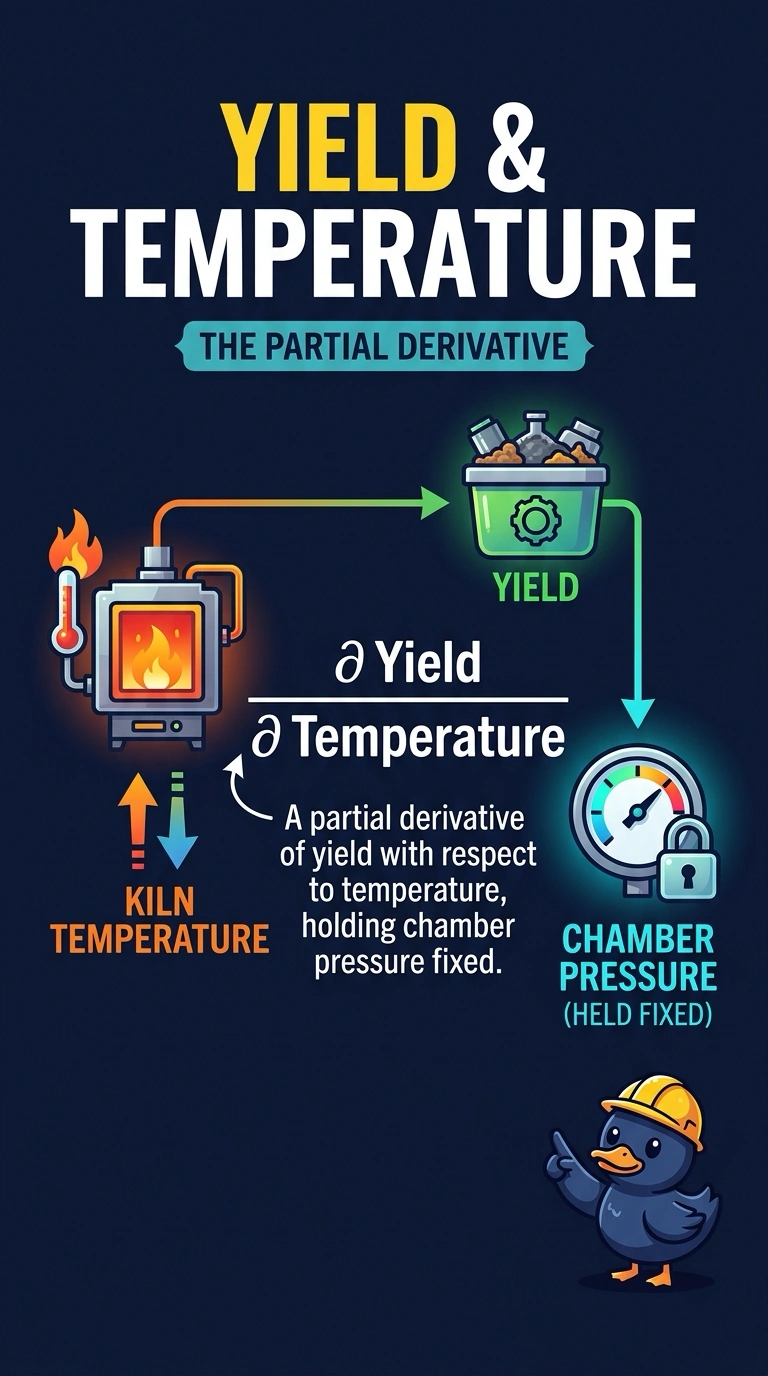
A factory yield equation depends on both kiln temperature and chamber pressure. An engineer wants the rate at which yield changes with temperature while pressure is held fixed. Which quantity is that?
Select an answer to reveal the explanation.
Short Explanation
Ask how the loaf rises when you turn the oven knob and leave the timer alone. That is a partial derivative: yield against temperature with pressure held fixed. Letting pressure drift at the same time answers a different question.
Full Explanation
A partial derivative measures how a function changes with one input while the other inputs are held fixed. For this yield equation that is the rate of change with respect to kiln temperature at constant chamber pressure, which is the quantity the engineer requested. An ordinary derivative along a path where pressure moves with temperature folds both inputs into one slope, so it does not isolate temperature. The combined change after both inputs move is a total change along that joint move, and neither input is held fixed. A raw gap between two kilns is an observed difference that need not come from the equation and does not hold pressure fixed by construction. Exam caveat: at a point where the inputs are tied together by another physical law, the partial still means 'pressure held fixed in the equation,' which may differ from a plant path that moves both; the stem asks for the held-fixed rate. Operational check: nudge temperature in the equation, recompute yield with pressure unchanged, and confirm the slope matches the partial with respect to temperature.