
A factory scientist has a square matrix of how each production line's sensor error covaries with the others. The scientist needs one number equal to the sum of the entries on the main diagonal. Which quantity is that?
Select an answer to reveal the explanation.
Short Explanation
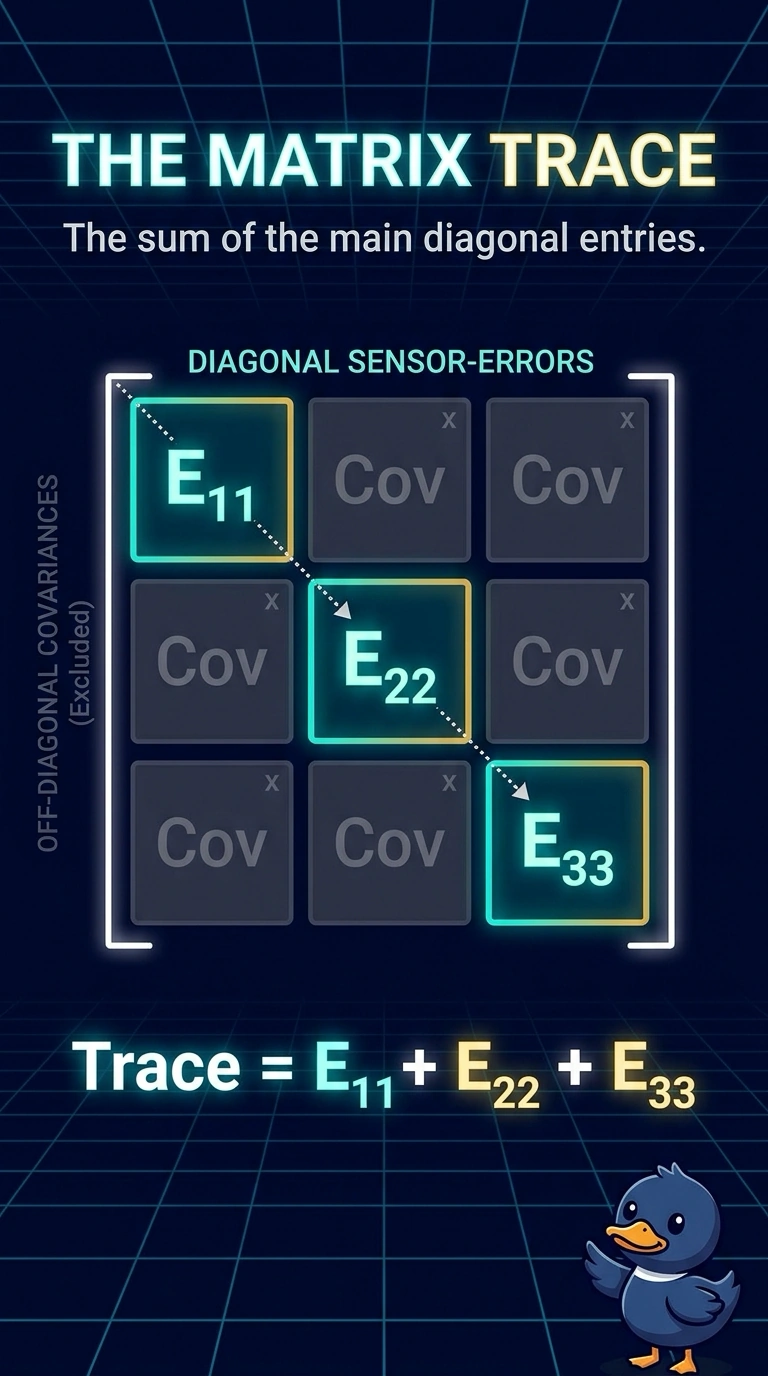
You can find the trace by adding the entries straight down the main diagonal, like totaling the bins in one designated column. For this covariance matrix, that adds each line’s own sensor-error variance and leaves off-diagonal covariances out. The determinant combines entries into a volume-like value, rank counts independent rows or columns, and spectral radius is the largest absolute eigenvalue—each answers a different question.
Full Explanation
The trace of a square matrix is defined as the sum of its main-diagonal entries. In this covariance matrix, those diagonal entries are each production line’s own sensor-error variance, so adding them gives the requested total and excludes every off-diagonal covariance between lines. Increasing an off-diagonal entry leaves the trace unchanged, confirming that those entries do not contribute to this sum. The determinant combines the matrix’s entries into a volume-like, product-based value; it is not a plain sum down the diagonal. Rank counts the number of linearly independent rows or columns, rather than adding the numeric diagonal entries. The spectral radius is the largest absolute eigenvalue, a single extreme value rather than the diagonal total. Exam caveat: the trace also equals the sum of the eigenvalues, but that is not the same as the largest absolute eigenvalue. Practical check: copy a small numeric matrix, add its diagonal cells by hand, and compare that total with the reported trace.