
A hospital infection-control team clusters caregiver movement traces. True groups follow long curved corridors rather than tight round blobs, and a few isolated traces should stay unlabeled instead of joining a group. Which method matches both requirements?
Select an answer to reveal the explanation.
Short Explanation
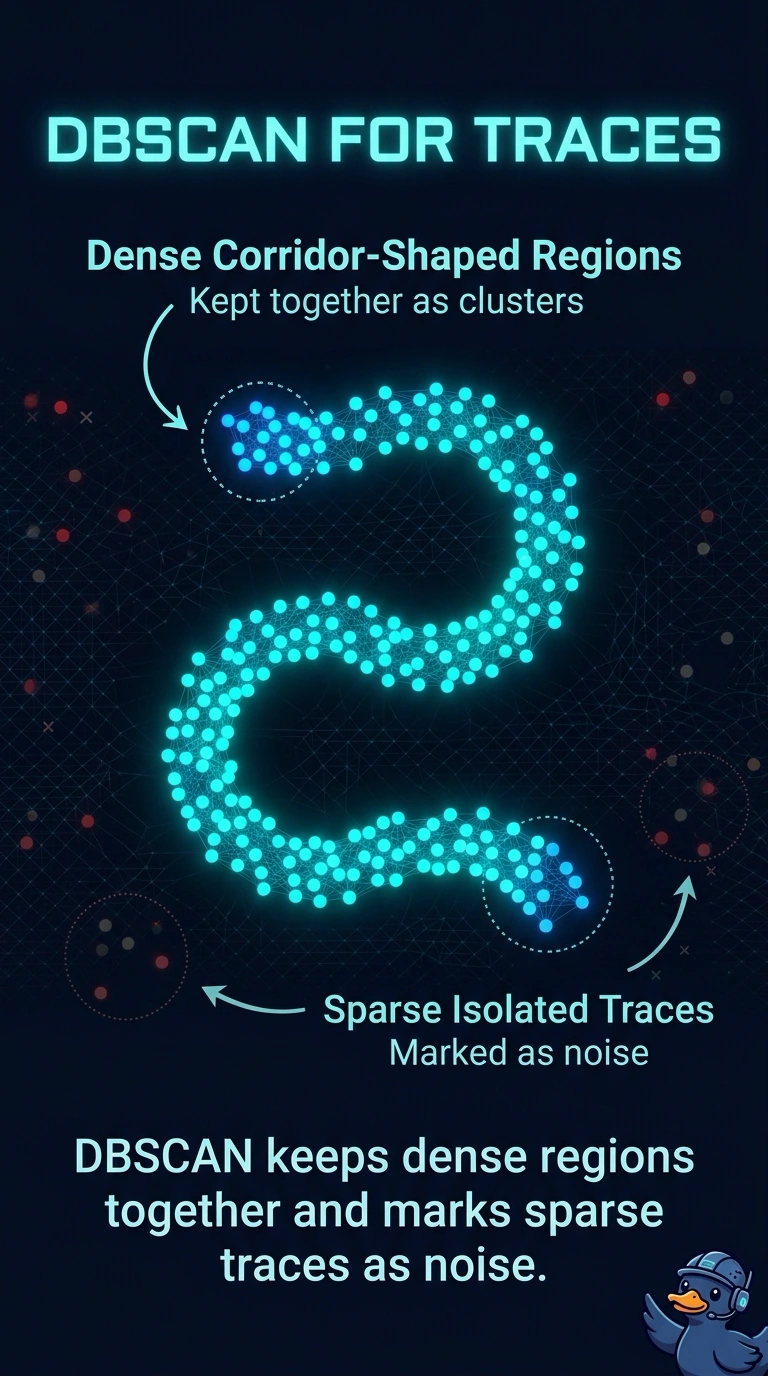
Some groups look like hallways, not coins, and a loner should stay a loner. You want a method that can follow a curved dense region and leave sparse traces unlabeled as noise. The trap is any method that forces every trace into a round center.
Full Explanation
DBSCAN defines a group as points dense enough to reach one another, so the group can bend along a corridor instead of sitting as a ball around a center. Points that are not dense enough to join that chain are labeled noise rather than pushed into a group. That pair of behaviors matches traces that follow curved halls and a few isolated walks that should stay unlabeled. k-means starts from a chosen number of centers and assigns every point to the nearest one, which pulls isolates in and prefers compact, roughly round groups. A Gaussian mixture that gives each group one normal ellipse also assigns every trace a component, so an isolate still belongs somewhere, and one ellipse is a poor match for a long curved hall. A complete-linkage hierarchical cut favors compact groups and, once the tree is cut, still names a cluster for every trace, with no density rule that leaves sparse traces as noise. Exam caveat: DBSCAN still needs a distance and a density choice suited to these traces; the point is the shape and the noise rule, not a universal neighborhood size. Operational check: plot a sample of traces, confirm corridor-shaped groups stay intact, and confirm the isolated walks are marked noise rather than absorbed.