
A retailer clusters its stores and computes a silhouette score for each store. The score is high for some stores and low for others. What does a high silhouette indicate about a store?
Select an answer to reveal the explanation.
Short Explanation
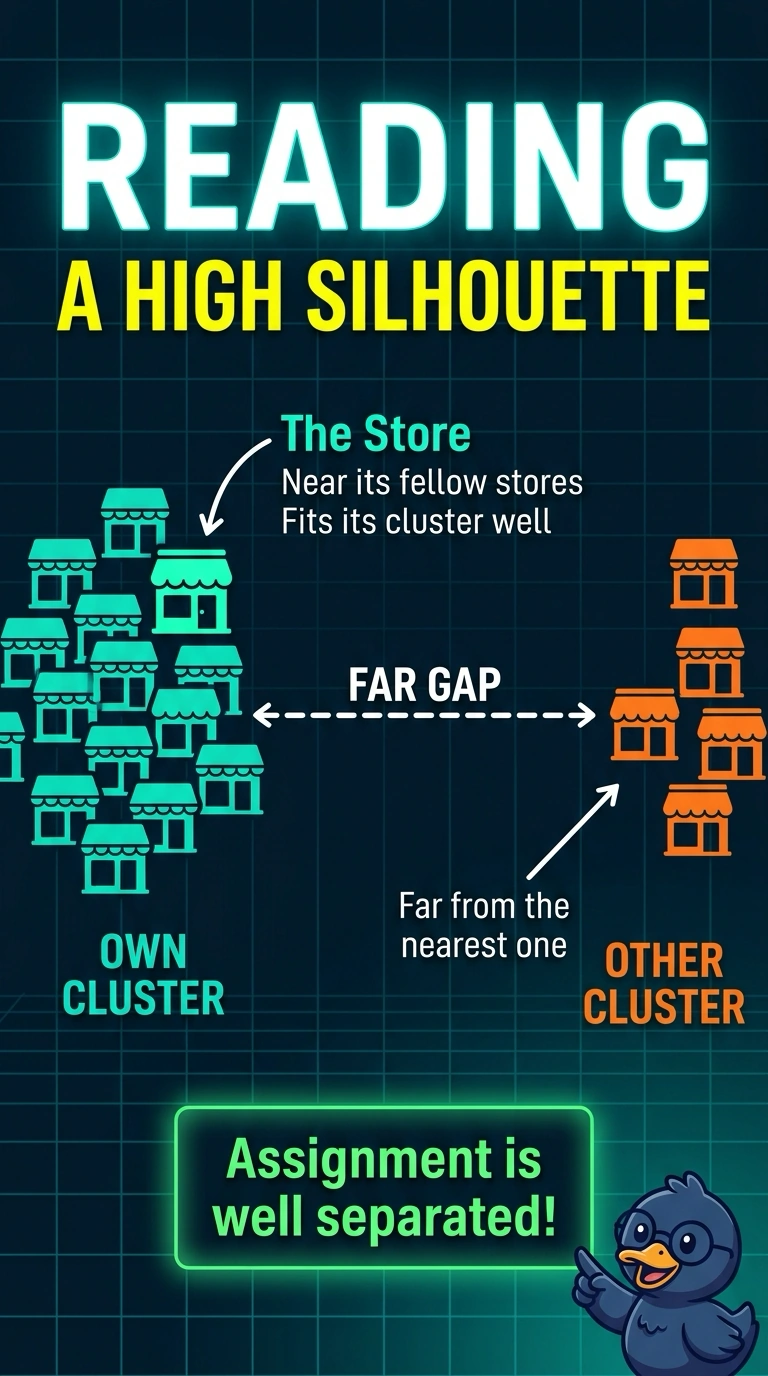
A tight group standing well away from the next group is easy to trust. You read a high silhouette as a store sitting near its own cluster and far from the next one. The elbow on a scatter chart is a different decision than this score.
Full Explanation
A silhouette compares how close a point is to its own cluster with how close it is to the nearest other cluster. The score is high when the store is near the other members of its cluster and far from the next cluster, which means the assignment is well separated. Both comparisons have to favor the assigned cluster. Closeness to its own group without distance from the next group does not produce a high score. A small further drop in within-cluster scatter is the elbow on a plot of scatter against cluster count, and that bend is not what a high silhouette says about one store. A sparse pocket that should be left as noise is a density-clustering judgment, and a high silhouette is about separation, not about discarding the store. The height at which two branches merged is a property of a hierarchical tree, not the silhouette of a store in a finished grouping. Exam caveat: a high average silhouette does not choose the number of clusters by itself if that number was never varied. Operational check: list stores with high silhouettes and stores with low ones, and confirm the low scores sit nearer another cluster than their assigned one.