
A logistics railroad wants a linear model of late arrivals that shrinks coefficients and can also set some of them exactly to zero. Which penalty is that mix?
Select an answer to reveal the explanation.
Short Explanation
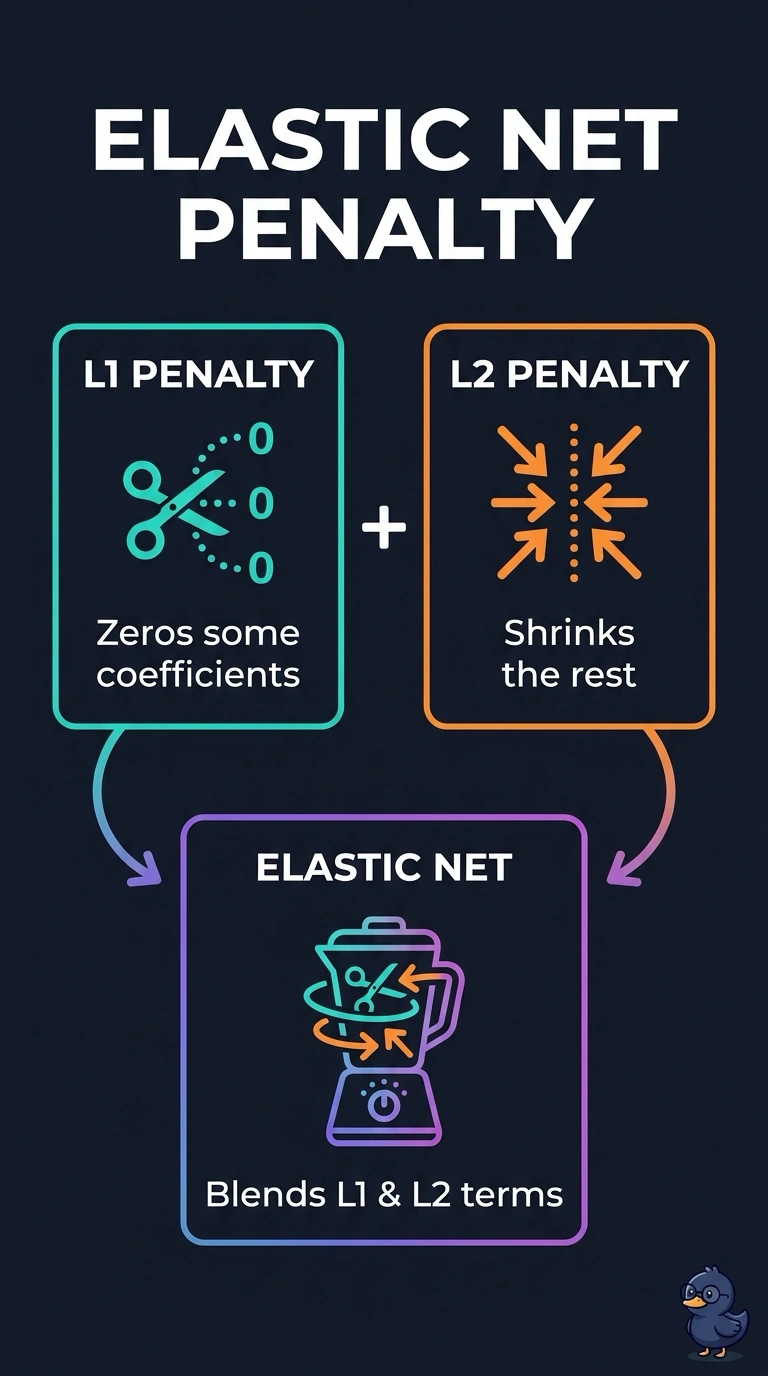
Think of a penalty that both tightens every bolt and removes the bolts you do not need. Elastic net mixes an L1 penalty with an L2 penalty so some coefficients can hit zero while the rest shrink. A shrink-only penalty, or a fit with no penalty, is the trap.
Full Explanation
Elastic net adds two penalties to a linear fit at once. The L1 term can drive some coefficients exactly to zero, which drops those predictors from the equation. The L2 term shrinks the remaining coefficients toward zero, which is the shrinkage half of the mix. The railroad asked for both behaviors in one linear model of late arrivals, which is the elastic-net mix. A pure ridge penalty is L2 only. It shrinks coefficients but keeps every predictor in the fitted equation rather than setting some exactly to zero. Ordinary least squares has no penalty, so it neither shrinks coefficients nor zeros them as part of the fit. A margin penalty from a support vector classifier is a classification objective about separating classes, not a blend of L1 and L2 penalties on a linear late-arrival model. Exam caveat: the mix is the point, so a penalty that only shrinks or a fit that does not penalize at all does not answer this request. Operational check: fit the penalized linear model and confirm the coefficient list contains both exact zeros and nonzero coefficients that are smaller than the unpenalized fit.