
A retail pharmacy chain fits a linear regression of weekly sales on many promotion flags and wants some coefficients driven exactly to zero so those flags drop out of the equation. Which penalty does that inside the regression?
Select an answer to reveal the explanation.
Short Explanation
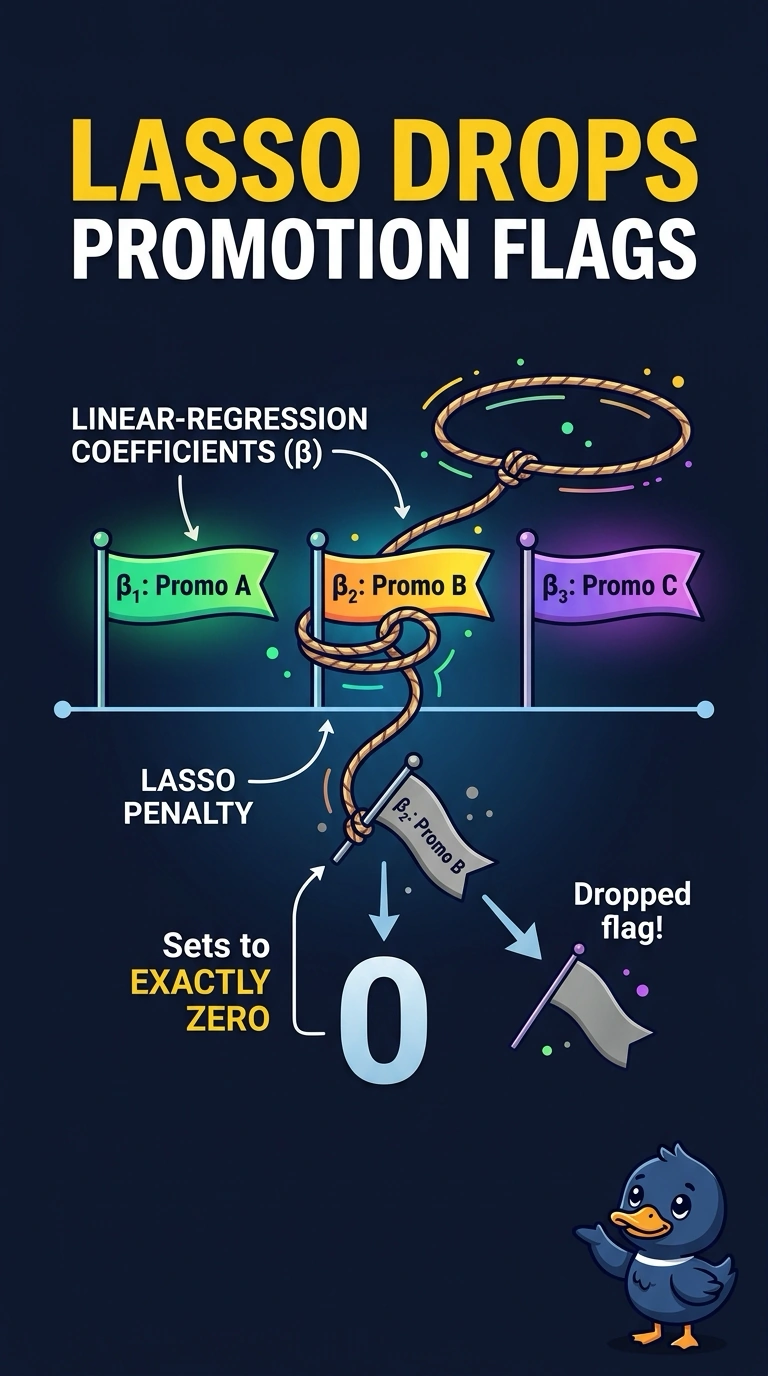
A lasso can snip unused strings on a regression until those coefficients sit at zero. That is how you drop promotion flags inside the fit rather than only shrinking them. The trap is a penalty that shrinks every flag and still keeps them all.
Full Explanation
Lasso adds an L1 penalty to a linear regression. Geometrically that penalty has corners on the axes, so the optimum can sit where some coefficients are exactly zero. Those zero coefficients drop the matching promotion flags out of the sales equation as part of the fit, which is what the pharmacy chain asked for. Ridge adds an L2 penalty. It pulls coefficients toward zero but does not set them exactly to zero in ordinary use, so every promotion flag stays in the equation. Deleting columns by hand before the fit can remove flags, but that selection happens outside the regression rather than through a penalty inside it. Raising the intercept shifts the baseline sales level and does not change which promotion coefficients are present. Exam caveat: a coefficient of zero means that flag is out of this fitted equation, not that the promotion could never matter in another specification. Operational check: inspect the fitted coefficients and confirm some promotion flags are exactly zero while the intercept and the retained flags remain.