
A bank fraud desk builds a naive Bayes classifier on flags that are clearly related, such as an overseas swipe and a high amount on the same card. A reviewer says the ranking is useless because independence is only approximate. Which conclusion is sound?
Select an answer to reveal the explanation.
Short Explanation
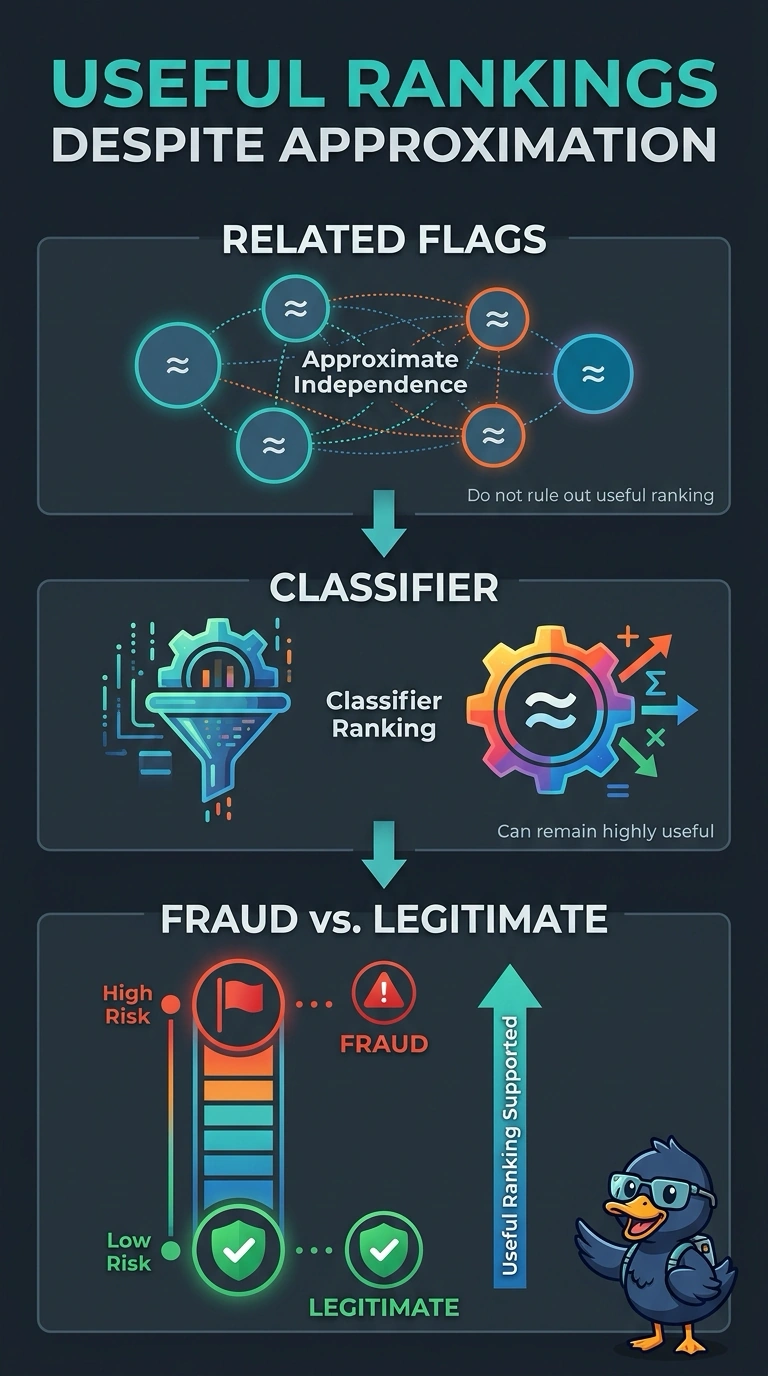
A slightly wrong ruler can still tell you which board is longer. Naive Bayes can rank the fraud class usefully even when the flags are only roughly independent. The trap is throwing the ranking out the moment the independence story is imperfect.
Full Explanation
Naive Bayes multiplies per-feature class likelihoods as if the flags were independent given the class. Real fraud flags often violate that assumption, because an overseas swipe and a high amount travel together. The resulting probabilities can be poorly calibrated, yet the ordering of transactions frequently remains useful for ranking fraud above legitimate activity. Approximate independence is not the same thing as a useless score. Discarding every class score treats any dependence as fatal to ranking, which overstates the assumption. The product can be a rough ranking even when it is not a perfect joint probability. Collapsing every flag into one combined column is not required before a ranking exists. The classifier was built to use the separate flags. A model that assumes perfect dependence among flags is a different family, and the desk does not need that assumption to keep a useful order from naive Bayes. Exam caveat: useful ranking is not the same claim as well-calibrated probabilities, so a later probability threshold may still need recalibration. Operational check: sort a labeled holdout by the naive Bayes score and compare fraud prevalence in the top slice with prevalence in the bottom slice.