
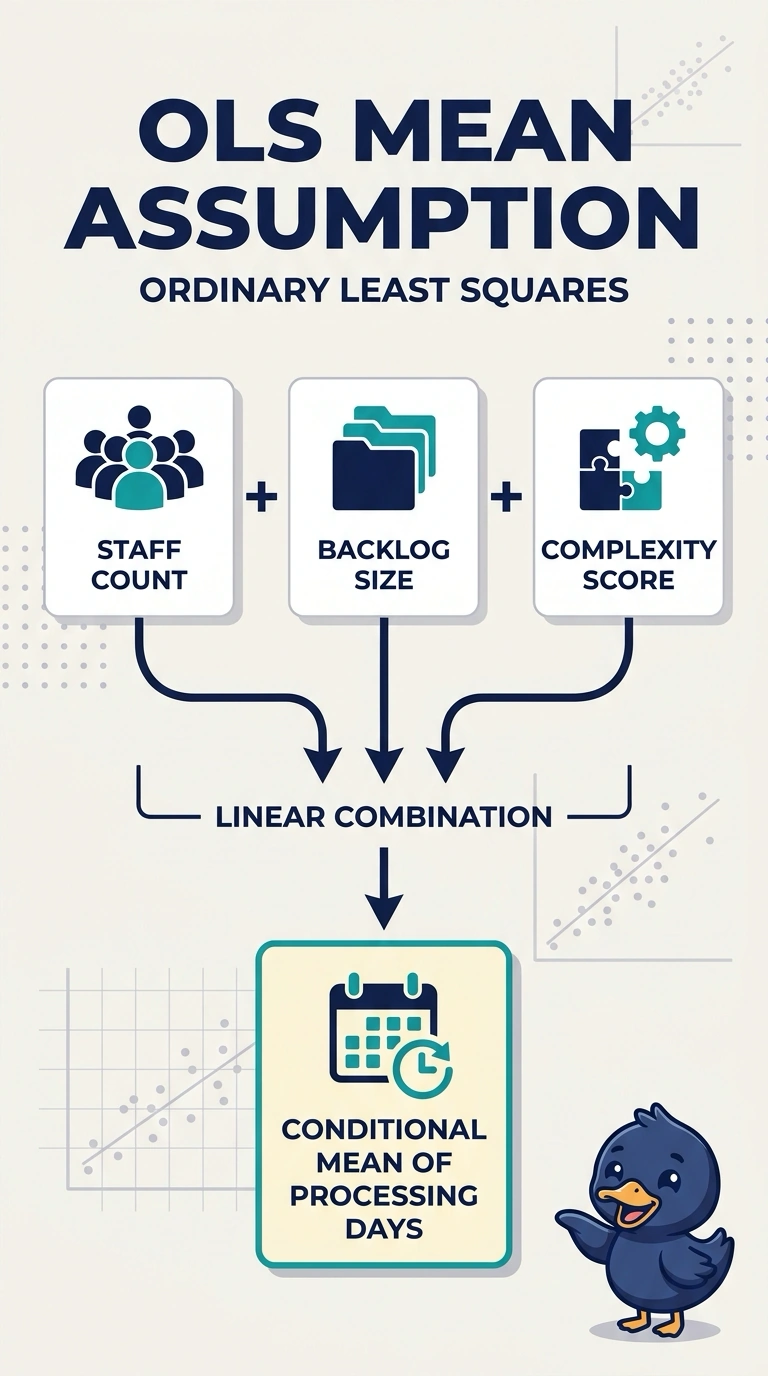
An agency models grant-processing days with ordinary least squares, using staff count, backlog size, and a complexity score as features. The team must state the assumption about the mean of processing days given those features. Which statement is that mean assumption?
Select an answer to reveal the explanation.
Short Explanation
The average outcome you care about has to ride a straight ramp built from the features, not a side condition about how wide the errors are. Ordinary least squares assumes the mean processing time is linear in staff count, backlog, and complexity. The trap is grabbing a different assumption, such as constant spread, and calling it the mean.
Full Explanation
The ordinary least squares mean assumption says the conditional expectation of the outcome is linear in the features. Here, the mean of grant-processing days, given staff count, backlog size, and complexity, is a linear combination of those three features. Uncorrelated predictors are not required for that linearity: features that move together can still enter a linear mean, though the separate coefficients become harder to pin down. Constant residual spread is the homoskedasticity assumption about variance, and it does not define the mean or force the mean to be linear. A mean confined to zero and one is a probability constraint for a binary model, not the mean assumption of ordinary least squares on a day count. Exam caveat: linear in the features means the conditional mean is a linear combination of the columns in the model; a curved mean violates that assumption even when residual variance is constant. Operational check: plot average processing days against each feature, or inspect a residual plot for a systematic curve, and confirm the modeled mean is the linear combination the team stated.