
A logistics team scores a delivery-time model with k-fold validation on one historical table of completed routes. What does that procedure do with the rows?
Select an answer to reveal the explanation.
Short Explanation
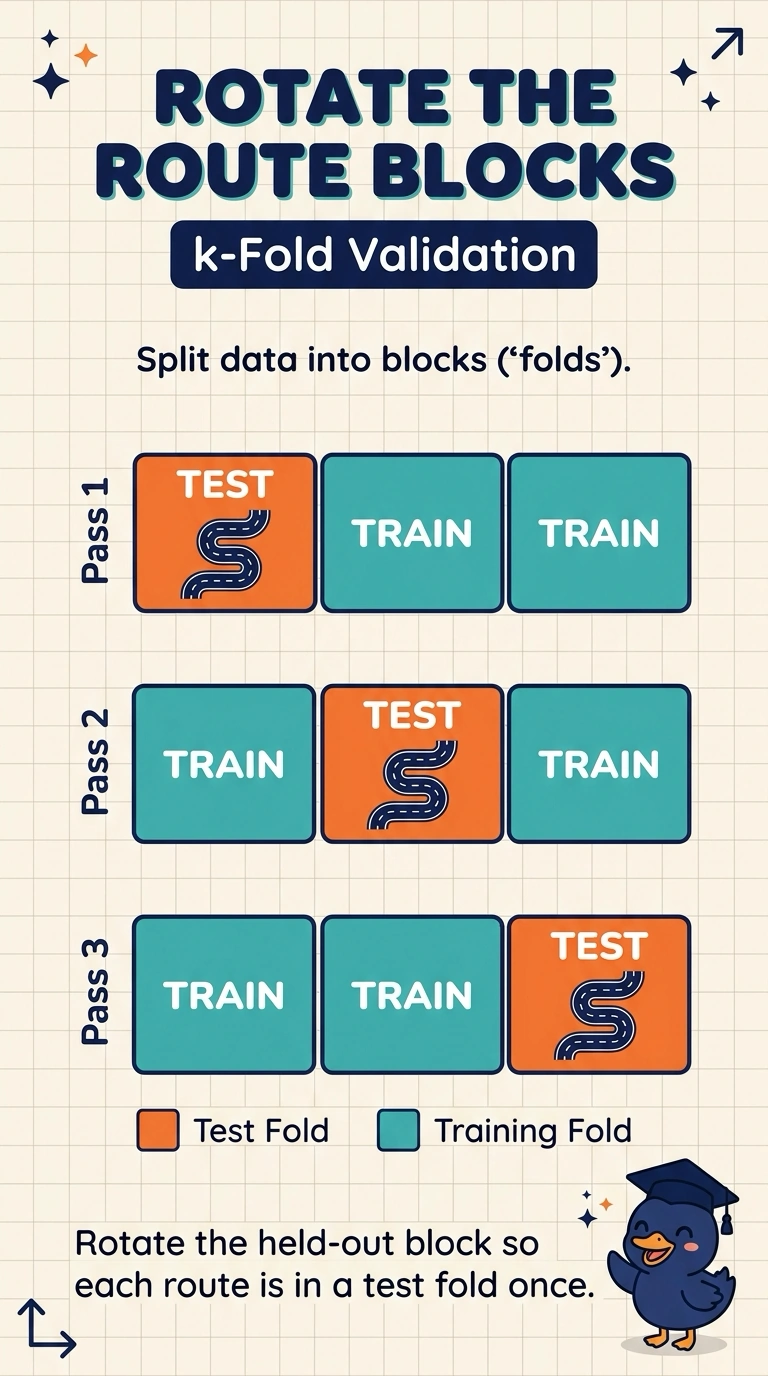
You can picture k-fold validation as rotating which block of routes sits out: each route is held out once and used for training on the other passes. Reusing one fixed final month is a single holdout, while fitting preprocessing on all routes first leaks information and training once on half the routes checks only one split.
Full Explanation
In standard k-fold validation, you partition the rows into folds. On each pass, you train on all but one fold and score the held-out fold; on the next pass, a different fold is held out. Across the passes, every route appears in the test fold once and in the training portion on the other passes, so this rotation evaluates each route as held out. Reusing one fixed final month as the test block on every pass is a single fixed holdout, not a rotation through the rows. Fitting preprocessing on all routes before the folds lets held-out routes influence the transformations, so the resulting score is not a clean test of unseen routes. Training once on a random half evaluates only that one split and does not place every route in a test fold. Exam caveat: the defining pattern is that each route is held out once, not simply that the model is scored repeatedly. Practical check: assign each route a test-fold ID and verify that every route has exactly one before averaging the fold scores.