
An internal chatbot answers employee questions about HR policy using only what its language model learned in training. Policies change monthly, so many answers are outdated. The company wants answers grounded in the current policy documents without retraining the model each month. Which approach fits?
Select an answer to reveal the explanation.
Short Explanation
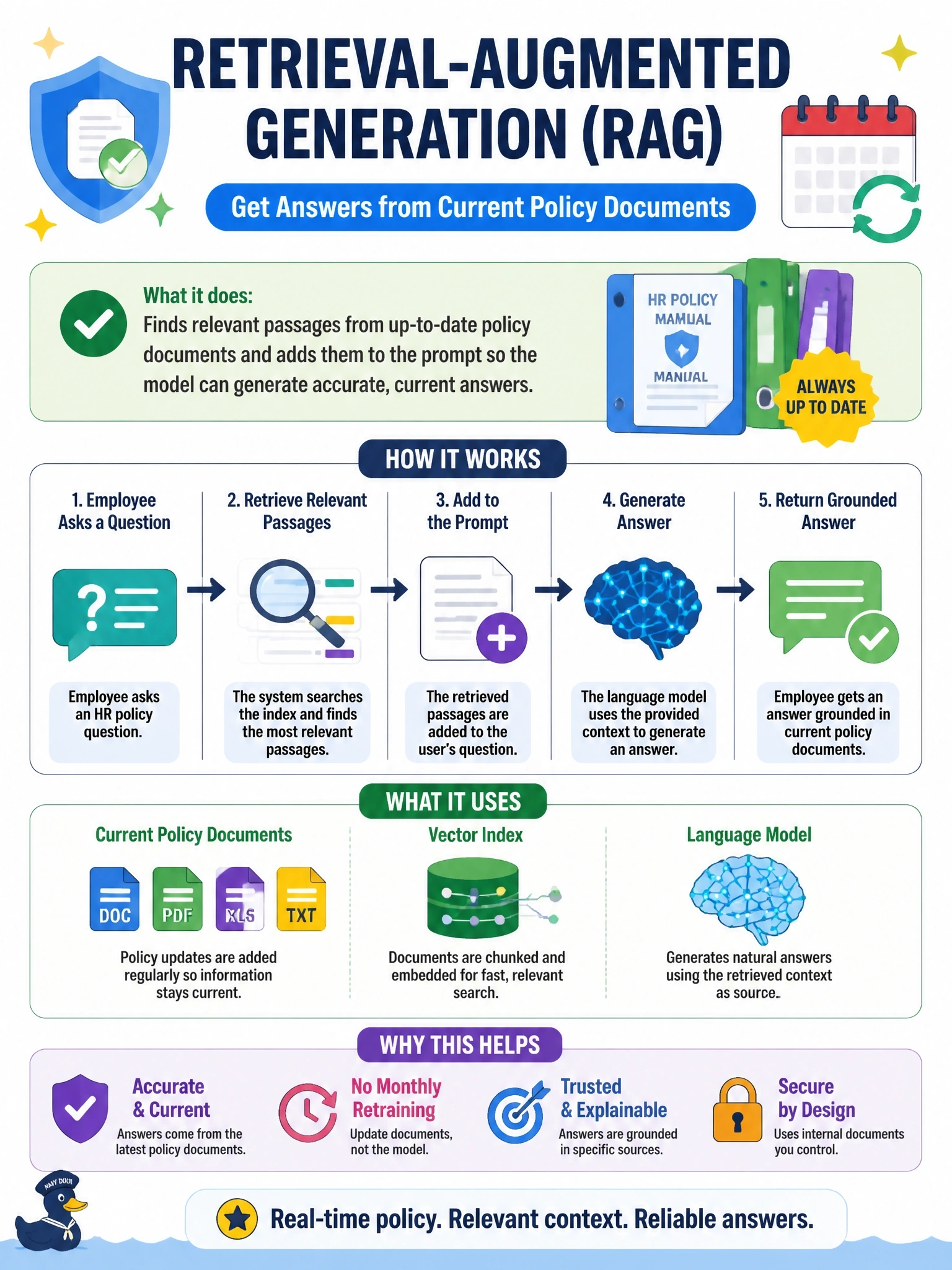
RAG is an open-book exam for the AI. Instead of answering from memory, it looks up the right pages in your current documents first and answers from those. Retraining every month is the expensive trap, and turning up the temperature just makes the answers more random, not more up to date.
Full Explanation
Retrieval-augmented generation (RAG) combines a language model with a retrieval step. Current documents are split into passages and indexed, often as vector embeddings in a vector store, so that passages semantically similar to a user's question can be found. At query time, the system retrieves the most relevant passages and includes them in the prompt, instructing the model to answer from that context. Updating answers then only requires re-indexing changed documents, not retraining the model. Retraining from scratch every time a policy changes is expensive and slow, and the scenario explicitly rules out retraining; even fine-tuning does not reliably make a model reproduce the latest document details. Raising the temperature increases randomness in token selection, producing more varied wording, but it adds no new information and makes answers less reliable. Robotic process automation automates repetitive user-interface tasks; pasting documents into a chat interface does not create a retrieval mechanism, and a single prompt cannot hold an entire policy library. Exam caveat: RAG quality depends on the data pipeline that feeds the index, including document freshness, chunking and access control, so it is a data integration task as much as an AI one. Operational check: after each policy update, re-index the changed documents and ask test questions whose answers changed, confirming the chatbot cites the new version.