
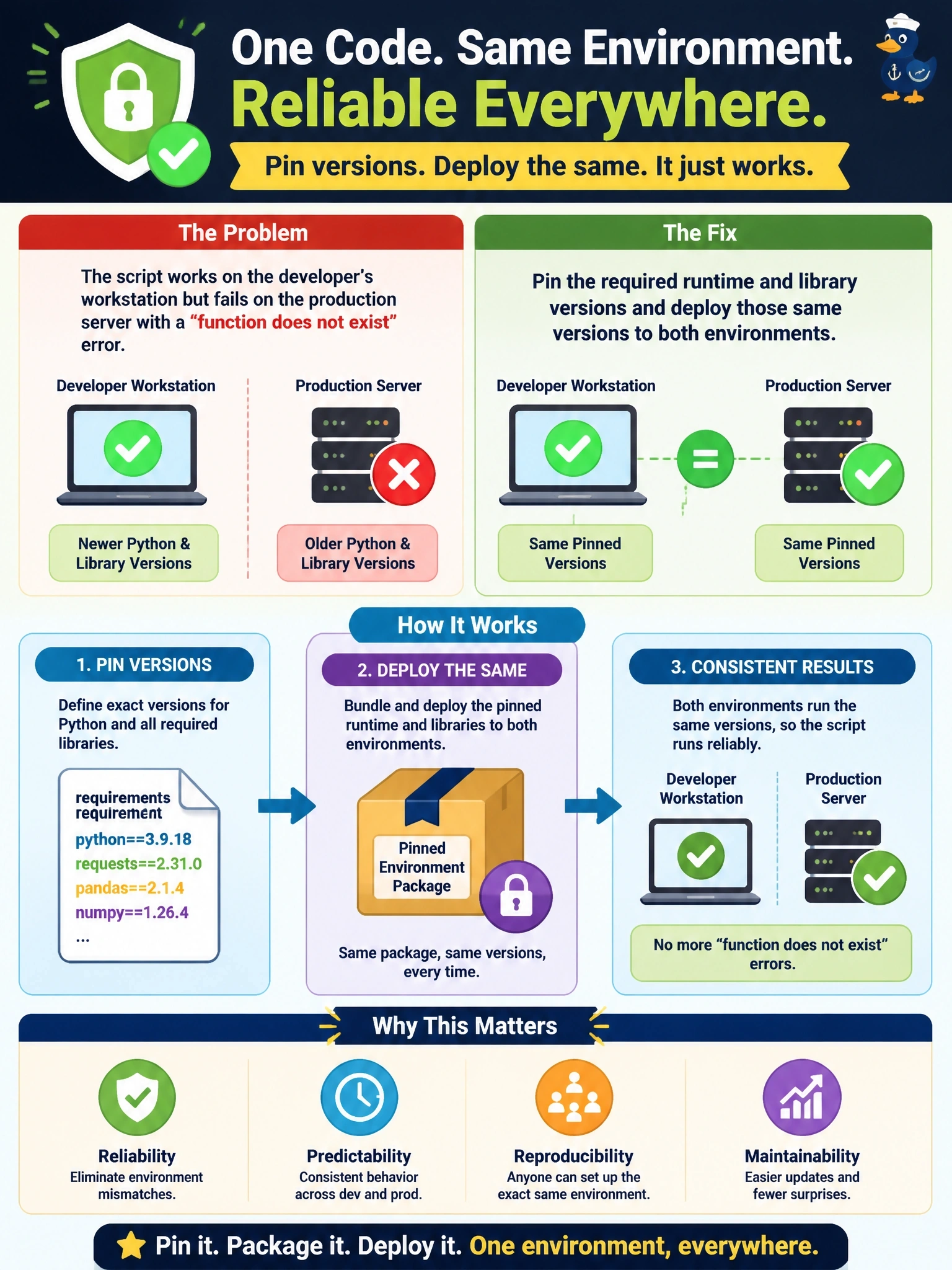
A Python integration script runs correctly on a developer's workstation but fails on the production server with an error saying a library function does not exist. Investigation shows the server has an older Python interpreter and older library versions than the workstation. What is the best fix?
Select an answer to reveal the explanation.
Short Explanation
"Works on my machine" is the oldest story in IT. The cure is making every machine the same machine: you write down the exact versions the script needs and install exactly those everywhere. Running it as admin won't conjure up a function that the old library simply doesn't have.
Full Explanation
Software versioning is a common infrastructure limitation in data acquisition. Functions are added, changed and removed between library releases, and interpreters differ in supported syntax and behavior, so a script developed against newer versions can fail on a host with older ones even though the code itself is correct. The robust fix is to declare the exact runtime and library versions the script requires, for example in a pinned requirements or lock file, and to build every environment from that declaration, often with isolated virtual environments or containers, so development, test and production match. Rewriting the script in another language is disproportionate and would introduce new dependencies of its own; the problem is environmental drift, not the language. Running with administrative privileges changes what the process may access, not which functions exist in the installed library, so the same error would occur. Adding memory addresses resource exhaustion, which would produce different errors; a missing function is a version problem, not a capacity one. Exam caveat: dependency changes should flow through change management and CI/CD, with tests run against the same versions used in production. Operational check: compare the installed package list and interpreter version on both hosts, deploy the pinned versions to a test server first and run the script end to end before production.