
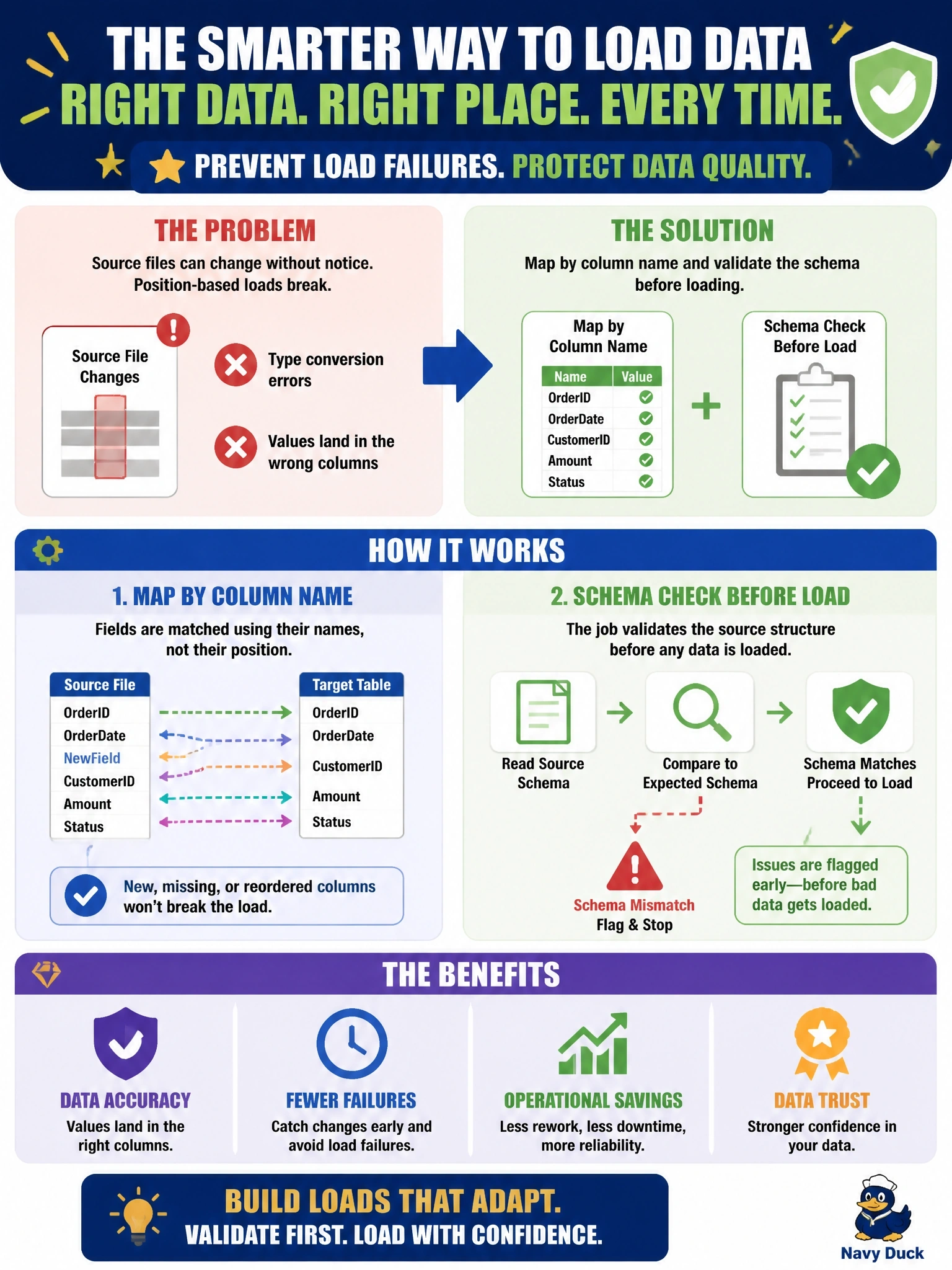
A source team inserted a new column into the middle of a daily extract file without notice. The load job maps fields to target columns by their position, so it now fails on type conversion errors or puts values into the wrong columns. Which change best prevents a repeat?
Select an answer to reveal the explanation.
Short Explanation
Positional mapping is like seating guests by chair number: add one chair in the middle and everybody's in the wrong seat. Mapping by name puts each guest where their name card is, and a schema check tells you somebody showed up uninvited. Turning off type checks would just let the wrong people sit down quietly.
Full Explanation
Schema mismatch occurs when the structure of incoming data no longer matches what the target or pipeline expects, for example after a column is added, removed, renamed, reordered or retyped at the source. A job that maps fields by ordinal position breaks as soon as a column is inserted ahead of others, because every later value shifts one place to the right, causing type errors or, worse, silently misaligned data. Mapping by column name, using the header or source metadata, makes the job tolerant of reordering and additions, and an explicit schema check that compares the incoming structure with the expected contract lets the pipeline stop and alert before bad data loads, so that changes are handled deliberately. Truncating and reloading the target addresses a data problem that does not exist; the target is not stale, the input structure changed. Raising the timeout is unrelated, since the job is failing on content, not on time. Disabling type validation would let shifted values, such as text in numeric columns or prices in quantity columns, load without error, turning a visible failure into silent corruption. Exam caveat: schema changes should also be governed through a data contract or change process with the source team. Operational check: run the updated job against both the old and new file layouts in a test environment and confirm the new column is either mapped or reported, never misaligned.