
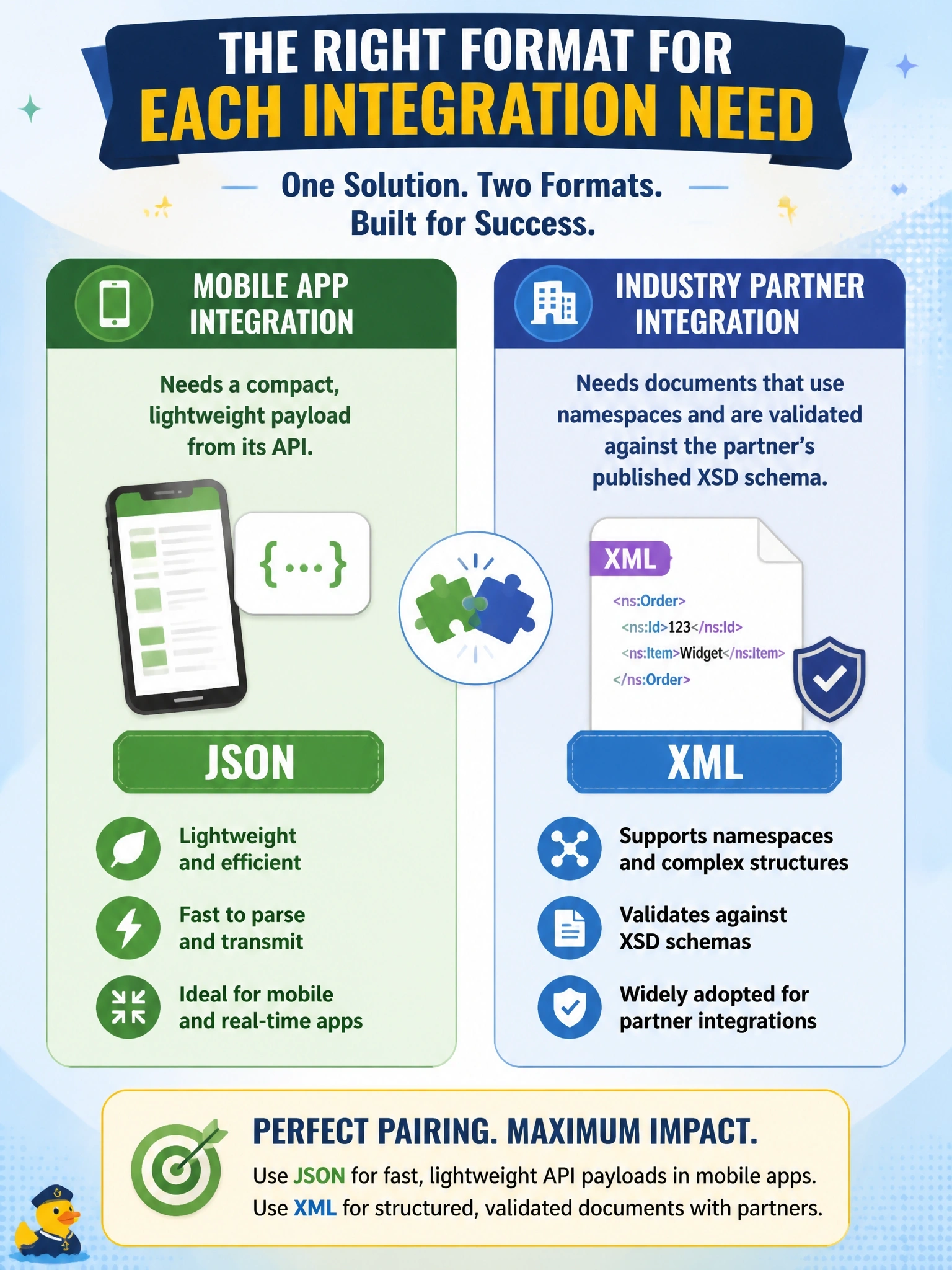
A company has two integration needs: a mobile app needs a compact, lightweight payload from its API, and an industry partner requires documents that use namespaces and are validated against the partner's published XSD schema. Which pairing of data formats fits these needs?
Select an answer to reveal the explanation.
Short Explanation
JSON is the backpack: light, quick and perfect for a phone. XML is the filing cabinet with labeled drawers, namespaces and a rulebook, the XSD, that says exactly what goes where. When your partner hands you an XSD, they're telling you they want XML.
Full Explanation
JavaScript Object Notation (JSON) represents data as objects, arrays and simple values with minimal syntax, which keeps payloads compact and makes them easy to parse in mobile and web clients; it is the common default for modern APIs. Extensible Markup Language (XML) uses tagged elements and attributes, supports namespaces that let vocabularies from different sources coexist without name collisions, and can be validated against an XML Schema Definition (XSD) that specifies element structure and data types. An industry partner that publishes an XSD and requires namespaces is specifying XML, while the mobile app's need for a lightweight payload points to JSON. Reversing the pairing gives the mobile app the more verbose format and gives the partner a format that does not use XSD or XML namespaces. Flat CSV files are compact for tabular data but have no namespace concept, no nesting and no built-in schema validation, so they meet neither the partner's requirement nor the structured needs of an API response. JSON has its own schema language, JSON Schema, but it does not use XSD and has no XML-style namespace mechanism, so the claim that it natively supports both is false. Exam caveat: format choice also affects encoding and parsing errors during acquisition, so declare character encoding explicitly. Operational check: validate a sample partner document against the XSD and confirm the mobile payload parses correctly in a test client.