
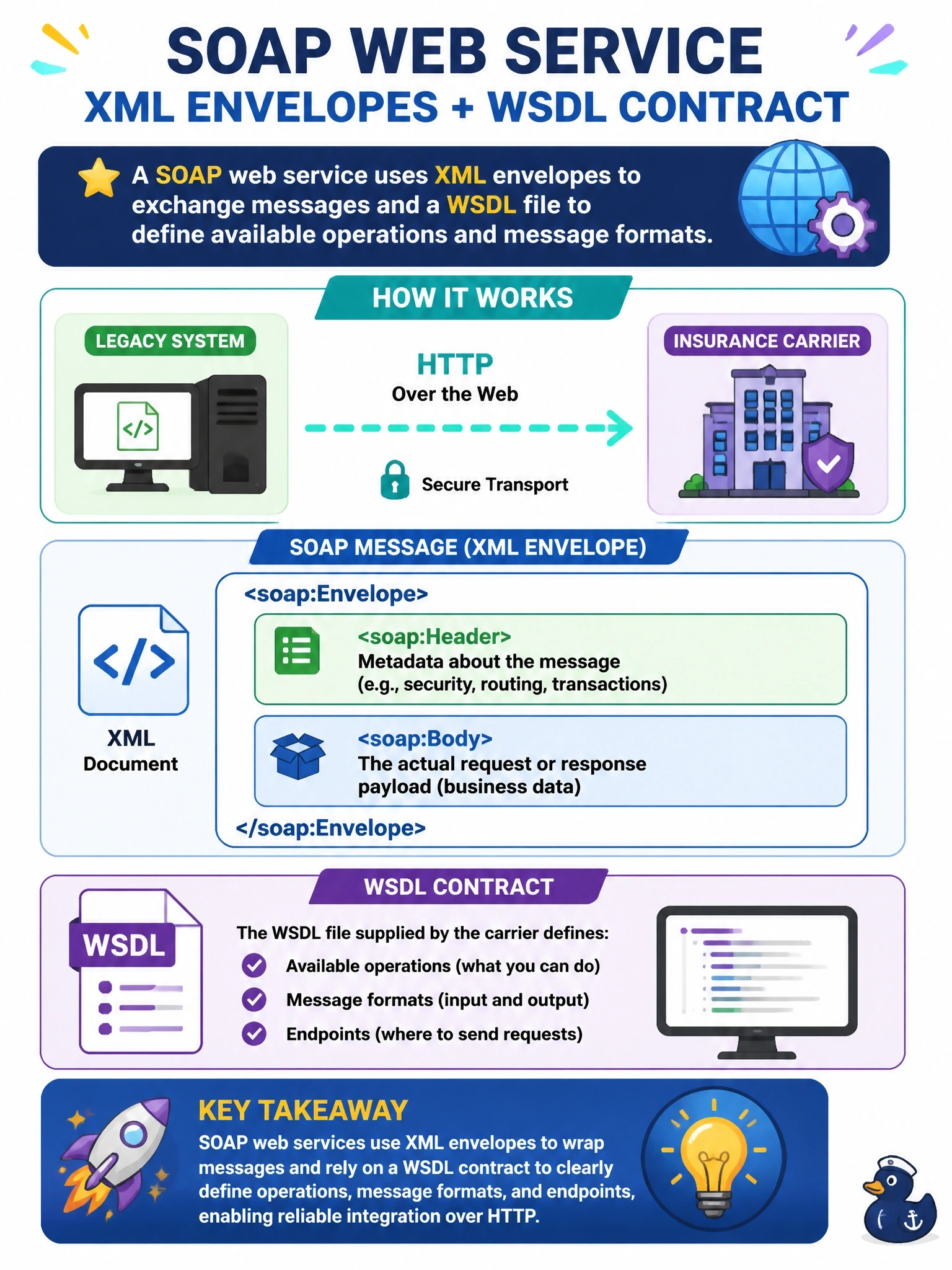
A legacy integration with an insurance carrier sends requests over HTTP as XML documents, each with an envelope containing a header and a body. The available operations and their message formats are defined in a WSDL file supplied by the carrier. Which type of interface is this?
Select an answer to reveal the explanation.
Short Explanation
See an envelope plus a WSDL? You're looking at SOAP, every time. It's the formal registered letter of web services: a strict envelope with a header and body, and a contract that spells out every operation. REST and OData are the casual postcards that live in URLs.
Full Explanation
The Simple Object Access Protocol (SOAP) is a messaging protocol in which each request and response is an XML document wrapped in a SOAP envelope, with an optional header for metadata such as security tokens and a body carrying the payload. Services publish a Web Services Description Language (WSDL) file that defines the available operations, their input and output message structures and the endpoint addresses, which allows client code to be generated from the contract. An XML envelope with a header and body, together with a WSDL file, identifies the interface as SOAP. A REST API typically uses HTTP verbs on resource URLs, commonly returns JSON, and has no mandatory envelope or WSDL contract, so it does not match. OData is also RESTful; it adds a metadata document and standard URL query options rather than operation-specific XML envelopes. JDBC is a Java database driver API that runs SQL statements over a database's native protocol, not an HTTP web service with XML messages. Exam caveat: SOAP remains common in finance, insurance and government integrations because of its formal contracts and built-in standards for security and reliability, even where newer systems use REST. Operational check: load the WSDL in a test client, call one read-only operation, and confirm that faults are logged and handled by the integration.