
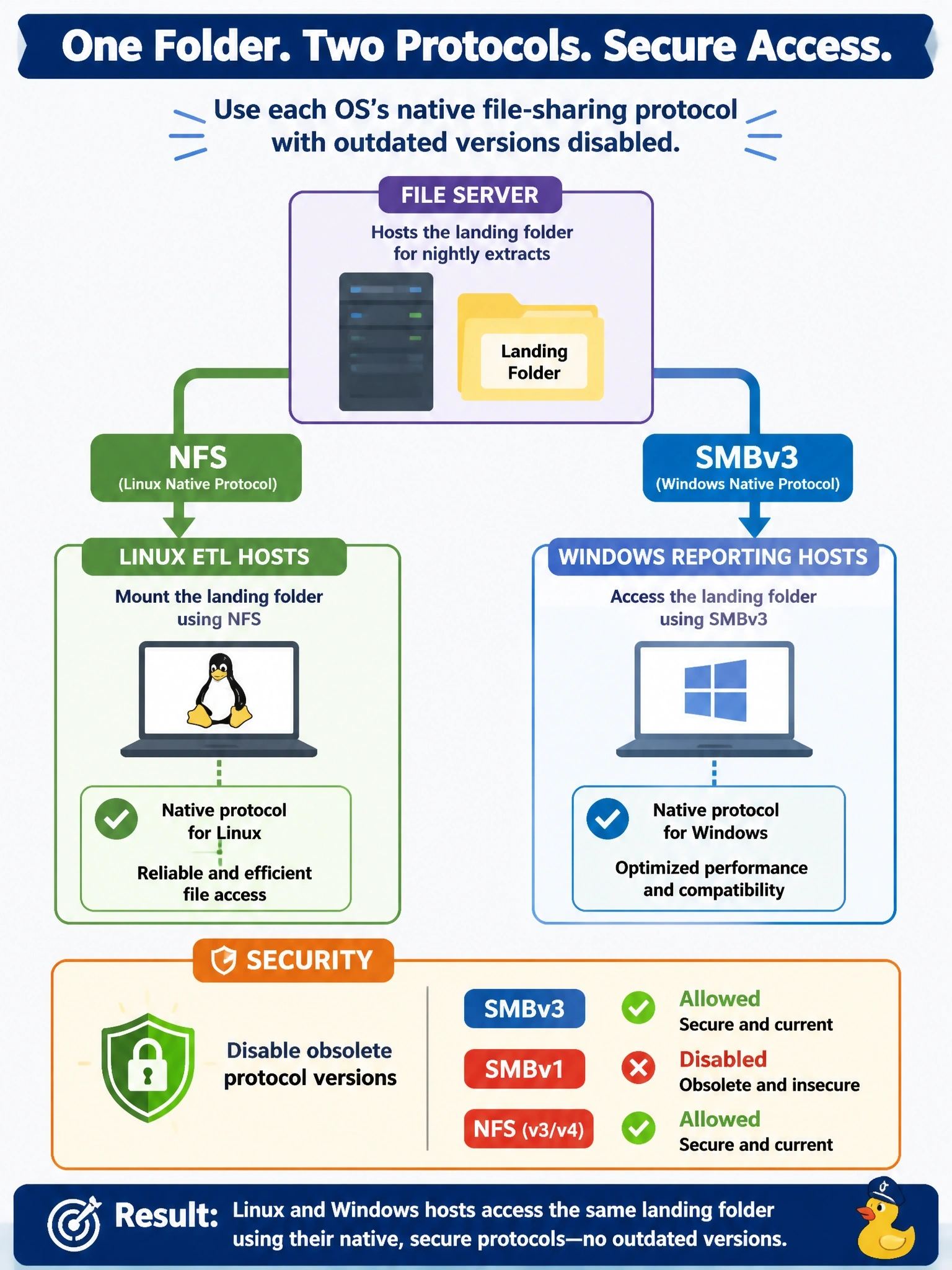
A file server hosts a landing folder for nightly extracts. Linux ETL hosts must mount it, and Windows reporting hosts must also access it, each using its operating system's native file-sharing protocol. Security requires that obsolete protocol versions be disabled. Which configuration fits?
Select an answer to reveal the explanation.
Short Explanation
Each operating system has a home language for file shares: NFS for Linux and Unix, SMB for Windows. You give each group its native protocol, and you make sure Windows uses a modern SMB version, not the ancient SMBv1 that attackers love. OData and RPC aren't file-sharing protocols at all, so don't get distracted.
Full Explanation
Network File System (NFS) is the native file-sharing protocol for Unix and Linux systems, which mount exported directories into their file system tree. Server Message Block (SMB) is the native file-sharing protocol for Windows, and current versions, SMBv2 and SMBv3, add better performance and security, with SMBv3 supporting encryption in transit. Exporting the landing folder over NFS for the Linux ETL hosts and sharing it over SMBv3 for the Windows hosts gives each group its native protocol, and disabling SMBv1 satisfies the requirement to remove obsolete versions. Sharing over SMBv1 for everyone violates the security requirement outright; SMBv1 lacks modern protections and has been exploited by widespread malware, which is why it is disabled by default on current systems. OData is a RESTful protocol for querying structured data through HTTP endpoints; it does not provide mounted file shares, and the extracts would have to be modeled as entities. RPC lets a client call procedures on a remote server; it is a building block that protocols use internally, not a file-sharing service that hosts mount. Exam caveat: both NFS and SMB need authentication and permissions configured; using a native protocol does not by itself secure the share. Operational check: confirm that the Linux hosts can mount and read the export, that the Windows hosts negotiate SMBv3, and that an SMBv1 connection attempt is refused.