
A native Windows reporting application, not written in Java, must query SQL Server, PostgreSQL and MySQL databases through one standard, language-neutral driver interface that the application already supports. What should the DBA set up on the reporting server?
Select an answer to reveal the explanation.
Short Explanation
Think of ODBC as the universal power adapter you plug databases into: one standard plug on the app side, a different driver for each engine on the other. JDBC is the same idea but only fits Java, and that's the trap here. Reading the raw database files over a share? That's like reading a book by looking at the printing press.
Full Explanation
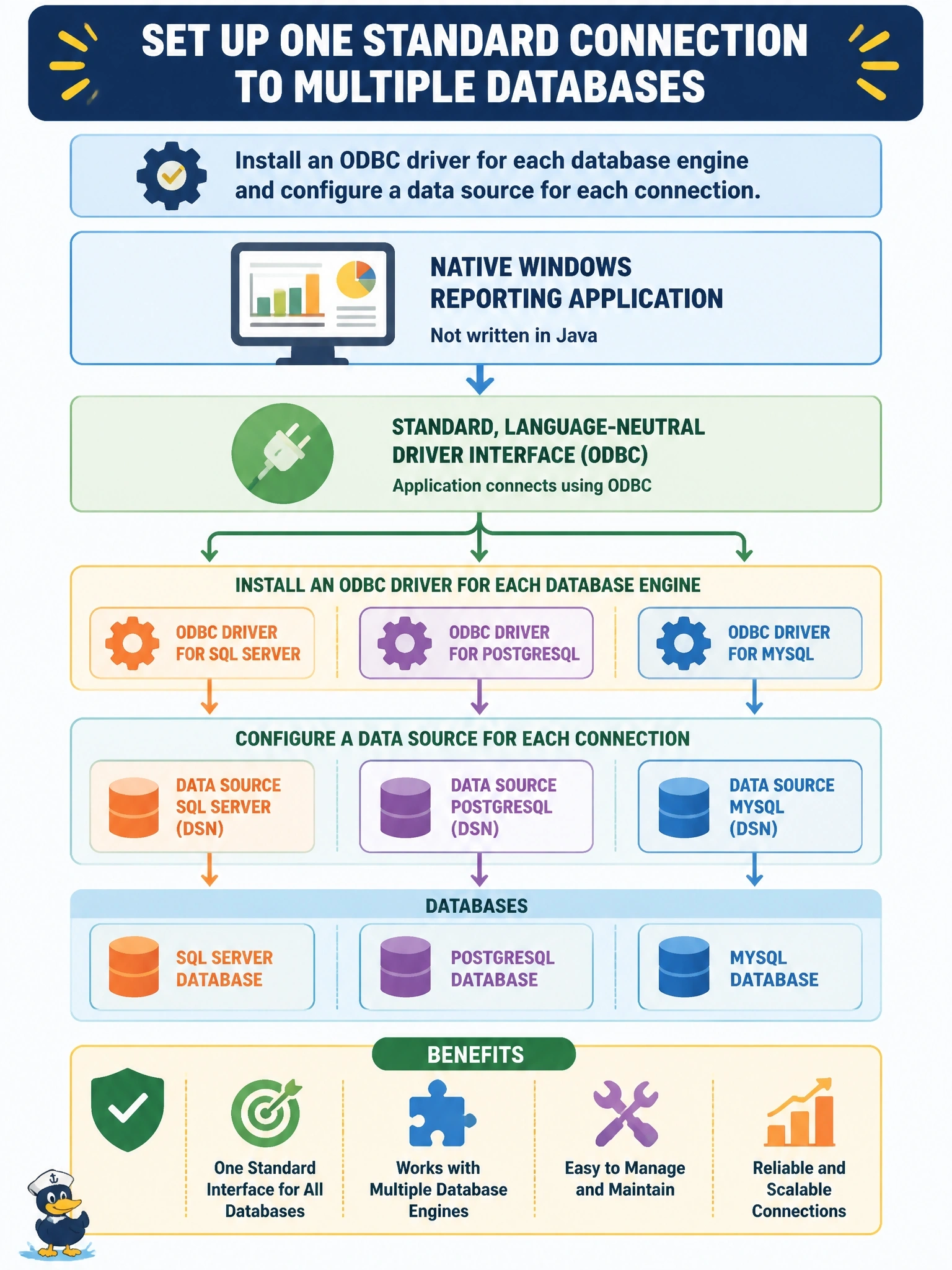
Open Database Connectivity (ODBC) is a standard, language-neutral call-level interface for database access. An application written against the ODBC API can reach many different engines by loading the appropriate vendor driver, while connection details are stored in a data source definition or connection string. Installing an ODBC driver for each engine on the reporting server and configuring a data source for each gives the application uniform access to all three databases through the interface it already supports. JDBC serves the same purpose but is defined for the Java platform; JDBC drivers run inside a Java virtual machine, so a native application that is not written in Java cannot simply load them. OData exposes data as RESTful HTTP resources and requires building and hosting a service for each database; it is not a driver interface, and the application is described as using a driver. Reading database files over an SMB share bypasses the database engine entirely: the files are locked and in a proprietary format while the engine runs, and direct reads would skip transactions, security and consistency. Exam caveat: match the driver technology to the client platform, ODBC for native and many scripting tools, JDBC for Java. Operational check: test each data source with the driver's connection test, confirm the driver bitness matches the application, and run a simple read-only query against each engine.