
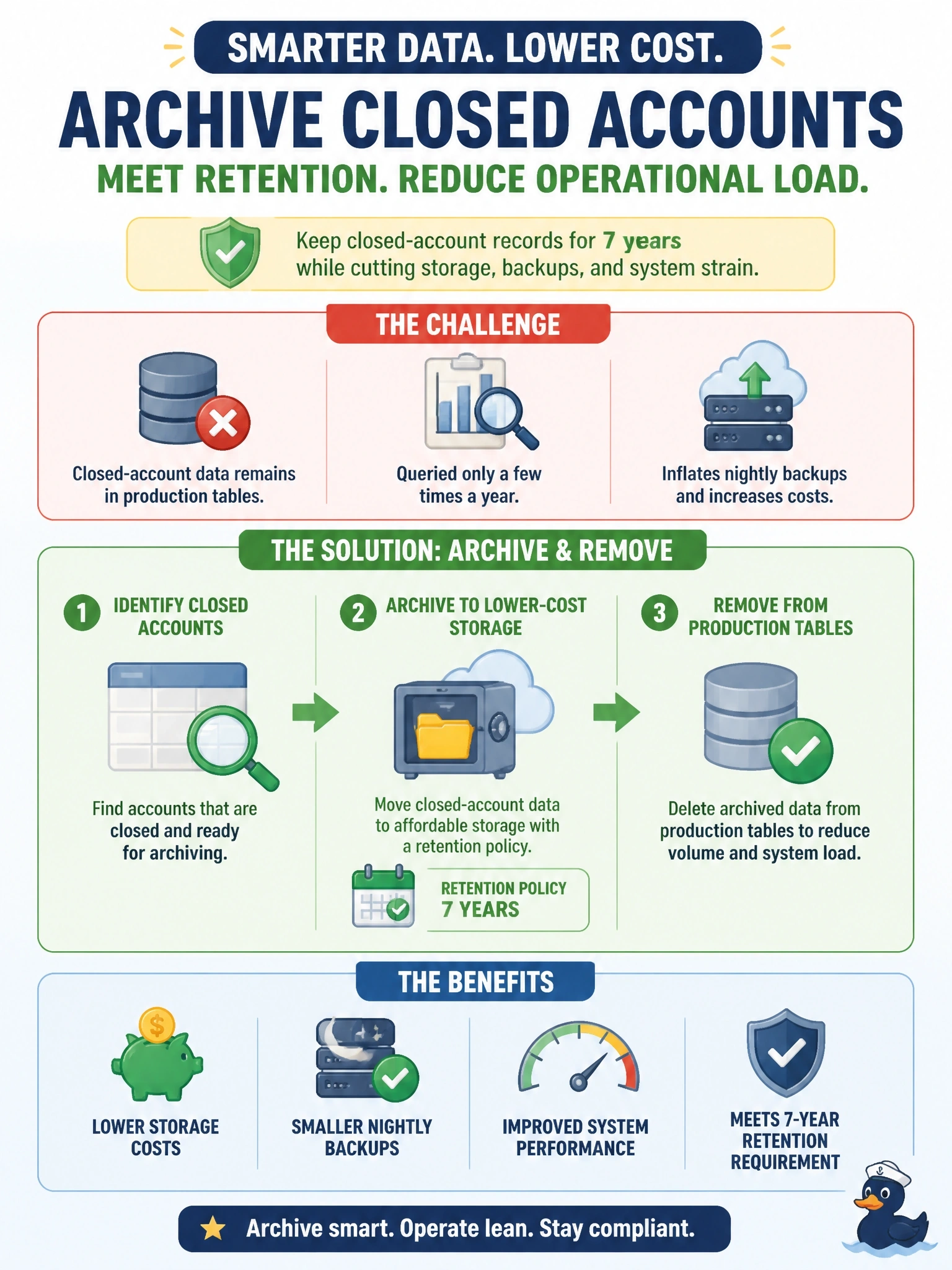
Regulations require a bank to retain closed-account records for seven years. The records are queried only a few times a year, yet they still sit in production tables and inflate every nightly backup. Which approach best meets the retention requirement while reducing operational load?
Select an answer to reveal the explanation.
Short Explanation
Archiving is moving the old tax returns from your desk to a labeled box in storage: you can still find them, but they stop cluttering your daily work. You move closed accounts to cheaper storage with a retention rule and take them out of production. Keeping seven years of backups is not an archive; it's a very expensive junk drawer.
Full Explanation
Archiving moves data that must be retained but is rarely accessed out of the operational database into storage designed for long-term retention, such as an archive database or lower-cost tiered storage, governed by a retention policy that specifies how long it is kept and when it is disposed of. Once archived and verified, the records are removed from production tables, which shrinks the working set, shortens backup and restore times, and reduces maintenance effort, while the rare queries run against the archive. Backups are for recovery, not retention: keeping seven years of nightly full backups multiplies storage enormously, and finding one account means restoring an old backup, which may depend on software versions no longer in use. Leaving the records in production and adding an index speeds the rare query but leaves every nightly backup and maintenance job carrying the same weight, which is the problem described. Weekly snapshots retained for seven years share the original storage and its failure domain, are not designed as a searchable long-term archive, and still keep the data in production. Exam caveat: archives must be protected and backed up themselves, since they hold the only copy of the archived data. Operational check: reconcile archived row counts against production before deleting, and confirm the archive's retention rule matches the seven-year requirement.