
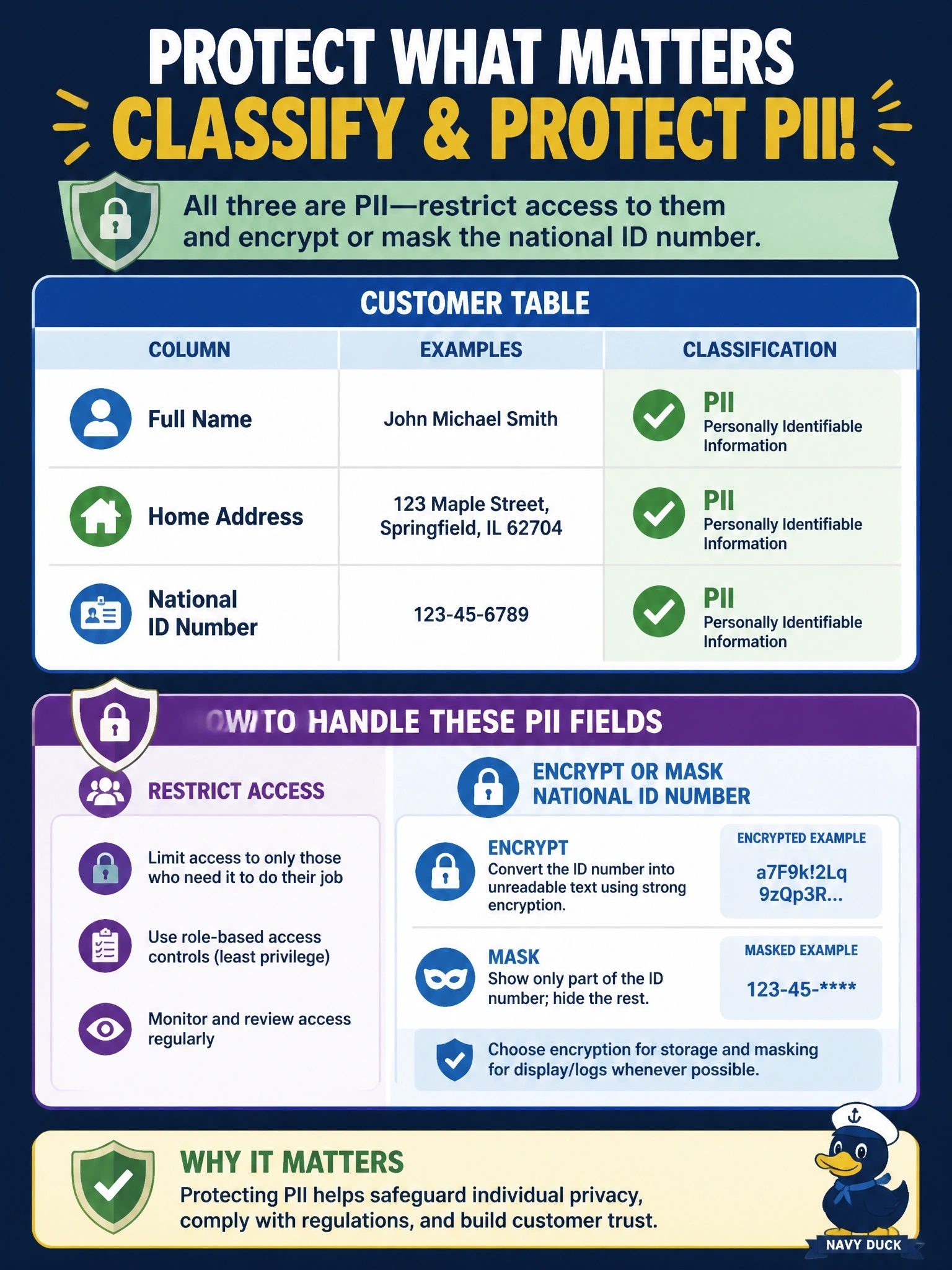
A customer table stores each person's full name, home address and national identification number. The team must classify these columns and decide on protection. Which classification and handling is most appropriate?
Select an answer to reveal the explanation.
Short Explanation
If a piece of data can point you to a specific person, on its own or combined with other data, it's PII. Names, addresses and national IDs all qualify, and the ID number deserves the strongest locks. Calling it PHI is the trap; PHI is health information tied to a person, and there's no health data here.
Full Explanation
Personally identifiable information is any information that can identify an individual, directly or when combined with other data. Full name and home address are direct identifiers, and a national identification number is a highly sensitive identifier frequently used in identity theft, so all three columns are PII. Appropriate handling includes classifying the columns, restricting access by least privilege, encrypting or masking the national ID so most users and non-production copies never see the full value, and auditing access. Treating names and addresses as public directory data ignores that they identify people and are commonly regulated as personal data, especially in combination. Protected health information is individually identifiable information related to health status, care or payment for care; these columns contain no health data, so classifying them as PHI misapplies health privacy rules. Arguing that the columns are not PII until combined in a query misunderstands the concept, because each column is personal data at rest regardless of how it is queried. Exam caveat: classification drives control selection, so the most sensitive element, here the national ID, sets the strongest required control. Operational check: record the classification in the data dictionary or catalog, then confirm via access reviews and test queries that only authorized roles can retrieve the unmasked national ID.