
An Employees table has the columns EmployeeID (primary key), EmployeeName, DepartmentID and DepartmentName. DepartmentName is determined by DepartmentID. Every value is atomic and the key is a single column. Which normal form does the table violate?
Select an answer to reveal the explanation.
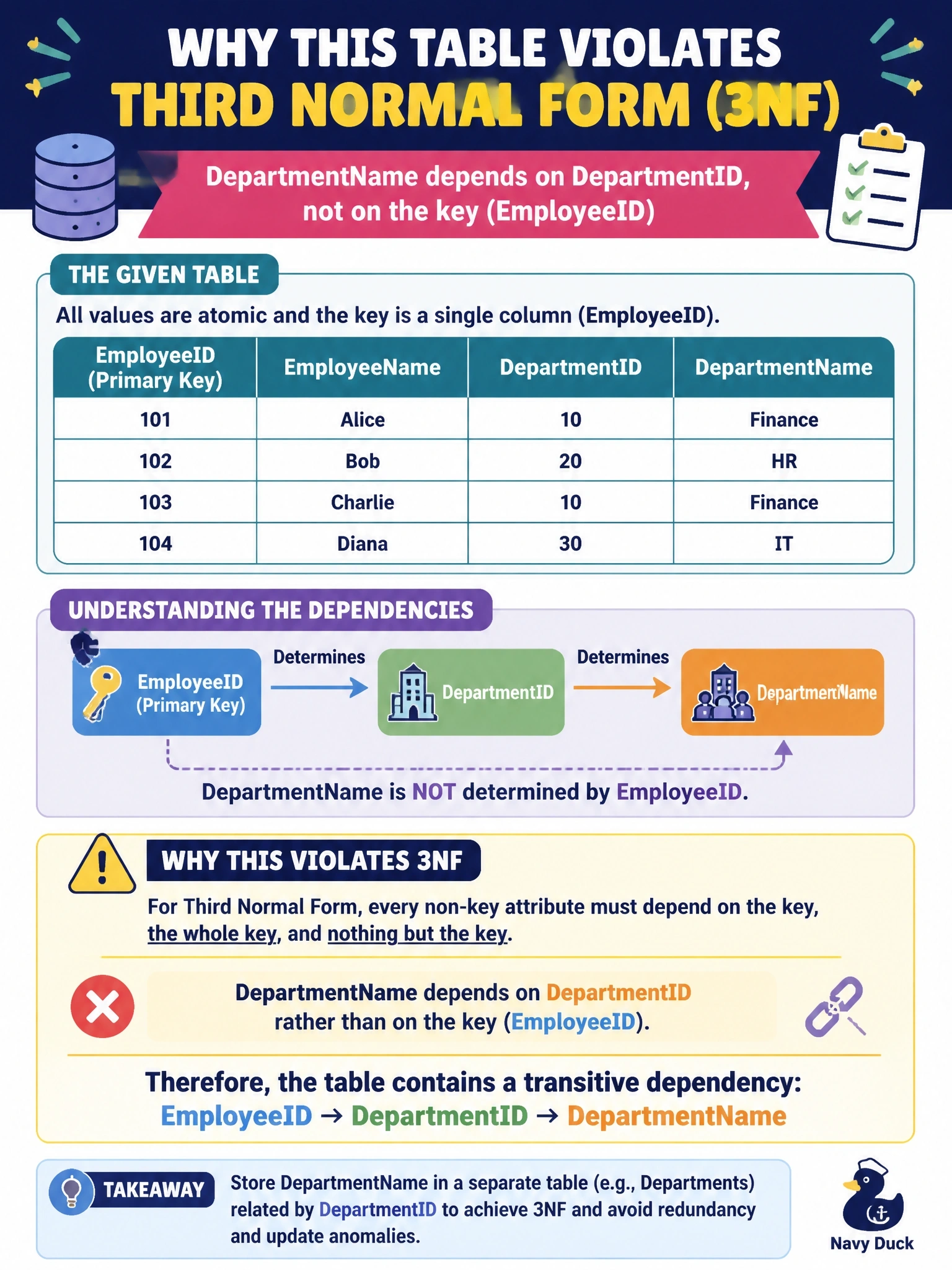
Short Explanation
Picture a chain you can follow: EmployeeID points to DepartmentID, and DepartmentID points to DepartmentName. That middleman link is a transitive dependency, and it's exactly what third normal form forbids. Don't get pulled toward 2NF; with a single-column key there's no 'part' of the key for anything to depend on.
Full Explanation
Third normal form requires that a table already be in second normal form and that no non-key column depend on another non-key column. Here EmployeeID determines DepartmentID, and DepartmentID determines DepartmentName, so DepartmentName depends on the key only transitively through a non-key attribute. That transitive dependency violates 3NF and produces the usual anomalies: renaming a department requires updating every employee row in it. The fix is to move DepartmentID and DepartmentName to a Departments table and keep only DepartmentID in Employees as a foreign key. First normal form concerns atomic values and the absence of repeating groups; a value repeating across rows is redundancy, not a 1NF violation, and the stem states every value is atomic. Second normal form concerns partial dependencies on part of a composite key; with a single-column primary key, partial dependency is impossible. Claiming the table is fully normalized because everything is ultimately determined by EmployeeID ignores that normalization cares about direct dependencies, not reachable ones. Exam caveat: a table that violates 3NF also fails stricter forms such as BCNF, but the first form broken is the one usually asked for. Operational check: list the functional dependencies for each table and flag any whose determinant is not a candidate key.