
A reporting session has been waiting for four minutes on a row that another session updated but has not yet committed. No error has been raised, and the waiting session resumes as soon as the other session commits. A colleague calls this a deadlock. Which statement is accurate?
Select an answer to reveal the explanation.
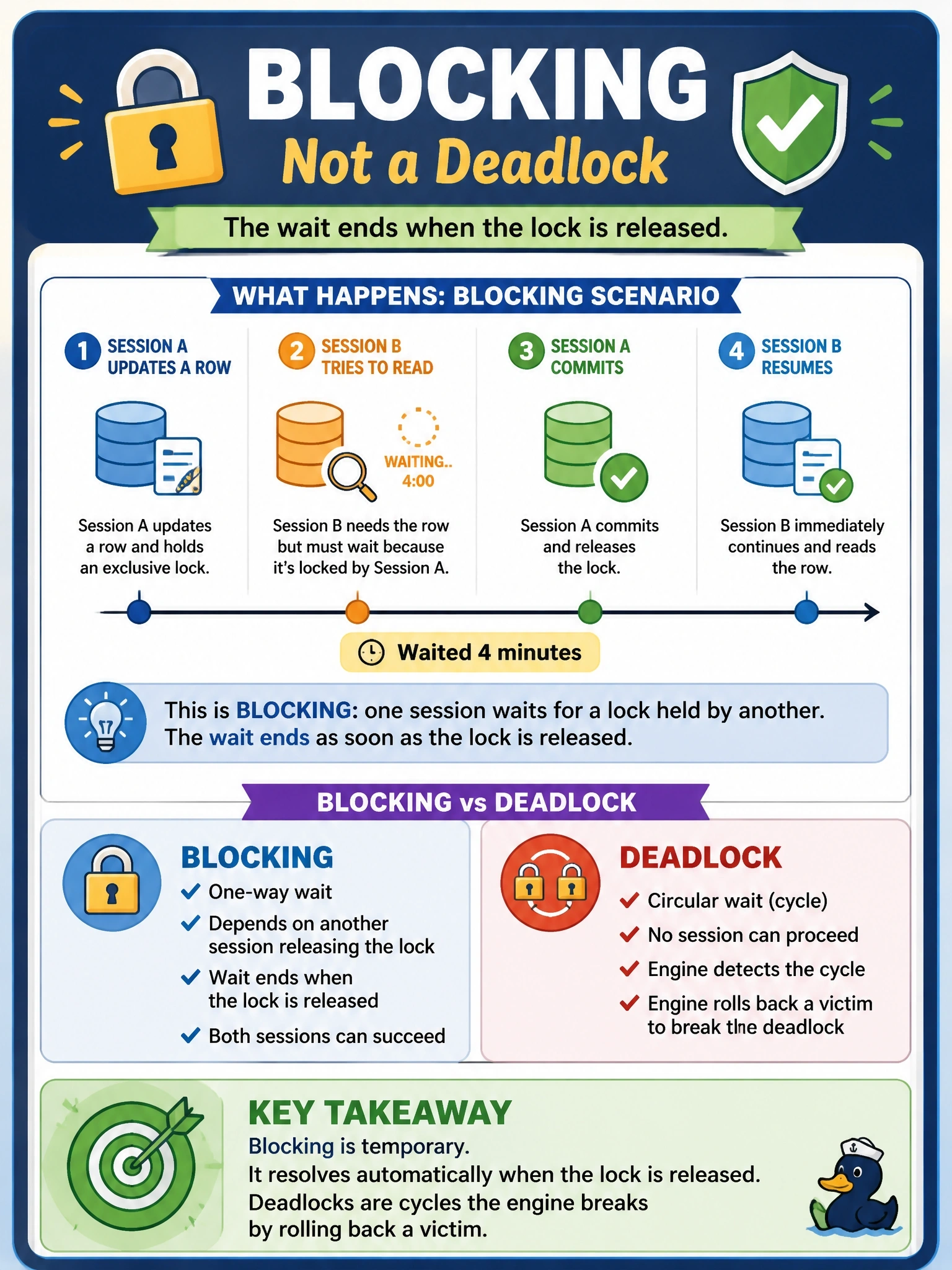
Short Explanation
Blocking is waiting in line behind someone at the ATM; annoying, but once they're done, it's your turn. A deadlock is two people each holding the other's card, and nobody moves until the bank steps in and cancels one of them. Your clue here is that the wait simply ended when the other session committed.
Full Explanation
Blocking occurs when one session holds a lock that another session needs; the second session waits until the first commits or rolls back, then proceeds. It can last a long time if the holding transaction stays open, but it resolves itself as soon as the lock is released, and no error is raised unless a lock timeout or command timeout is reached. A deadlock is different: two or more sessions each wait on locks held by the others, forming a cycle in which none can proceed. The engine detects the cycle and rolls back one participant, the deadlock victim, returning an error to that session. The scenario, a one-directional wait that ended when the holder committed, is blocking. Classifying any long wait as a deadlock is incorrect; duration is not the criterion, the presence of a cycle is. Saying a deadlock leaves both sessions waiting until an administrator intervenes describes the opposite of how engines behave, since deadlock detection resolves cycles automatically. Claiming blocking only occurs across databases is wrong; blocking most often happens between sessions working on the same tables in the same database. Exam caveat: long blocking chains and deadlocks are both monitored, but they have different fixes; blocking usually calls for shorter transactions or better indexing, deadlocks for consistent access order. Operational check: inspect current sessions and their wait resources, identify the head of the blocking chain, and review why its transaction remains open.