
A database server responds slowly. Monitoring shows moderate CPU use, but the operating system reports a high rate of paging to the page file or swap space, and available physical memory is near zero. What is the most likely problem?
Select an answer to reveal the explanation.
Short Explanation
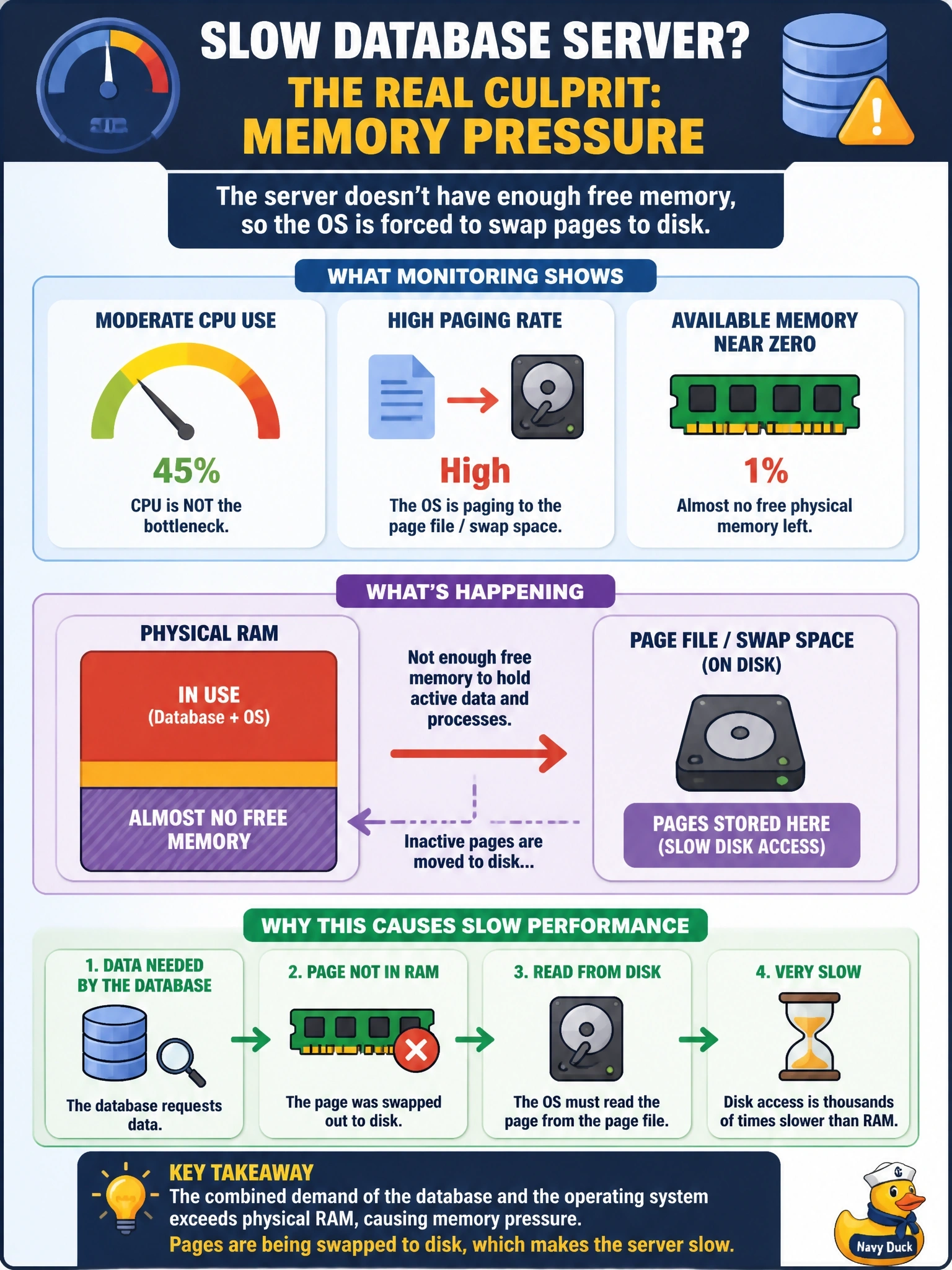
Paging is your server's way of saying the desk is too small, so it keeps shoving papers into a filing cabinet and pulling them back out. That shuffling is slow, and the clue is right there in the OS counters: heavy paging and no free memory. Don't chase CPU here; the numbers already told you it isn't busy.
Full Explanation
When processes need more memory than physical RAM can supply, the operating system moves memory pages to disk and reads them back on demand. Heavy paging, together with near-zero available memory, is the signature of memory pressure, and because disk access is far slower than RAM, database performance degrades sharply even though CPU use stays moderate. Common causes include a database memory cap set too high relative to the host, other services competing for RAM, or workload growth. CPU saturation would show processor utilization near its maximum and run queues building; the scenario explicitly reports moderate CPU, which rules this out as the primary bottleneck. Network saturation would appear as high interface utilization, dropped packets or retransmissions, and would affect transfer of results rather than producing OS-level paging. Index fragmentation can increase the number of pages a query must read, but it does not cause the operating system to swap memory to disk, and its effect would show up as higher database I/O rather than paging counters. Exam caveat: operating system performance is monitored separately from database metrics because OS-level problems such as paging can cripple a database whose internal counters look normal. Operational check: compare the database memory setting with total RAM, leave headroom for the OS and other processes, identify other memory consumers, and confirm paging drops after adjustment.