
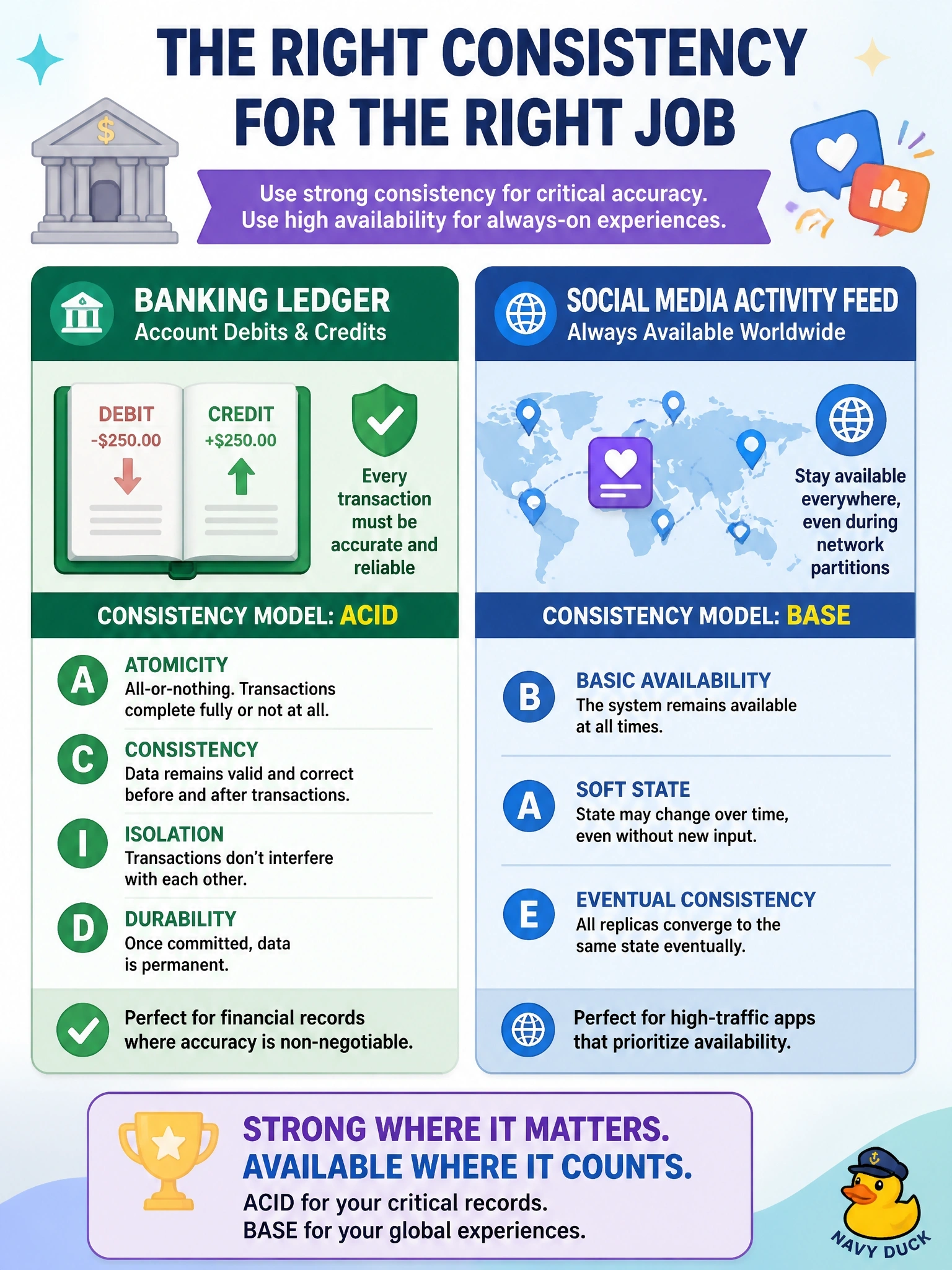
An architect is choosing data stores for two new services: a banking ledger that records account debits and credits, and a social media activity feed that must stay available worldwide even during network partitions. Which pairing of consistency models is most appropriate?
Select an answer to reveal the explanation.
Short Explanation
Money has to add up exactly, every time, so the ledger gets ACID. A feed that shows a like two seconds late hurts nobody, so it can trade strict consistency for availability with BASE. Flip them around and you've got a bank that loses pennies.
Full Explanation
The choice between ACID and BASE follows from what the data can tolerate. A banking ledger requires that each debit and credit be atomic, that balances always satisfy integrity rules, that concurrent transactions do not corrupt each other and that committed entries survive failures; any temporary inconsistency could allow overdrafts or lost funds. That is the ACID model. A social media activity feed values staying available everywhere, including during network partitions, and users accept that a new post or reaction may appear in some regions a moment later; eventual consistency under BASE fits. Reversing the pairing would risk inconsistent balances in the ledger while paying the coordination cost of strict transactions for a feed that does not need it. Choosing BASE for both because of global traffic ignores the ledger's correctness requirements, since traffic volume does not make inconsistency acceptable for money. Choosing ACID for both because data must be kept permanently confuses durability with the whole model; BASE systems also store data durably, and forcing strict consistency on the feed would sacrifice availability during partitions. Exam caveat: many modern platforms offer tunable consistency, so the decision may be per operation. Operational check: document each service's tolerance for stale reads and verify the chosen store meets it.