
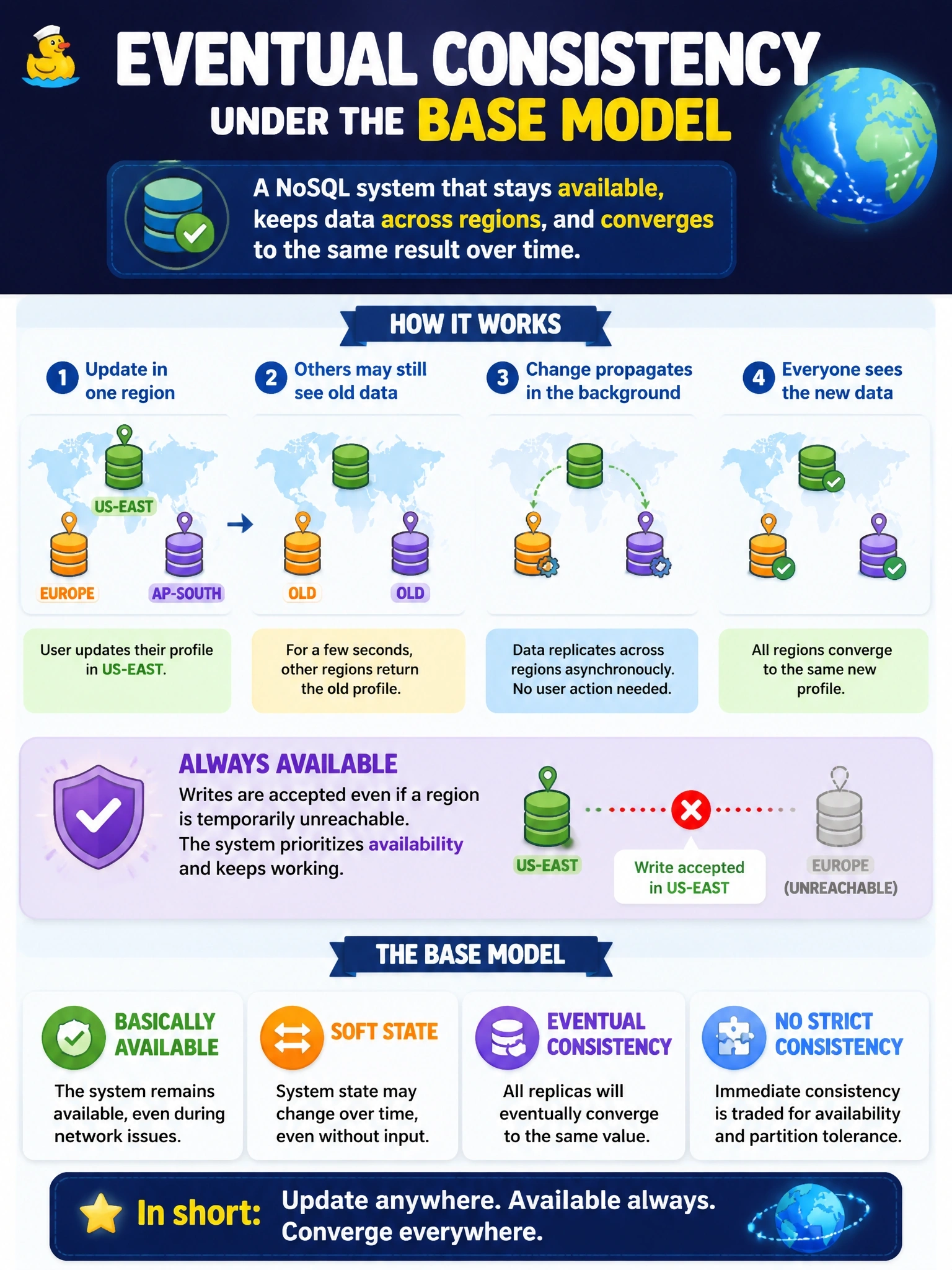
A user updates their profile on a globally distributed NoSQL store. For a few seconds, users reading from another region still see the old profile, and then everyone sees the new version. The system accepts writes even if a region is temporarily unreachable. Which consistency model does this behavior illustrate?
Select an answer to reveal the explanation.
Short Explanation
BASE trades instant agreement for always being open for business. Every region will agree eventually, but for a moment some readers see yesterday's news. That's eventual consistency, and you should treat it as a feature here, not a bug.
Full Explanation
BASE stands for basically available, soft state and eventual consistency, a model commonly adopted by distributed NoSQL systems. The system prioritizes availability and partition tolerance: writes are accepted locally even when other regions are unreachable, and updates propagate asynchronously. During propagation, replicas may return different values, which is the soft state, but in the absence of new writes all replicas converge to the same value, which is eventual consistency. The profile briefly appearing old in another region, then updating everywhere, is the defining symptom. Strong consistency under ACID would require every read after a committed write to return the new value, typically through synchronous coordination that may reject writes when regions cannot communicate, contradicting the stated behavior. Read-committed isolation describes visibility of concurrent transactions within a transactional system; it prevents dirty reads but does not describe cross-region replication lag. Snapshot isolation within one replica gives each transaction a consistent point-in-time view of that replica and does not explain different regions converging over time. Exam caveat: many distributed stores let applications choose stronger consistency per request at the cost of latency or availability. Operational check: measure replication lag between regions and confirm it stays within what the application can tolerate.