
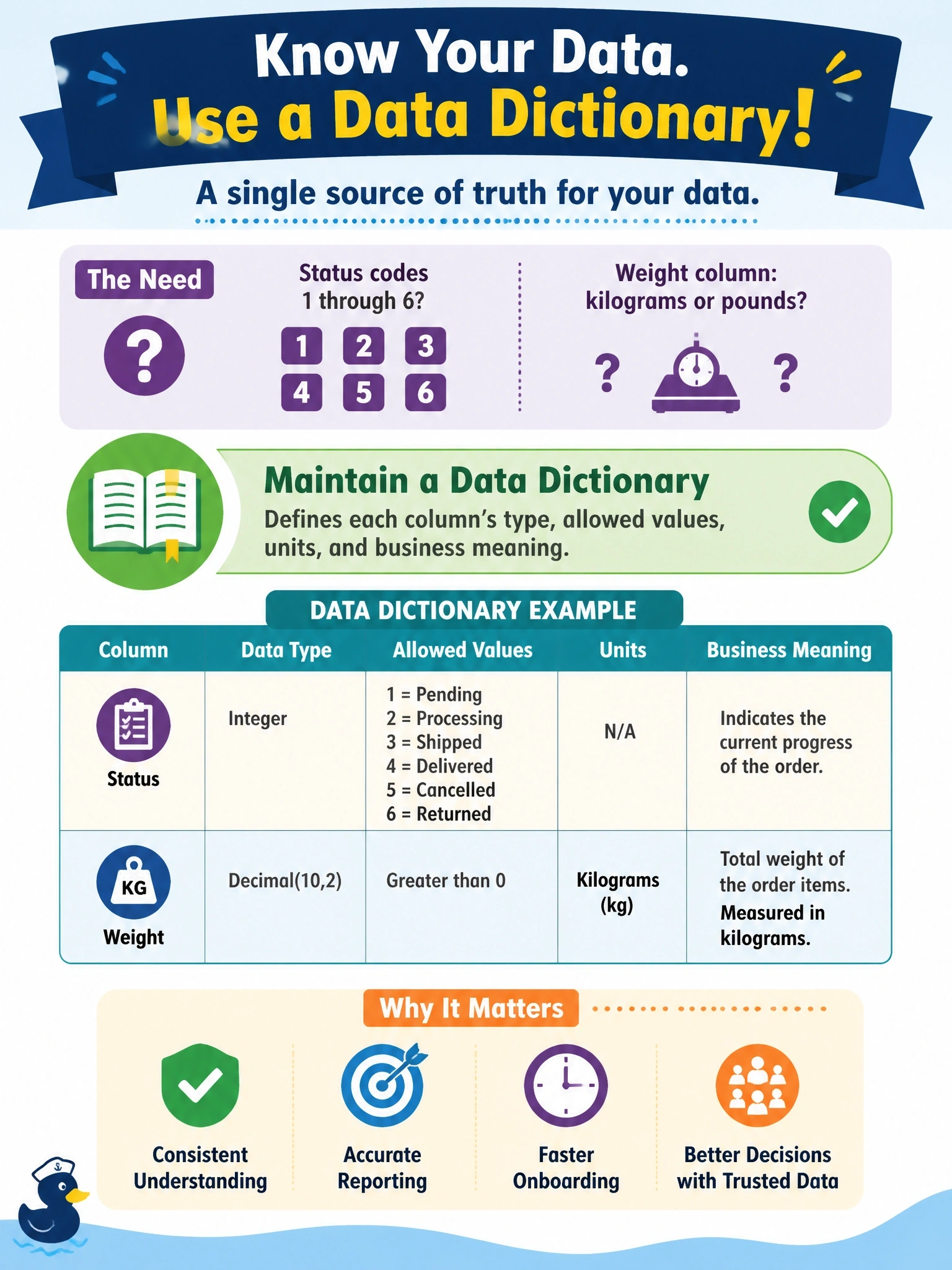
A newly hired developer cannot tell what the codes 1 through 6 in an order table's status column mean, or whether the weight column stores kilograms or pounds. Which design documentation should the team maintain to answer these questions?
Select an answer to reveal the explanation.
Short Explanation
A data dictionary is the legend on the map. Without it, a 3 in the status column could mean shipped, cancelled or anything else you'd care to guess. An ERD shows the roads between tables, but it won't tell you what the signs say.
Full Explanation
A data dictionary documents each table and column in business and technical terms: name, data type and length, nullability, default, allowed values or code lists, units of measure, ownership, source and a plain-language description. It is the reference that tells a developer that status 4 means shipped and that weight is stored in kilograms, preventing misinterpretation and inconsistent use in new code and reports. An entity relationship diagram shows entities, keys and relationships between tables; it is excellent for understanding structure but normally does not list code meanings or units for individual columns. A maintenance SOP describes how and when routine tasks such as index rebuilds are performed, which is operational guidance rather than a description of data content. An execution plan shows how the optimizer processes a specific query, including access methods and join order, and has nothing to say about what a stored value means. Exam caveat: lookup tables with descriptions can enforce code meanings in the schema itself, but the dictionary still documents units and intent. Operational check: confirm every column in the order table has a dictionary entry with type, allowed values and units, and make updating the dictionary part of the schema change process.