
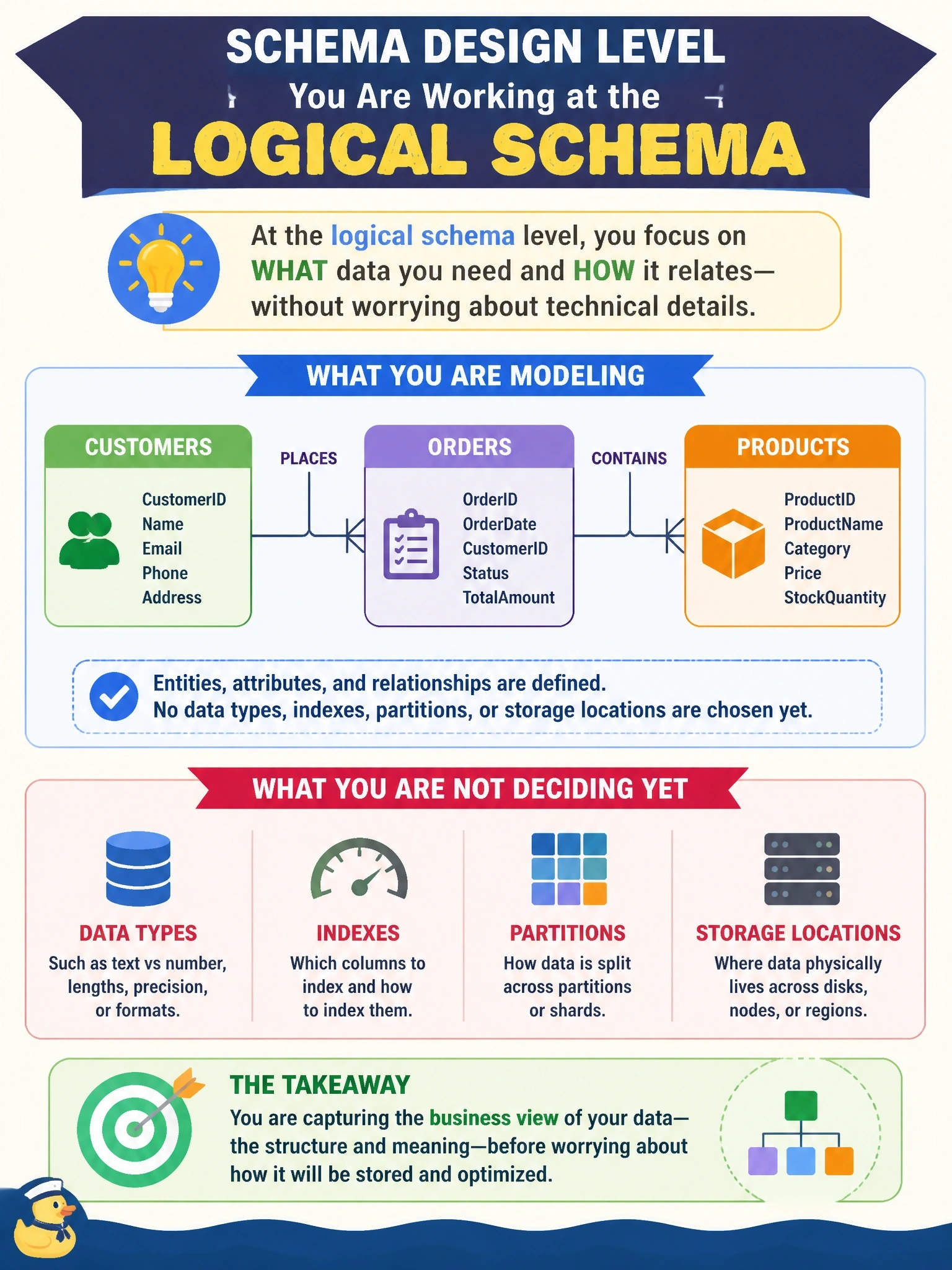
Early in a project, an architect is modeling customers, orders and products along with their attributes and relationships, but has not yet chosen data types, indexes, partitions or storage locations. At which level of schema design is the architect working?
Select an answer to reveal the explanation.
Short Explanation
Think of the logical schema as the floor plan and the physical schema as the construction drawings with pipe sizes and wiring. Right now you're watching someone still drawing rooms and doors. Data types and storage come later, in the physical design.
Full Explanation
Logical schema design describes the data independent of how a particular engine will store it: entities, their attributes, keys and the relationships and cardinalities between them, normally normalized to remove redundancy. It answers what data exists and how it relates. Physical schema design follows and translates that model into implementation details for a specific platform: data types and lengths, indexes, partitioning, file or tablespace placement, compression and storage parameters. Because the architect has deliberately not chosen types, indexes, partitions or storage, the work is logical. The physical schema is the next stage and is defined by precisely the decisions the stem says have not been made. A partitioning scheme is one physical design element that splits large tables across ranges or keys for manageability and performance; it presupposes tables and keys already exist. An execution plan is produced by the query optimizer at run time to show how a statement will be processed, which is an operational artifact rather than a design level. Exam caveat: some texts add a conceptual model above the logical one; the DataSys+ objectives name logical and physical. Operational check: review the model and confirm it contains entities, attributes, keys and relationships but no engine-specific types or storage settings.