
A team needs to install a custom-compiled extension into its database engine, which requires changing operating system packages and kernel settings on the host. It wants to run this in a public cloud. Which cloud service model fits?
Select an answer to reveal the explanation.
Short Explanation
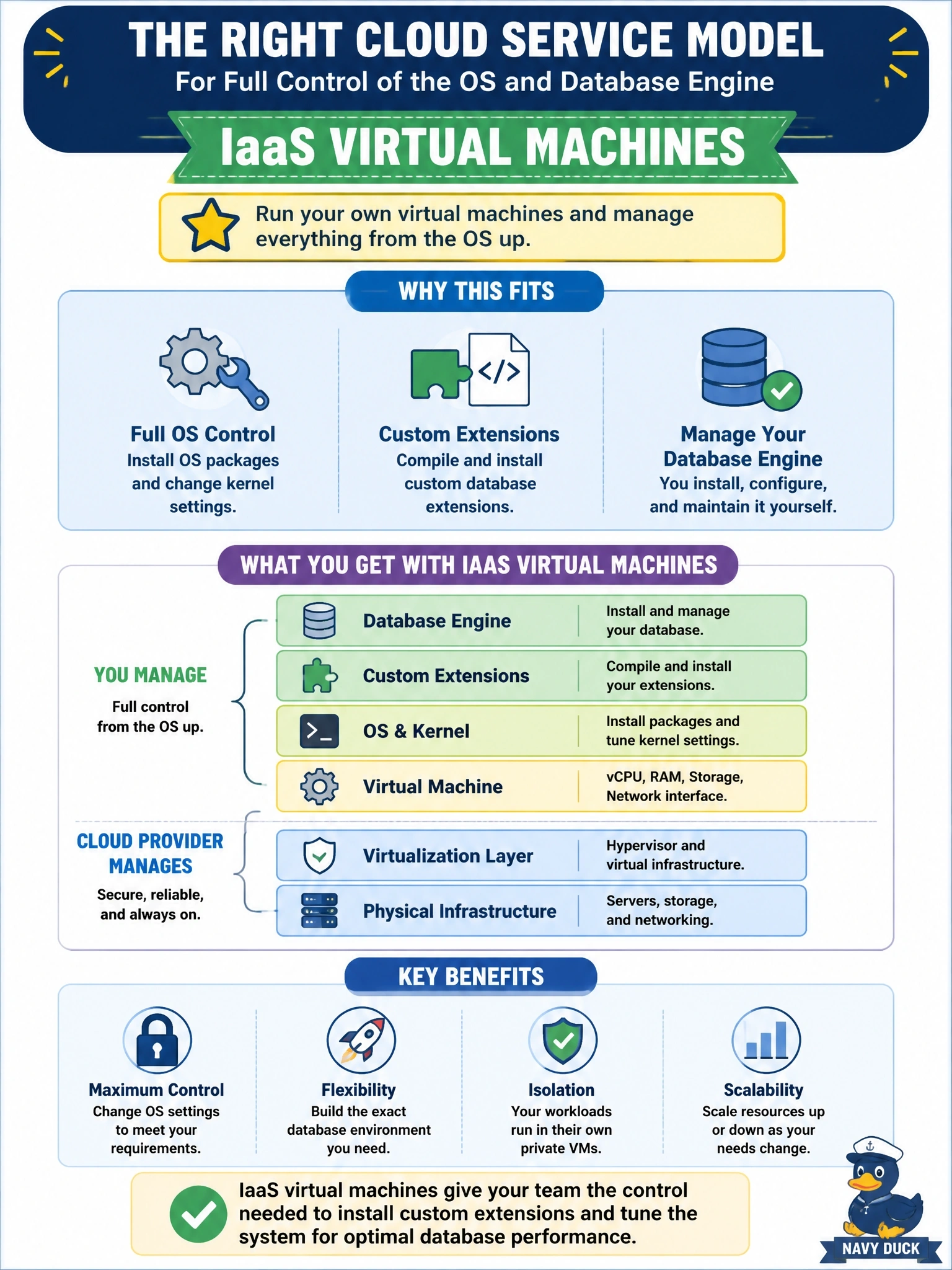
If you need the keys to the whole house, including the basement, you rent the house, not a hotel room. IaaS hands you the virtual machine and its operating system. Managed database services keep the OS and host to themselves.
Full Explanation
Cloud service models differ in where the provider's responsibility stops. With Infrastructure as a Service, the provider supplies virtualized compute, storage and networking, and the customer controls the operating system, installed packages, kernel settings and the database engine. That level of control is required to compile and load a custom extension that depends on OS changes. The trade-off is that the customer also owns patching, backups, high availability and monitoring for everything above the hypervisor. A DBaaS instance gives the customer a database endpoint while the provider manages the engine, host and patching; host-level OS changes are not permitted by design. A PaaS database service may allow a curated set of extensions, but the customer can enable only what the provider supports and cannot alter the underlying OS, so a custom-compiled extension with OS dependencies falls outside it. A SaaS application exposes business functionality and data access through the application; the vendor owns the underlying database entirely. Exam caveat: PaaS and DBaaS are often used interchangeably for managed databases, and both remove OS access. Operational check: confirm in the provider's shared responsibility documentation that the chosen model grants operating system administrative access before committing.