
Company policy requires that customer records remain in the company's own data center. Separately, the analytics team runs large quarterly models on anonymized aggregates and needs a burst of compute for a few days each quarter. Which hosting approach best fits both requirements?
Select an answer to reveal the explanation.
Short Explanation
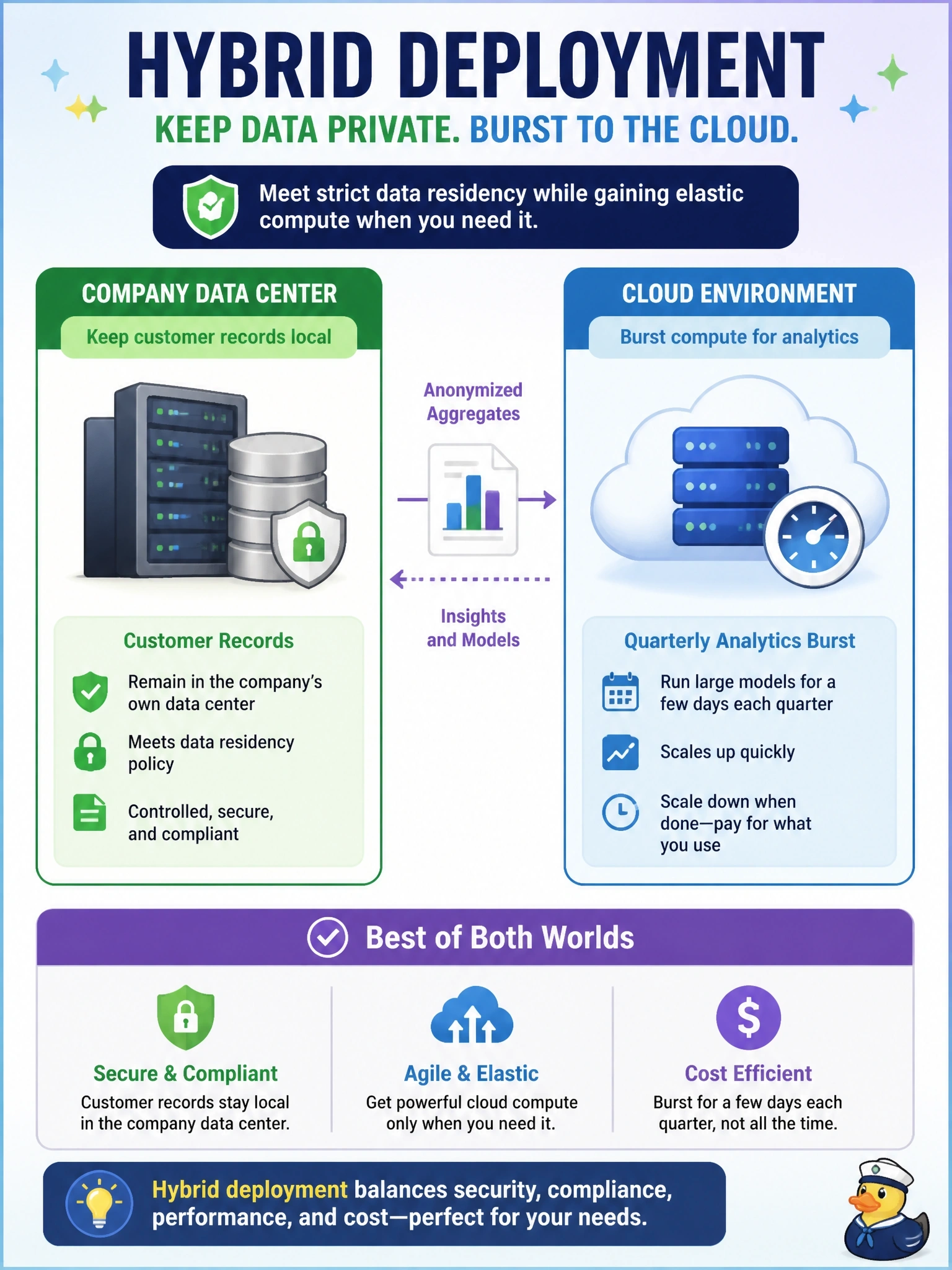
When one set of data has to stay home and another job wants to stretch its legs in the cloud, you don't have to pick just one. Hybrid lets you keep the sensitive records on site and rent compute only when you need it. The trap is going all-in on one side and breaking one of the requirements.
Full Explanation
A hybrid deployment combines on-premises infrastructure with cloud resources and lets each workload run where its constraints are met. The customer records stay in the company's data center to satisfy the residency policy, while the anonymized aggregates used for quarterly modeling can be moved to cloud compute that is provisioned for a few days and then released, avoiding the cost of owning peak capacity year-round. On-premises only satisfies the data location rule but forces the company to buy and maintain hardware for a burst that occurs a few days per quarter, leaving it idle the rest of the time. Cloud-based only provides elastic compute but would place the customer records outside the company's own data center, breaking the stated policy. Single-tenant colocation is still a fixed physical footprint in a third party's facility; it neither keeps the records in the company's own data center nor provides elastic burst compute. Exam caveat: hybrid adds integration, network and security design work, so it is chosen because the requirements genuinely split, not by default. Operational check: document which data sets may leave the data center, confirm only anonymized aggregates are transferred, and verify the cloud resources are deprovisioned after each quarterly run.