
A team plans to host a new OLTP order database, which performs thousands of small random writes per second, on a few high-capacity 7,200 RPM spinning disks because they offer the lowest cost per terabyte. What is the main concern with this storage specification?
Select an answer to reveal the explanation.
Short Explanation
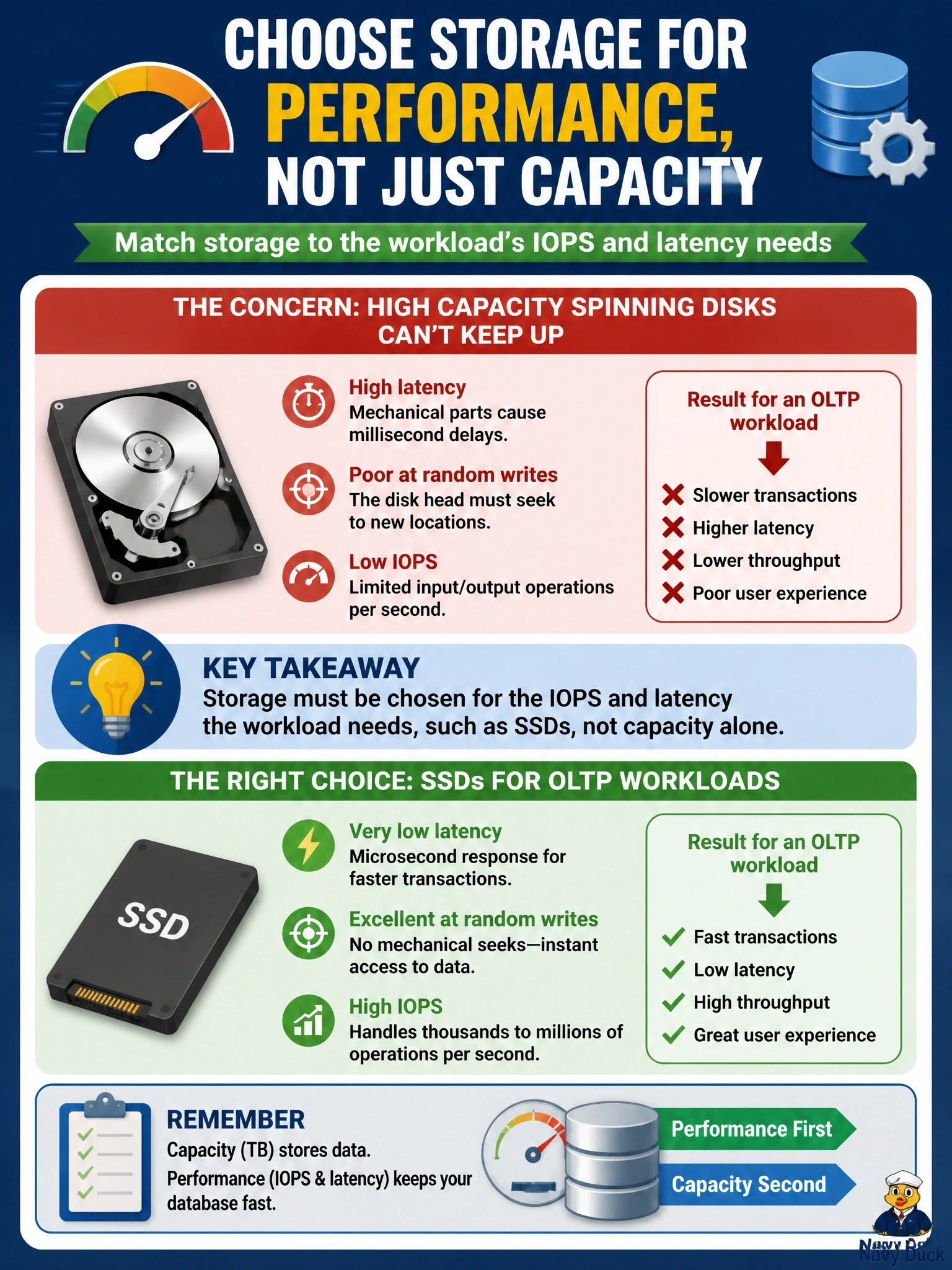
Buying big slow disks for OLTP is like widening a parking lot when the real problem is a single-lane entrance. Random writes care about how many operations per second the storage can do and how fast each one finishes. Buying more capacity won't fix that for you.
Full Explanation
Storage specifications cover size, speed and type, and for OLTP the speed dimension is decisive. Thousands of small random reads and writes per second depend on IOPS and per-operation latency; a spinning disk is limited by seek time and rotational latency, so each spindle delivers only a modest number of random operations regardless of capacity. Solid-state storage, or enough spindles in a suitable array, is chosen to meet the measured IOPS and latency targets, with capacity treated as a separate requirement. Assuming larger disks deliver proportionally more random IOPS is false: capacity scales with platter density, while random performance is bounded by mechanical movement. Tape is sequential-access archive media, entirely unsuitable for live database files that require random access. Raising the file system block size does not eliminate seek and rotation delays, and a mismatch with the database page size can make I/O less efficient. Exam caveat: a large data warehouse doing sequential scans may legitimately prioritize capacity and throughput, so the workload type drives the choice. Operational check: benchmark candidate storage with a random small-block mixed read and write profile representative of the workload, and confirm IOPS and latency meet targets at expected peak concurrency.