
A production database is 2 TB today and has grown at a steady 4 percent per month for the past two years. The new server must run for three years without a storage expansion. Which sizing approach should the planner use?
Select an answer to reveal the explanation.
Short Explanation
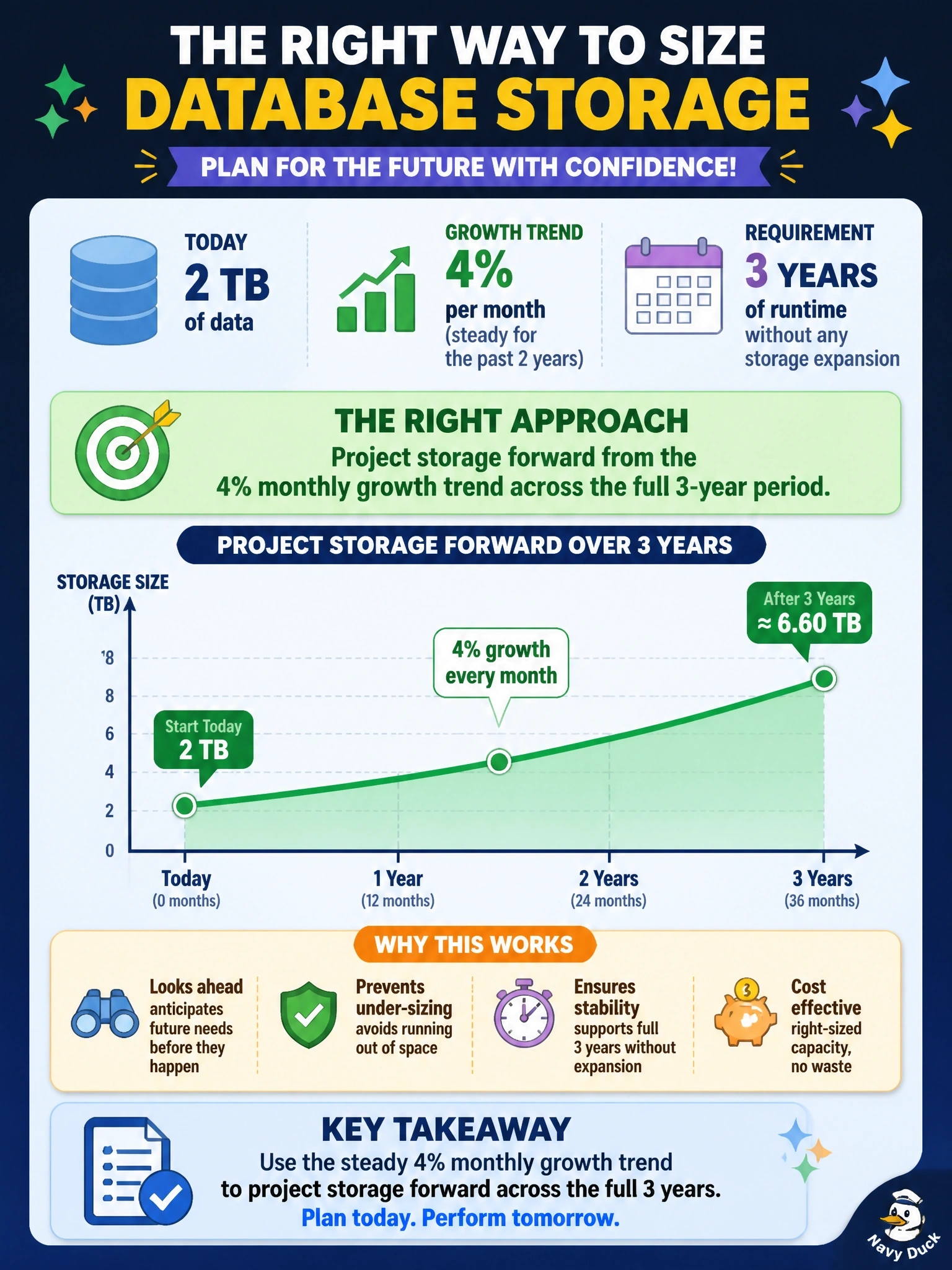
Sizing for today is like buying shoes for a toddler that need to fit for three years. Compounded 4 percent a month adds up fast, so you project the trend forward. The trap is applying the growth rate once instead of every month.
Full Explanation
Resource projection forecasts future capacity from observed usage trends so a system is sized for its planned service life rather than for the day it is installed. Here the database grows about 4 percent per month, so storage at the end of 36 months is roughly the current size compounded monthly; 1.04 raised to the 36th power is just over four, which puts the projection around 8 TB before adding index, log and free-space overhead. The planner then adds headroom for unexpected growth and validates the trend against business plans. A fixed 10 percent buffer on today's size would be exhausted within a few months at this growth rate, breaking the requirement to avoid expansion. Planning to add disks when space runs low contradicts the stated constraint and turns capacity planning into a reactive emergency. Applying the 4 percent once adds only about 80 GB, which treats a monthly rate as a one-time increase and badly underestimates compounded growth. Exam caveat: growth may not stay linear or exponential forever, so projections should be revisited as actual usage is monitored. Operational check: chart monthly database size against the projection curve and alert when actual growth runs meaningfully ahead of the forecast.