
A Java development team is adopting Ebean for a new order-management service, and a junior developer asks what the framework will actually do between the application's classes and the relational database. Which description of an object-relational mapper (ORM) is accurate?
Select an answer to reveal the explanation.
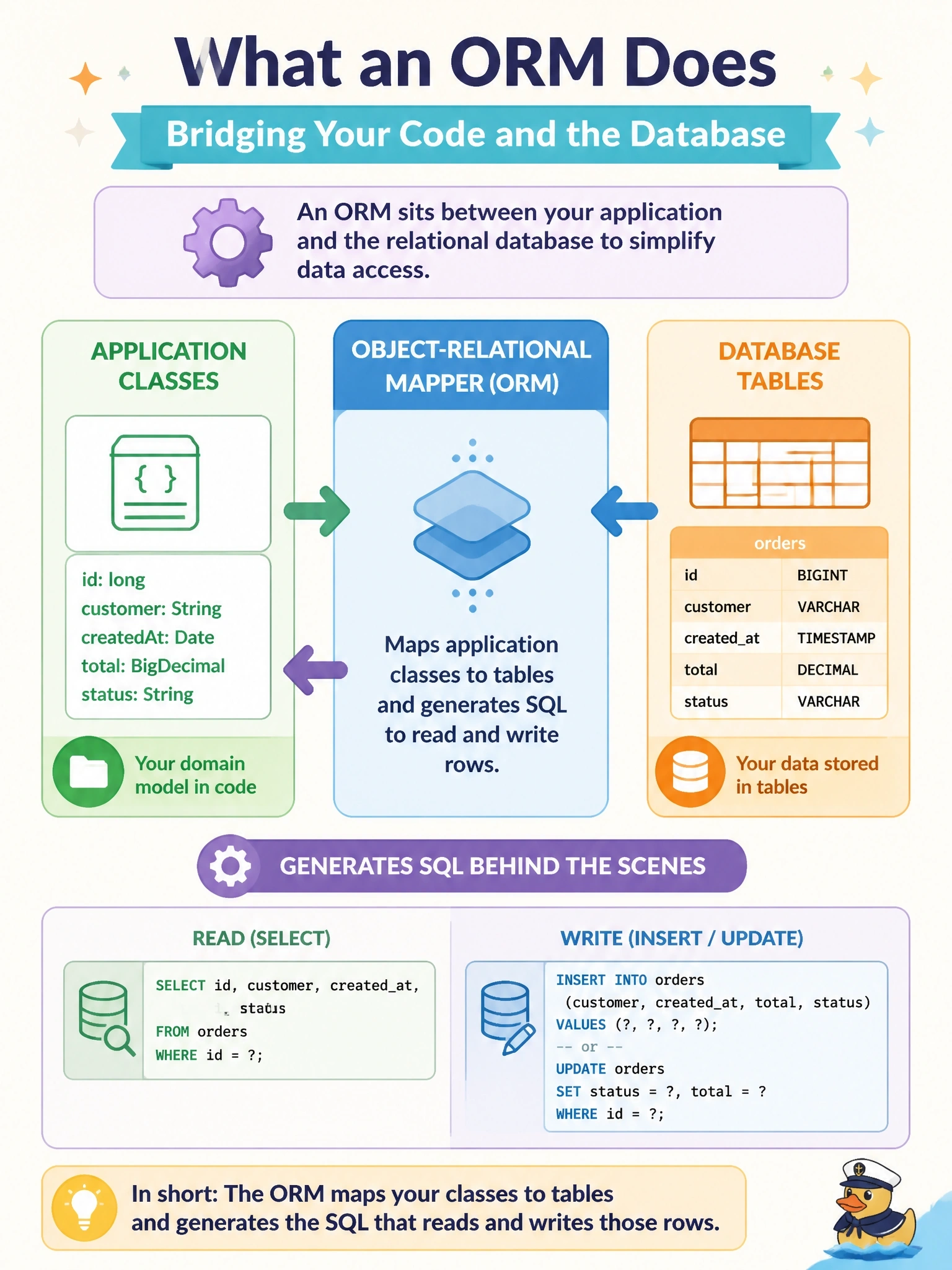
Short Explanation
Think of an ORM as a translator sitting between your objects and your tables. You work with classes like Order and Customer, and the ORM turns that into the INSERT, SELECT and UPDATE statements the database understands. The trap is thinking it changes how the database runs queries; the database still parses, optimizes and executes every statement it receives.
Full Explanation
An object-relational mapper such as Ebean, Hibernate, Entity Framework or SQLAlchemy maps classes and their properties to tables and columns, then generates SQL at run time when the application loads, saves or queries objects. The developer manipulates objects; the framework emits parameterized statements, tracks changes and converts result rows back into objects. That convenience is exactly why ORM usage matters for database performance: the SQL is produced by the framework, so its shape depends on mappings and fetch settings. Replicating objects into a document store describes a synchronization or caching layer, not an ORM; the ORM's target is the relational database itself. Compiling stored procedures into application bytecode is not something an ORM does; stored procedures stay in the database and an ORM can only call them. Replacing the optimizer is also wrong by concept, because the database engine still parses, plans and executes each statement and chooses indexes on its own. Exam caveat: dbt is listed alongside ORMs in the objectives but works as a SQL transformation framework, so read each scenario carefully. Operational check: enable the framework's SQL logging in a test environment and confirm which statements a given object operation produces.