
A data engineer builds lineage-tracked ETL into the vector store powering the clerk RAG assistant. Which role contribution is shown?
Select an answer to reveal the explanation.
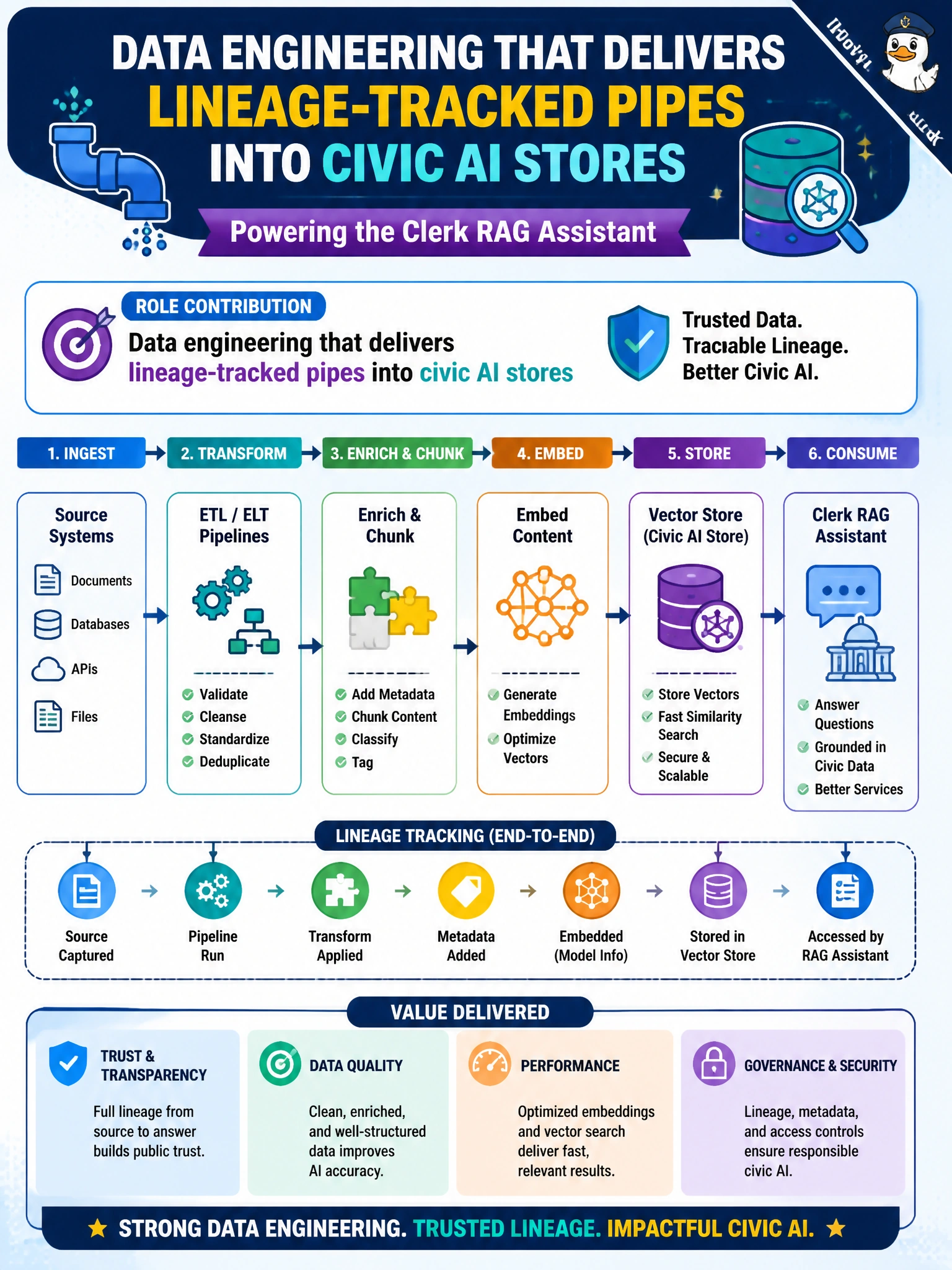
Short Explanation
You're seeing lineage-tracked ETL into the clerk RAG vector store — that's classic data-engineer work building trustworthy pipes, not training lineage-tracked embeddings or auditing lineage-tracked pipelines. You'll get it right when you focus on the build work, not maintaining lineage-tracked templates.
Full Explanation
Data engineering that delivers lineage-tracked pipes into civic AI stores is shown when a data engineer builds lineage-tracked ETL into the vector store powering the clerk RAG assistant. Lineage connects source records to transformed chunks/embeddings so municipal teams can explain what the assistant can retrieve, support takedowns/corrections, and investigate bad answers. That contribution works because RAG quality and safety depend on trustworthy pipelines—not only on the LLM—especially when clerk corpora include sensitive operational documents.
Data engineering that maintains lineage-tracked templates for civic AI stores fails as a task match; maintaining templates is upkeep of existing artifacts, not building lineage-tracked ETL into the vector store. Data engineering that trains lineage-tracked embeddings for civic AI stores fails by mapping a model-training function onto a pipeline-build task; training embeddings is model creation, not building the ETL pipes that load the store. Data engineering that audits lineage-tracked pipelines for civic AI stores fails by confusing an oversight/review function with building vector-store pipelines; auditing checks pipelines rather than delivering the ETL that loads the store.
Exam caveat: lineage that stops at “file landed in bucket” is incomplete for RAG; exams increasingly expect lineage through chunking/embedding versions that affect retrieval. Operational check: emit lineage metadata for each ETL stage into the clerk vector store, version embeddings with source pointers, test delete/correct propagations, and alert when untracked corpora are mounted into production retrieval indexes.
Prefer to study offline? Printable PDF study book + test engine ($7.50, unofficial). These questions stay free here.