
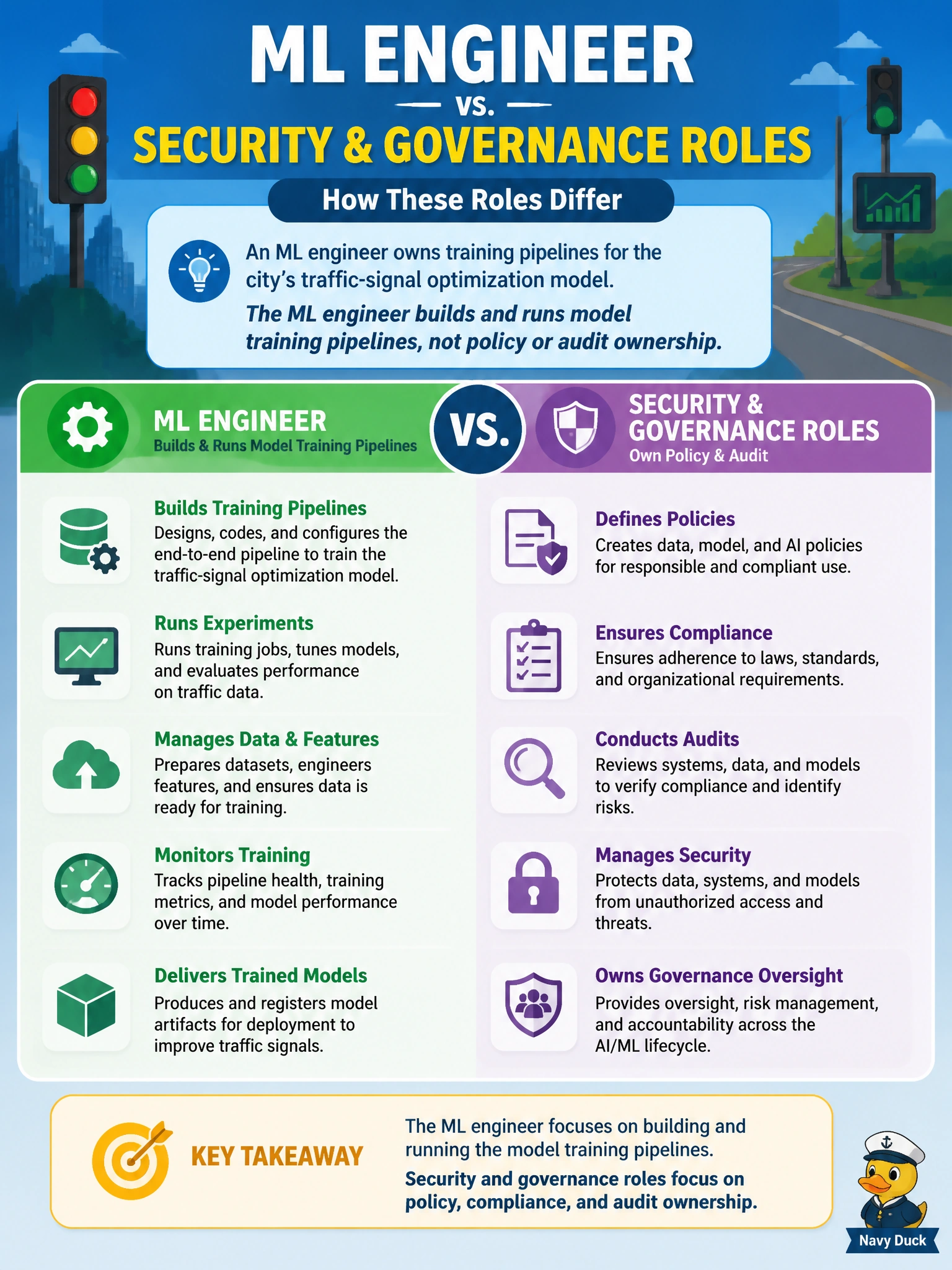
An ML engineer owns training pipelines for the city’s traffic-signal optimization model. How does this role differ from security or governance roles?
Select an answer to reveal the explanation.
Short Explanation
Traffic-signal training pipelines are ML-engineer work — you build and run the model path. Setting risk tolerance and authorizing releases, conducting independent audits and attesting controls, or owning incident response and directing forensics is work you'll find in governance, audit and security teams, not pipeline ownership.
Full Explanation
The ML engineer builds and runs model training pipelines, not policy or audit ownership—that is how the role differs when owning training pipelines for the city’s traffic-signal optimization model. ML engineers implement data ingestion into training, experiment tracking, training compute, evaluation wiring, and promotion handoffs to MLOps. For traffic-signal optimization, that means reliable, reproducible model engineering under platform constraints, not setting model risk tolerance and authorizing production release policy decisions or conducting independent compliance audits and attesting control effectiveness inside training pipelines.
The claim that the ML engineer sets model risk tolerance and authorizes production release policy decisions fails because setting risk tolerance and authorizing production releases are governance and policy ownership functions, not pipeline engineering duties. The claim that the ML engineer conducts independent compliance audits and attests control effectiveness fails because independent compliance audits and attestation are independent audit functions performed by compliance/audit, not engineering tasks embedded in model training pipelines. The claim that the ML engineer owns incident response coordination and directs forensic investigation efforts fails because coordinating incident response and directing forensics are incident response responsibilities triggered by security events, not training pipeline ownership.
Exam caveat: in small municipal teams people wear multiple hats, but exam answers still map primary accountability; pipeline ownership ≠ setting risk tolerance and release policy decisions ≠ independent audits and attestation ≠ incident response coordination and forensics direction. Operational check: document RACI for the traffic-signal model (ML engineer: train/eval pipelines; governance: model risk tolerance, production release policy decisions; audit/compliance: independent audits, control attestation; security operations: incident response coordination, forensic investigation), and ensure training environments cannot silently become production without MLOps/security gates.
Prefer to study offline? Printable PDF study book + test engine ($7.50, unofficial). These questions stay free here.