
An AI architect designs the reference pattern for department RAG assistants on the city’s cloud. What role is primarily demonstrated?
Select an answer to reveal the explanation.
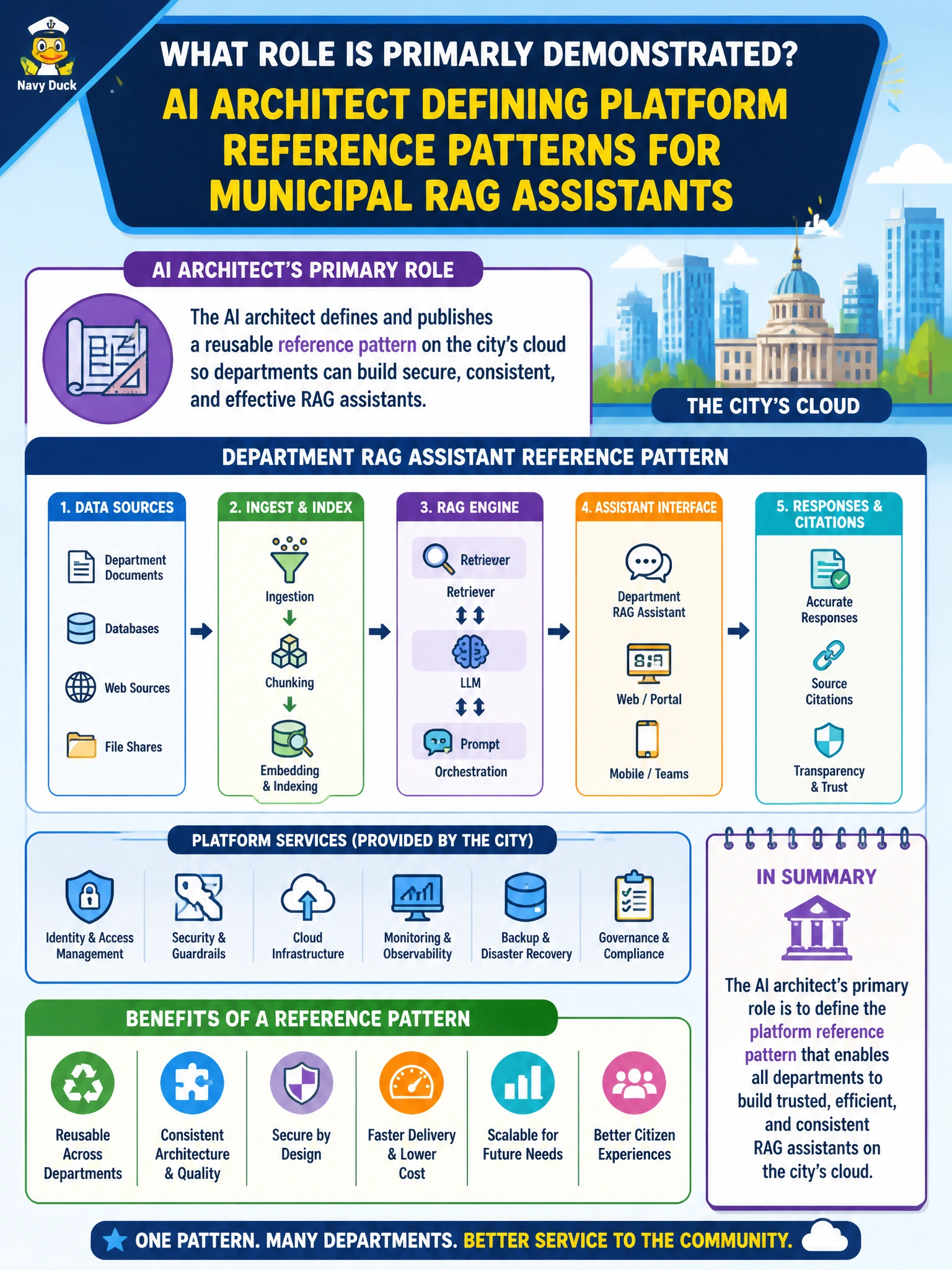
Short Explanation
Somebody has to draw the shared blueprint for department RAG bots on city cloud — that's the AI architect. You're not building ingestion pipelines, customizing one department's deployment, or monitoring live assistants for drift — you're defining the reusable reference pattern they'll all inherit. It's about the city-wide blueprint, not the hands-on build or operate tasks.
Full Explanation
An AI architect defining platform reference patterns for municipal RAG assistants demonstrates the architecture role: producing reusable designs for retrieval, identity, logging, isolation, and integration so departments do not each invent incompatible assistants on the city's cloud. The role works because reference patterns encode security and operability defaults—tenant boundaries, data access patterns, evaluation hooks—into a shared blueprint that speeds safe delivery across agencies while preserving consistency. An AI architect building data ingestion pipelines for municipal RAG assistants fails as a match because that is hands-on implementation work to move and prepare data, not the platform architecture work of defining the reusable reference pattern for retrieval, identity, logging, isolation, and integration. An AI architect customizing department RAG deployments for municipal assistants fails as a match—tailoring one department's stack is delivery customization, not defining the reusable city-wide reference pattern that all departments inherit. An AI architect monitoring live RAG assistants for municipal performance drift fails because that is ongoing operational observability for drift and performance, not the designer work of producing the RAG hosting reference pattern itself. Exam caveat: questions often keep the AI architect title constant and test whether you can separate defining the platform reference pattern and guardrails from doing hands-on work like building ingestion pipelines, customizing department deployments, or monitoring live assistants for performance drift—defining the shared blueprint is the demonstrated role here. Operational check: publish the municipal RAG reference architecture (authn/z, corpus controls, redact-before-embed, observability), require department builds to inherit it, and distinguish pattern definition from building ingestion pipelines, customizing single-department deployments, or monitoring live drift—verify new assistants reuse the approved blueprint.
Prefer to study offline? Printable PDF study book + test engine ($7.50, unofficial). These questions stay free here.