
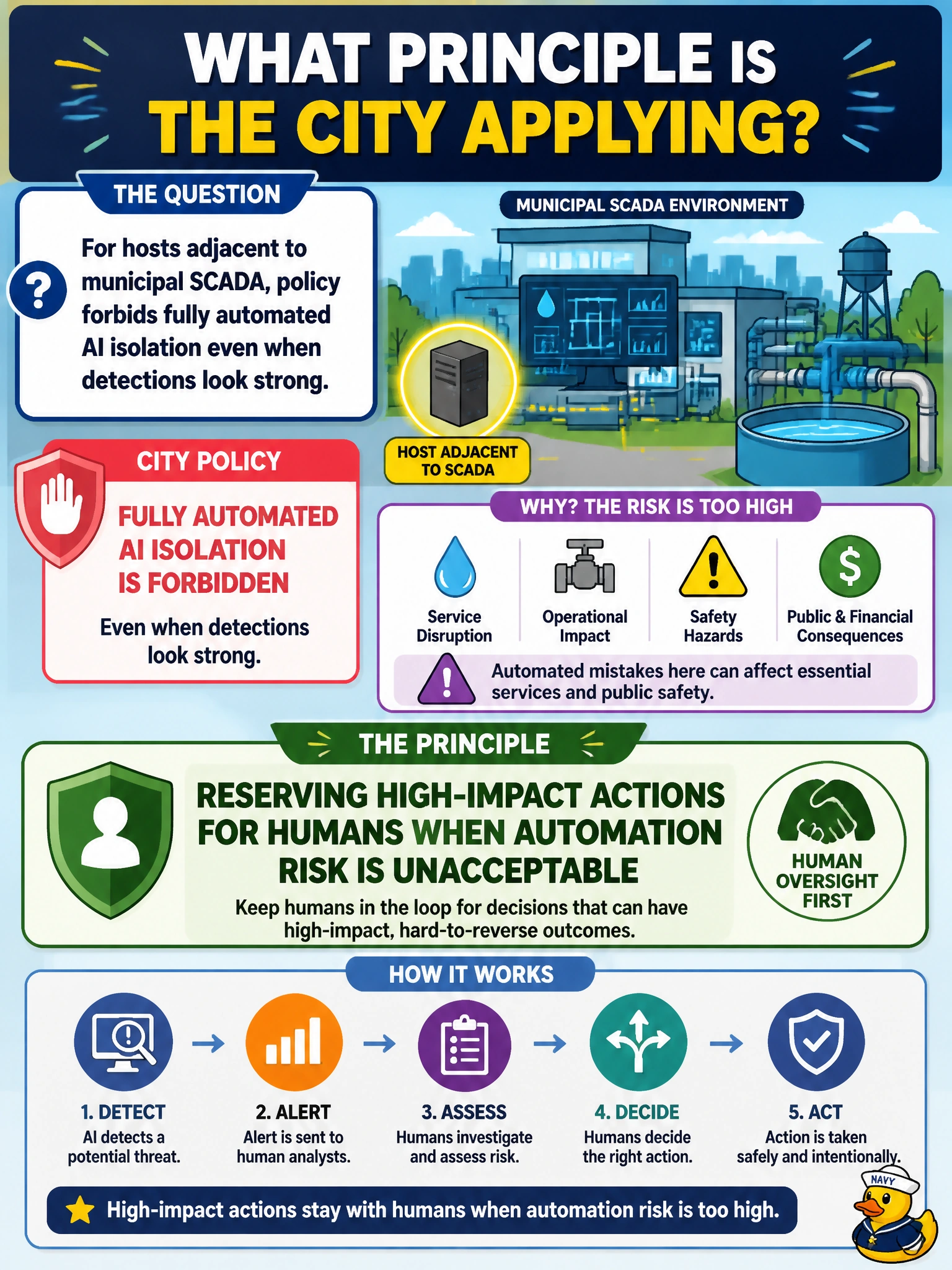
For hosts adjacent to municipal SCADA, policy forbids fully automated AI isolation even when detections look strong. What principle is the city applying?
Select an answer to reveal the explanation.
Short Explanation
Near SCADA, even a confident AI does not yank hosts offline alone — some buttons stay human. Keeping your approval only for low-impact alerts when you've got capacity or handing isolation to owners only when impact is low still misses the point — you'll need humans for the high-impact SCADA-adjacent calls where risk is unacceptable. Just bumping routine telemetry reviews to operators when costs rise doesn't help because you'll still lack required human approval before that high-impact isolation happens.
Full Explanation
Reserving high-impact actions for humans when automation risk is unacceptable is the principle behind forbidding fully automated AI isolation on hosts adjacent to municipal SCADA—even when detections look strong. Isolation can stop lateral movement, but near industrial control or plant-adjacent networks it can also interrupt processes that affect water, power, or other civic operations. Policy that keeps a human in the decision loop works because false positives, incomplete asset context, and fragile OT/IT boundaries make unsupervised automation a availability and safety risk, not merely a convenience tradeoff.
Retaining human approval for low-impact alerts when analyst capacity allows fails because the policy mandates human authorization for high-impact SCADA-adjacent isolation unconditionally, not human review of low-impact alerts only when staffing permits. Escalating routine telemetry reviews to operators when containment costs increase fails because routine review is not the high-impact action requiring control, and cost-triggered escalation does not provide required human authorization before isolation near SCADA. Assigning final isolation authority to asset owners when operational impact is low fails because the principle reserves human authority precisely for cases where operational impact is high and automation risk is unacceptable, not only for low-impact cases where isolation is safer.
Exam caveat: “adjacent to SCADA” must be defined with accurate asset inventory; misclassified hosts can either over-block useful automation or under-protect true plant-connected systems. Operational check: maintain a high-impact action allowlist, require dual authorization for isolation near SCADA, validate detections with network/asset context before action, and rehearse joint IT/OT response so humans can act quickly without defaulting to unsupervised AI isolation.
Prefer to study offline? Printable PDF study book + test engine ($7.50, unofficial). These questions stay free here.