
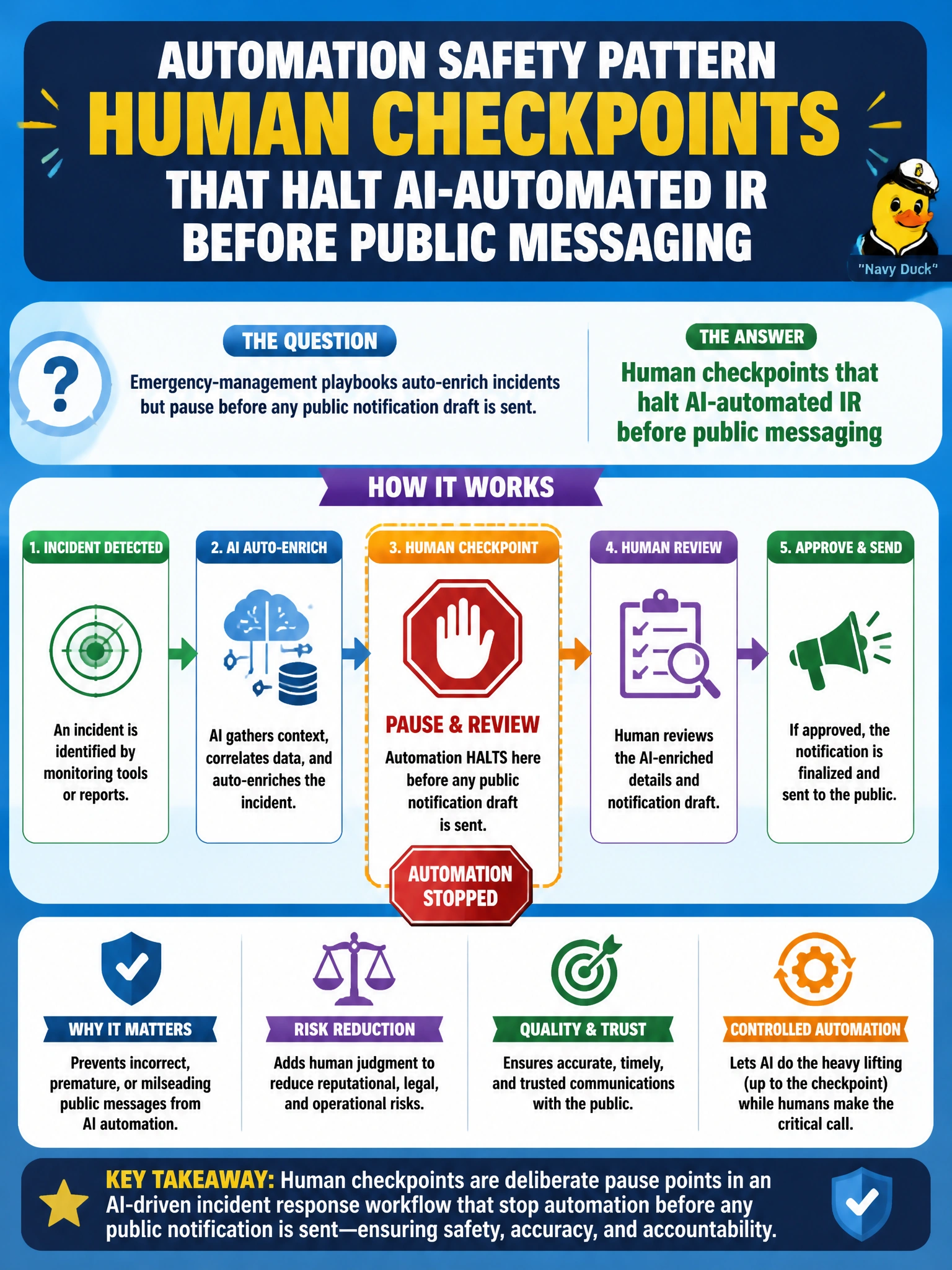
Emergency-management playbooks auto-enrich incidents but pause before any public notification draft is sent. What automation safety pattern is shown?
Select an answer to reveal the explanation.
Short Explanation
Enrich away, but stop before the city speaks in public — that pause is the human checkpoint. You'll miss it with audit trails or rate limits — logs just record after it's sent and throttling still lets a bad notice go out without a human okay. You'll miss it with sandbox tests too — they're lab checks, not a live block before sending.
Full Explanation
Human checkpoints that halt AI-automated IR before public messaging show a safety pattern for emergency-management playbooks: automate enrichment and internal ticket work freely, but pause before any resident-facing notification draft is sent. That works because enrichment is internal and reversible, whereas public notices create irreversible civic communication—rumors, legal commitments, and trust effects—if wrong. Keeping a human (often on-call leadership or PIO-aligned authority) in the loop for outbound messaging preserves accuracy, tone, and authorization while still gaining AI speed on triage prep.
Audit trails that log AI-automated IR around public messaging are not the safety pattern in question; they record actions for review without halting, since the playbook is meant to let enrichment run automatically and only pause before public messaging. Rate limits that throttle AI-automated IR during public messaging are wrong because throttling only slows send volume and cannot prevent an inaccurate or unauthorized notice that has already created civic impact. Sandbox tests that vet AI-automated IR before public messaging target the wrong control point; they validate logic in a test environment while leaving the actual risk — an unapproved public notification draft going out — ungated in live operation.
Exam cavection: a “draft waiting” state must be technically enforced (no send credential in the automation identity), not only written in a runbook that busy responders might skip. Operational check: separate enrich-bot permissions from public-post credentials, require named human send approval with message hash logging, and tabletop a phishing or outage scenario to confirm enrichment proceeds while outbound notices remain blocked until approved.
Prefer to study offline? Printable PDF study book + test engine ($7.50, unofficial). These questions stay free here.