
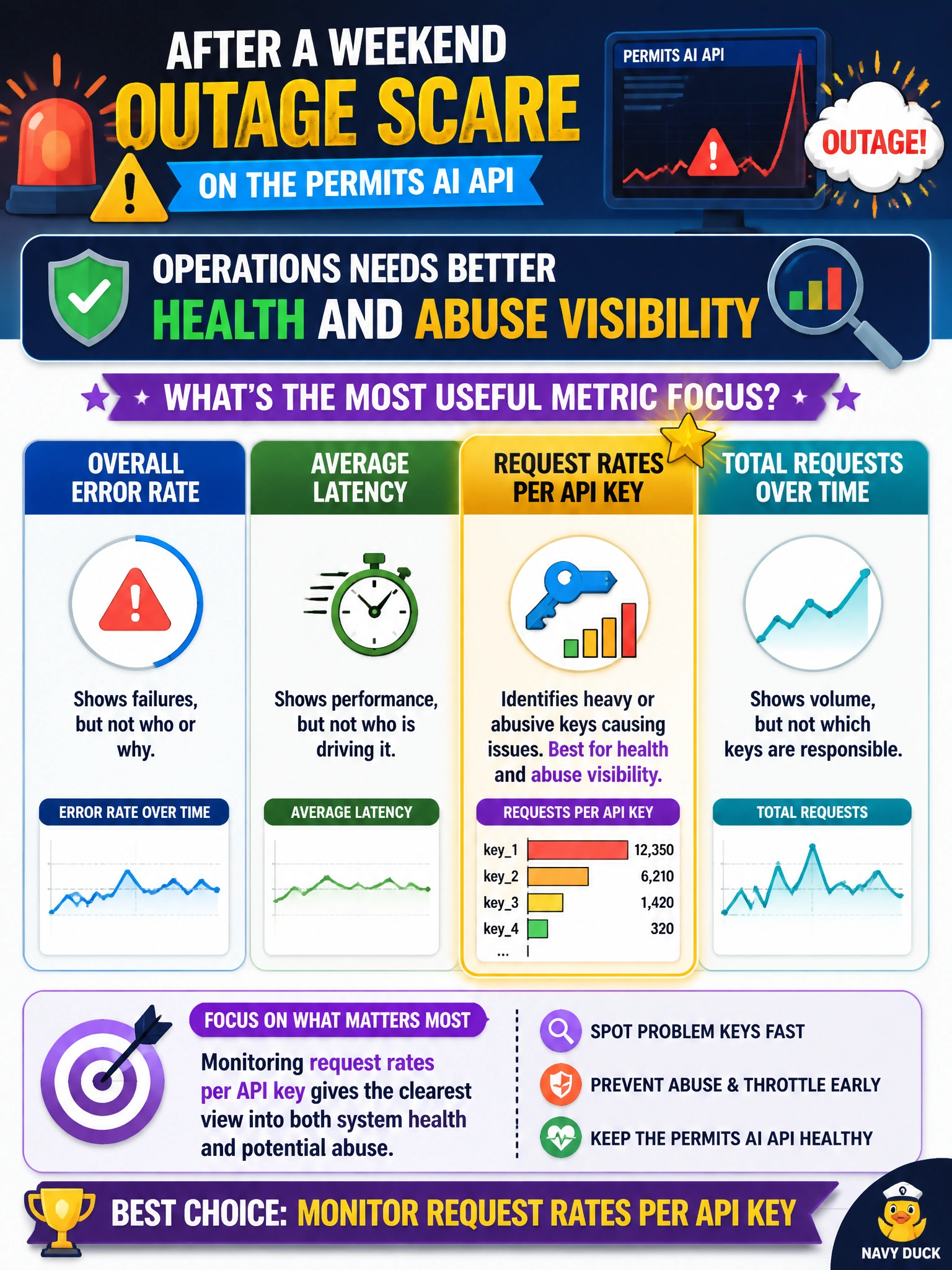
After a weekend outage scare on the permits AI API, operations needs better health and abuse visibility. Which metric focus is most useful?
Select an answer to reveal the explanation.
Short Explanation
Traffic per key tells you who is hammering the door. Watching request rates on the permits AI API spots health and abuse problems after that weekend scare. Latency per key, errors per key, and cache hits won't show you who's driving the surge.
Full Explanation
After a weekend outage scare on the permits AI API, monitoring request rates per API key is the most useful health and abuse metric focus. Per-key rates reveal which consumers are driving load, which keys are malfunctioning in retry loops, and which credentials may be stolen or shared in scrapers. Sudden spikes, sustained saturation, or asymmetric traffic from a single key give operations actionable signal for throttling, key rotation, and capacity response—exactly the visibility needed after an availability scare. For a city permits service, API keys map to departments, vendors, or public apps, so rate telemetry also supports fair-use and accountability.
Monitoring response latency per API key for the permits AI service fails attribution of abuse: per-key latency shows which consumers experience slowness but does not show which keys are driving spikes, hammering the API, or sharing credentials. Monitoring error counts per API key for the permits AI service fails as the primary abuse metric: per-key errors reveal failing callers, but successful scraping or hammering traffic that returns successes does not elevate errors and does not show which keys are driving load. Monitoring cache hit ratios per API key for the permits AI service fails abuse visibility: cache efficiency shows optimization opportunities but does not show which keys are driving load, hammering the API, or sharing credentials.
Exam caveat: Request-rate monitoring complements latency and cost meters; rate alone does not diagnose every failure mode. Also distinguish soft rate limits (throttle) from detection (observe and alert)—both are useful after an outage scare. Stolen keys may look like "legitimate" traffic until baselines and anomaly detection are applied.
Operational check: Enable per-API-key request-rate dashboards and alerts for the permits AI service; baseline normal departmental usage; alert on sudden spikes or retry storms; pair with automated throttling and key rotation runbooks; and prioritize per-key request rates over cache hit ratios per API key for the permits AI service, which do not reveal API abuse or per-key health.
Prefer to study offline? Printable PDF study book + test engine ($7.50, unofficial). These questions stay free here.