
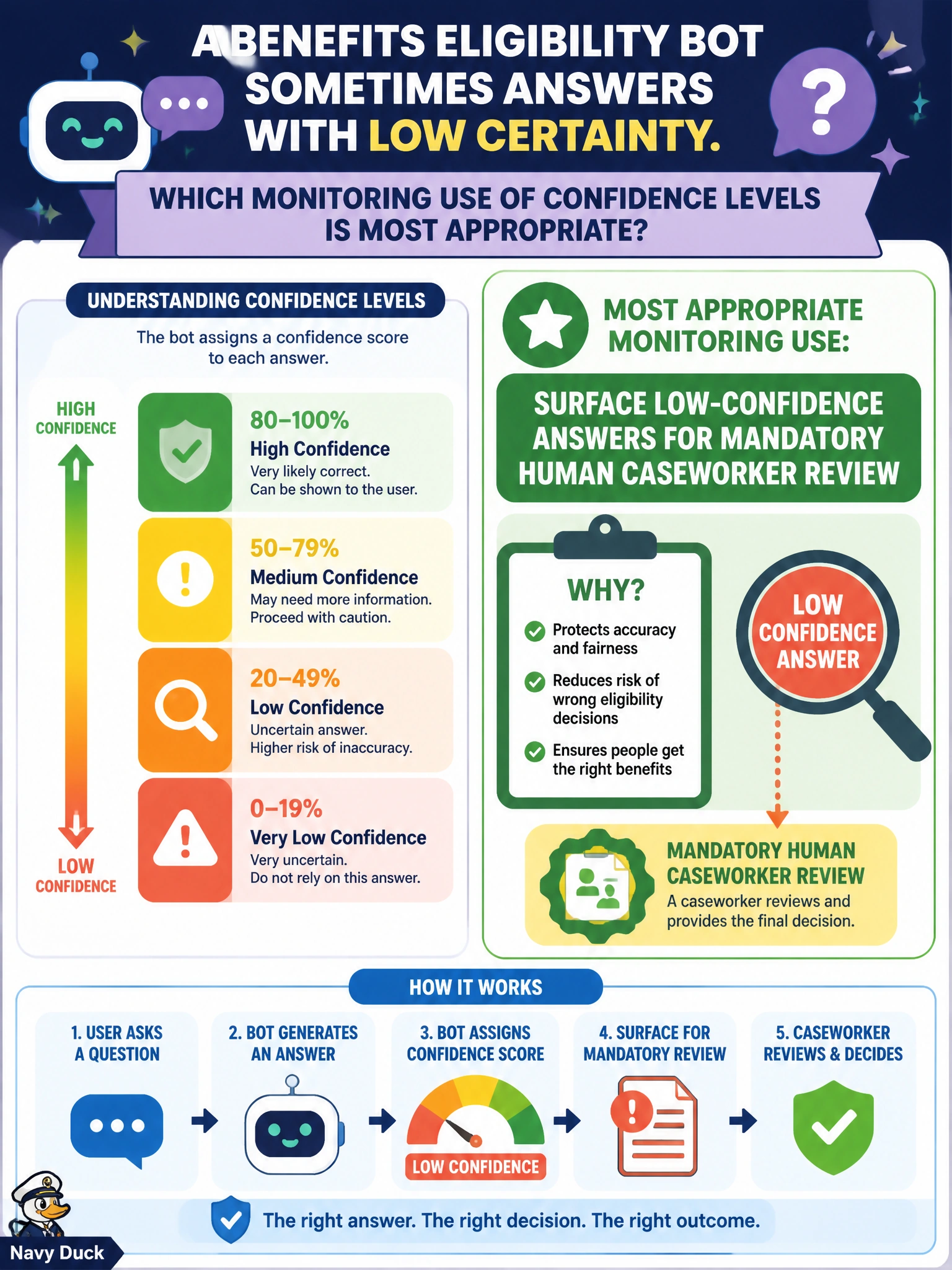
A benefits eligibility bot sometimes answers with low certainty. Which monitoring use of confidence levels is most appropriate?
Select an answer to reveal the explanation.
Short Explanation
When the bot shrugs, you'll need a human checking it every time — reviewing only answers it's sure about leaves the risky ones untouched, and waiting for a periodic audit or a retraining review lets bad calls reach people. If you let shaky answers slide until later, you'll turn mistakes into policies.
Full Explanation
For a municipal benefits eligibility bot, the most appropriate monitoring use of confidence levels is to surface low-confidence answers for mandatory human caseworker review. Confidence is an operational signal that the model's recommendation is uncertain relative to its training and retrieval context; in high-impact civic decisions about benefits, that uncertainty should trigger oversight rather than silent automation. Routing shaky answers into a caseworker queue converts a metric into a control: residents are not auto-approved or auto-denied on weak evidence, and staff can correct or escalate. Over time, low-confidence clusters also inform evaluation, retraining, and corpus gaps for the eligibility service.
Flagging high-confidence answers for mandatory human caseworker review fails because it inverts the control—reviewing answers where the model is most certain while letting uncertain low-confidence answers auto-decide benefits wastes caseworker capacity and leaves the riskiest cases unreviewed. Surfacing low-confidence answers for periodic human caseworker audit review fails safety and fairness: periodic audit is delayed sampling, not a mandatory safeguard on every uncertain answer—backlog pressure or audit cycles are not reasons to let uncertain eligibility outcomes reach residents without immediate caseworker review. Routing low-confidence answers to mandatory model retraining review fails because retraining review is a long-term model improvement process, not a control that protects the current resident; residents still receive unreviewed low-confidence recommendations while the model awaits a future update.
Exam caveat: Confidence monitoring must actually route uncertain answers to a human, continuously—not flag high-confidence answers for mandatory human caseworker review, not only surface low-confidence answers for periodic human caseworker audit review, and not route low-confidence answers to mandatory model retraining review. Thresholds must be validated and applied on an ongoing basis for the benefits domain. Also distinguish confidence monitoring from hallucination audits; related but not identical controls.
Operational check: Define low-confidence thresholds for the eligibility bot and apply them continuously; automatically enqueue those answers for caseworker review; measure override rates; prohibit auto-approve paths for below-threshold scores; and audit that confidence metrics remain enabled, acted upon, and monitored rather than flagging high-confidence answers for mandatory review, only surfacing low-confidence answers for periodic audit review, or routing low-confidence answers to retraining review.
Prefer to study offline? Printable PDF study book + test engine ($7.50, unofficial). These questions stay free here.