
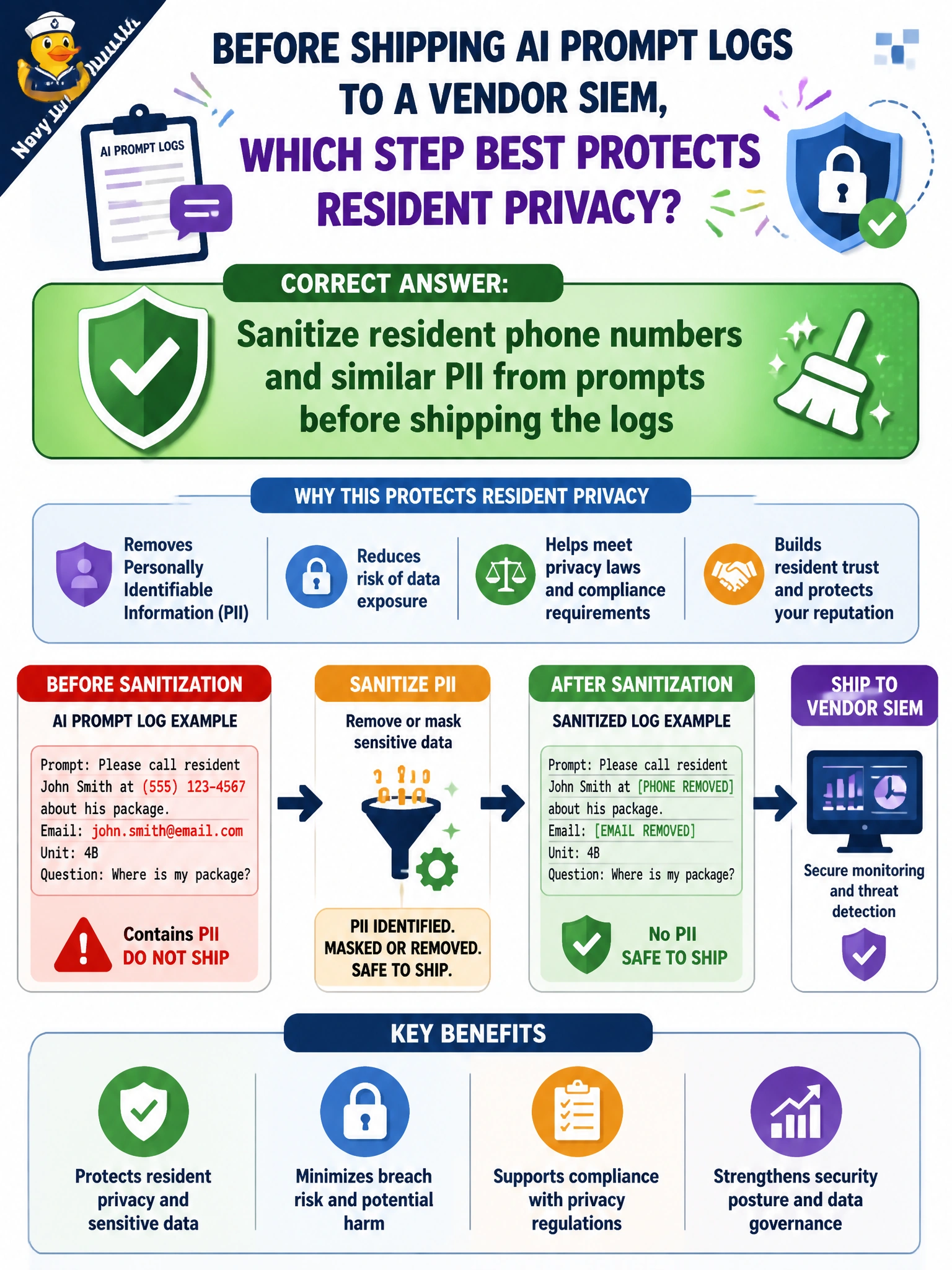
Before shipping AI prompt logs to a vendor SIEM, which step best protects resident privacy?
Select an answer to reveal the explanation.
Short Explanation
Do not mail the diary pages with the phone numbers still on them. Sanitize resident PII out of AI prompt logs before they leave for a vendor SIEM — access controls, transport encryption, and display masks don't remove the data before it ships. A half-redacted log, or an unredacted backlog shipped later, still leaks.
Full Explanation
Before shipping AI prompt logs to a vendor SIEM, sanitizing resident phone numbers and similar PII from prompts best protects privacy while still allowing security monitoring. Municipal AI logs often echo contact details residents paste into 311 or benefits assistants; those values are not required for most detection use cases and should be redacted, masked, or tokenized at the agency boundary. Sanitization reduces third-party exposure under contracts, breach notification risk, and unauthorized vendor-side browsing, while preserving structure needed for abuse and availability detections. Privacy-preserving telemetry is a deliberate pipeline step, not an afterthought once raw logs have already left the city.
Relying on vendor SIEM role-based access controls fails because access controls only limit who can search the data after it arrives; they do not remove resident phone numbers and other PII from the logs before they leave the agency, so the vendor still receives and stores sensitive resident data. Encrypting prompt log transport with TLS fails because transport encryption protects data in motion only; once the logs reach the vendor SIEM, resident phone numbers and similar PII remain stored in cleartext and available to the vendor. Masking resident phone numbers in SIEM prompt display views fails because display-layer masking happens after the logs have already been shipped to the vendor; the underlying data still contains resident PII in the vendor's environment and does not prevent exposure at the source.
Exam caveat: Sanitization before egress must cover every PII-bearing field and every log path that leaves the city—live stream and historical archive alike—not just the field that is easiest to redact or the traffic that is easiest to catch.
Operational check: Insert a PII sanitization stage before the vendor SIEM exporter; test that phone numbers, emails, and case IDs are all stripped or masked together; sample egress batches, including historical archive exports, not just the live stream; keep an unsanitized municipal copy only if policy requires and access is tightly controlled; and update the vendor DPA to reflect sanitized telemetry for the city's AI monitoring feed.
Prefer to study offline? Printable PDF study book + test engine ($7.50, unofficial). These questions stay free here.