
City SOC wants early warning when the 311 AI gateway starts failing under load. Which integration best supports that goal?
Select an answer to reveal the explanation.
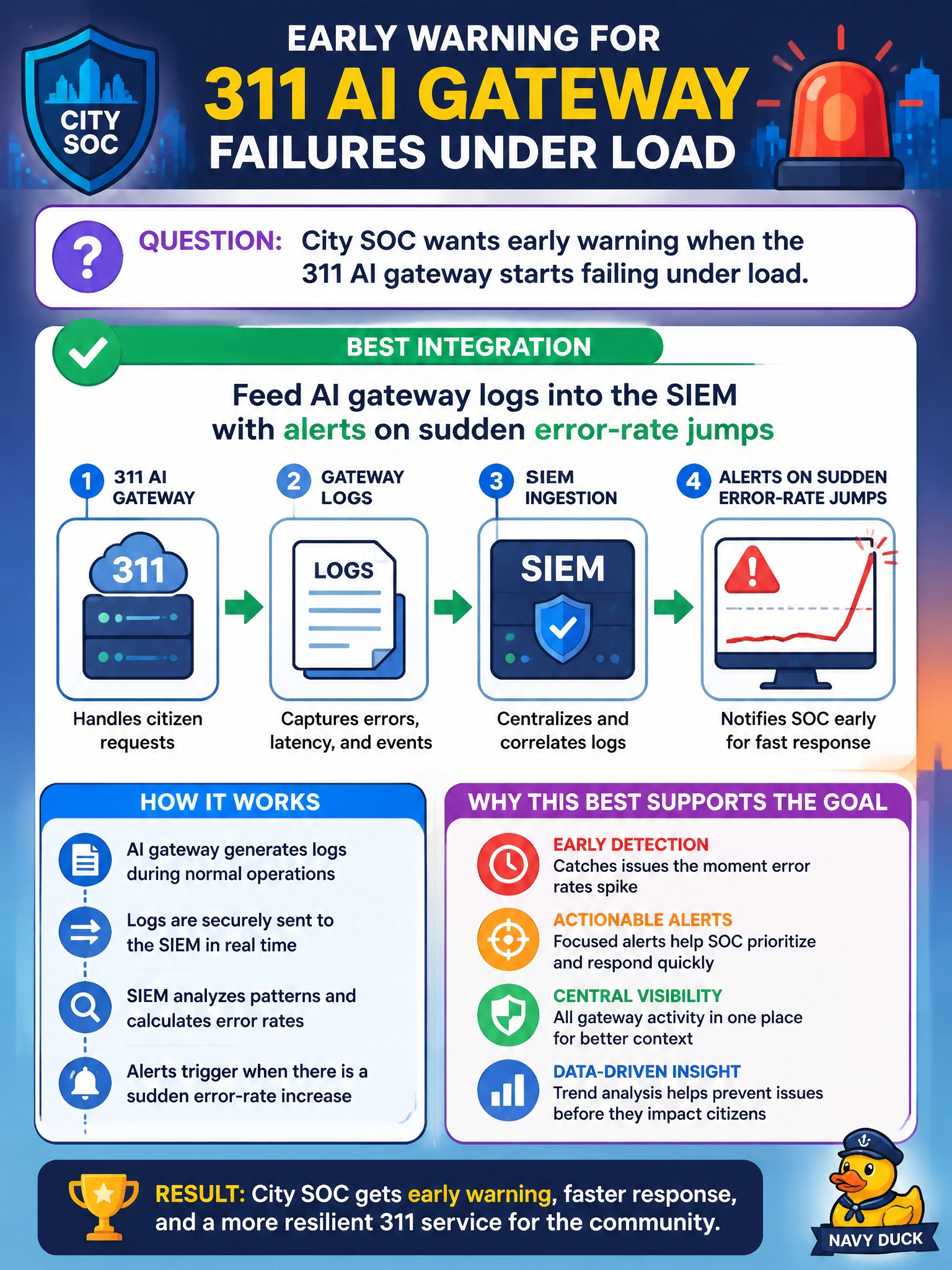
Short Explanation
If the 311 bot's gateway is coughing, the SIEM should hear it — and somebody should get paged. You want error-rate paging, not hourly billing usage totals, daily capacity report exports, or stable success-rate plateaus that'll miss a load failure. You'll get paged for billing or daily reports, or you'll miss the outage entirely if it's watching stable success.
Full Explanation
Feeding 311 AI gateway logs into the municipal SIEM with alerts on sudden error-rate jumps gives the SOC early warning when the assistant starts failing under load or abuse. Centralized correlation turns gateway 5xx spikes, latency cliffs, and auth failures into actionable incidents instead of waiting for stable success-rate plateaus to reveal a problem. For a city 311 channel, availability of the AI gateway affects resident service; SIEM integration aligns AI operations with the same detection and on-call patterns used for other public-facing municipal APIs. Threshold and anomaly alerts on error rate compress mean time to detect during storms, campaigns, or bot traffic.
Feeding AI gateway logs into the SIEM with alerts on hourly billing usage totals fails because billing usage totals track cost consumption, not gateway error-rate jumps under load; the SOC chases usage-spend alerts while the 311 gateway degrades, and nobody is paged when error rates spike. Feeding AI gateway logs into the SIEM with alerts on stable success-rate plateaus fails resiliency and detection—stable success-rate plateaus track healthy periods, not real-time gateway failure, and no one is paged when error rates spike; a stable plateau is not SOC-wide early warning. Feeding AI gateway logs into the SIEM with alerts on daily capacity report exports fails availability detection; daily exports summarize capacity in batch, not sudden error-rate jumps under load, so the SOC is not paged when the gateway starts failing.
Exam caveat: SIEM ingestion is necessary but not sufficient—parsers, detections, and on-call ownership must exist for AI-specific fields (model route, tenant, API key). Alerting on hourly billing usage totals, daily capacity report exports, or stable success-rate plateaus all defeat early warning because none pages the SOC on sudden AI gateway error-rate jumps.
Operational check: Confirm 311 AI gateway logs ship continuously to the SIEM; validate error-rate and latency detections fire in staging; assign on-call ownership rather than relying on stable success-rate plateaus; do not substitute stable success-rate plateau tracking for real-time error-rate monitoring in production; and run a game-day that injects elevated error rates to prove paging works before peak 311 seasons.
Prefer to study offline? Printable PDF study book + test engine ($7.50, unofficial). These questions stay free here.