
A county red team will test municipal AI services. Which planning approach best incorporates AI-focused adversarial techniques?
Select an answer to reveal the explanation.
Short Explanation
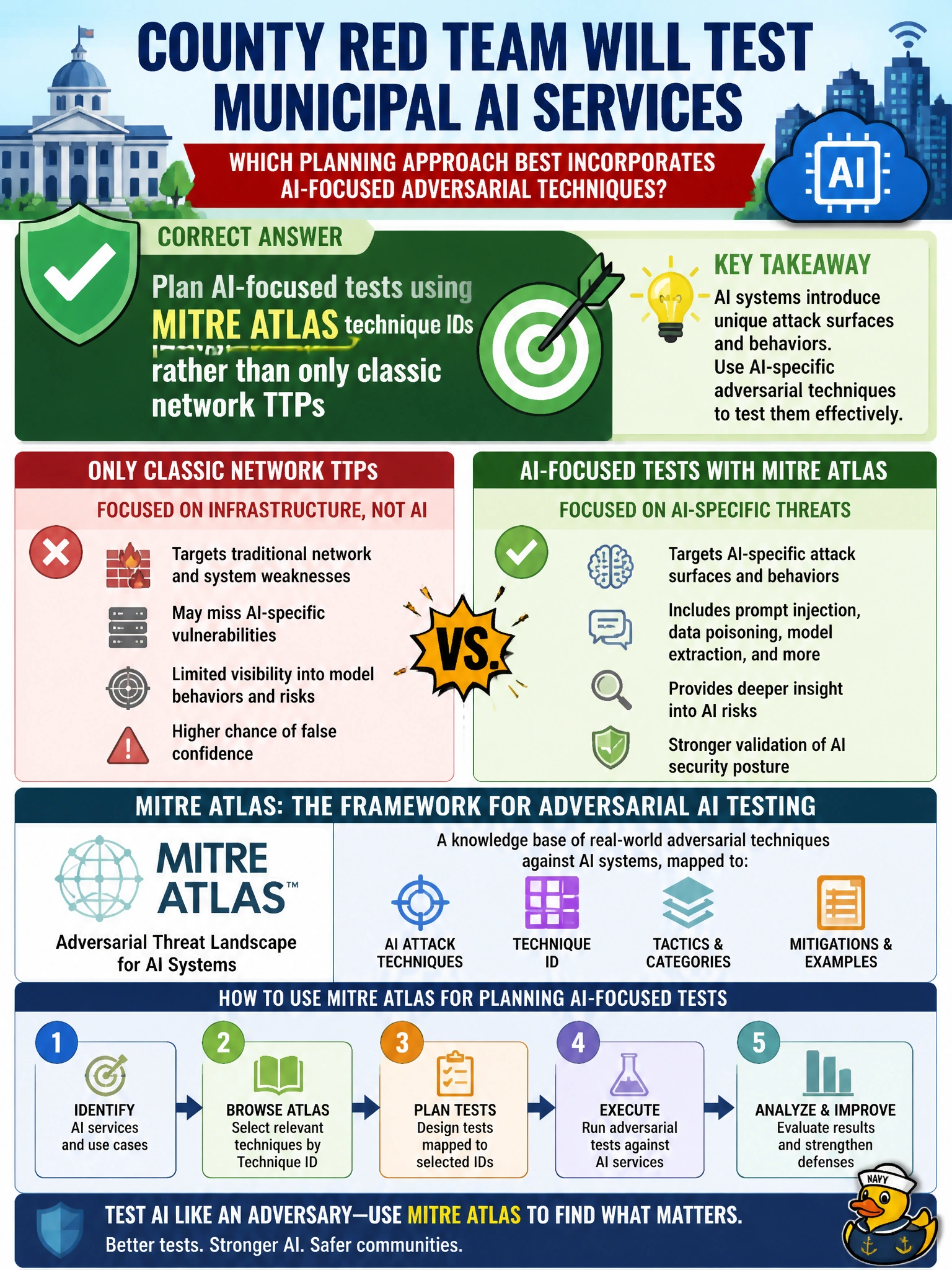
If the target is an AI stack, bring ATLAS technique IDs to the planning table. Classic network-only playbooks miss model theft and data poisoning paths. You'll find that using CVSS scores to sequence your evasion steps won't give you an attack plan, stretching ATT&CK network IDs to cover model evasion won't give you ATLAS tactics, and treating OWASP controls as adversary flows won't let you run real AI attacks.
Full Explanation
Red-team planning against municipal AI services must incorporate AI-focused adversarial techniques, not only classic network TTPs. Planning tests with MITRE ATLAS technique IDs lets the county red team structure authorized exercises for model theft, data poisoning, adversarial inputs, prompt abuse, and related AI paths alongside traditional access testing. That approach matches the actual attack surface of municipal LLM APIs, retrieval pipelines, and model stores, and produces findings leadership can track with the same vocabulary SOC and architecture teams use.
Planning AI-focused tests using MITRE ATT&CK enterprise IDs for guided ML model evasion cases still relies on classic network TTPs and does not incorporate AI-focused ATLAS techniques for the model or data plane. Planning AI-focused tests using OWASP LLM Top 10 controls as planned adversary technique flows treats defensive controls as adversary emulation and does not provide the MITRE ATLAS technique IDs needed to execute AI-focused adversarial tests. Planning AI-focused tests using CVSS severity scores to sequence model evasion procedures provides severity ratings for prioritization but does not incorporate AI-focused adversarial techniques or structure testing of model and data-plane paths.
Exam caveat: AI systems require ATLAS-informed red-team scopes beyond classic network playbooks. Operational check: include ATLAS technique IDs in the rules of engagement, obtain authorization for model and data-plane tests, execute the plan safely, and report findings mapped to those IDs for remediation owners.
Prefer to study offline? Printable PDF study book + test engine ($7.50, unofficial). These questions stay free here.