
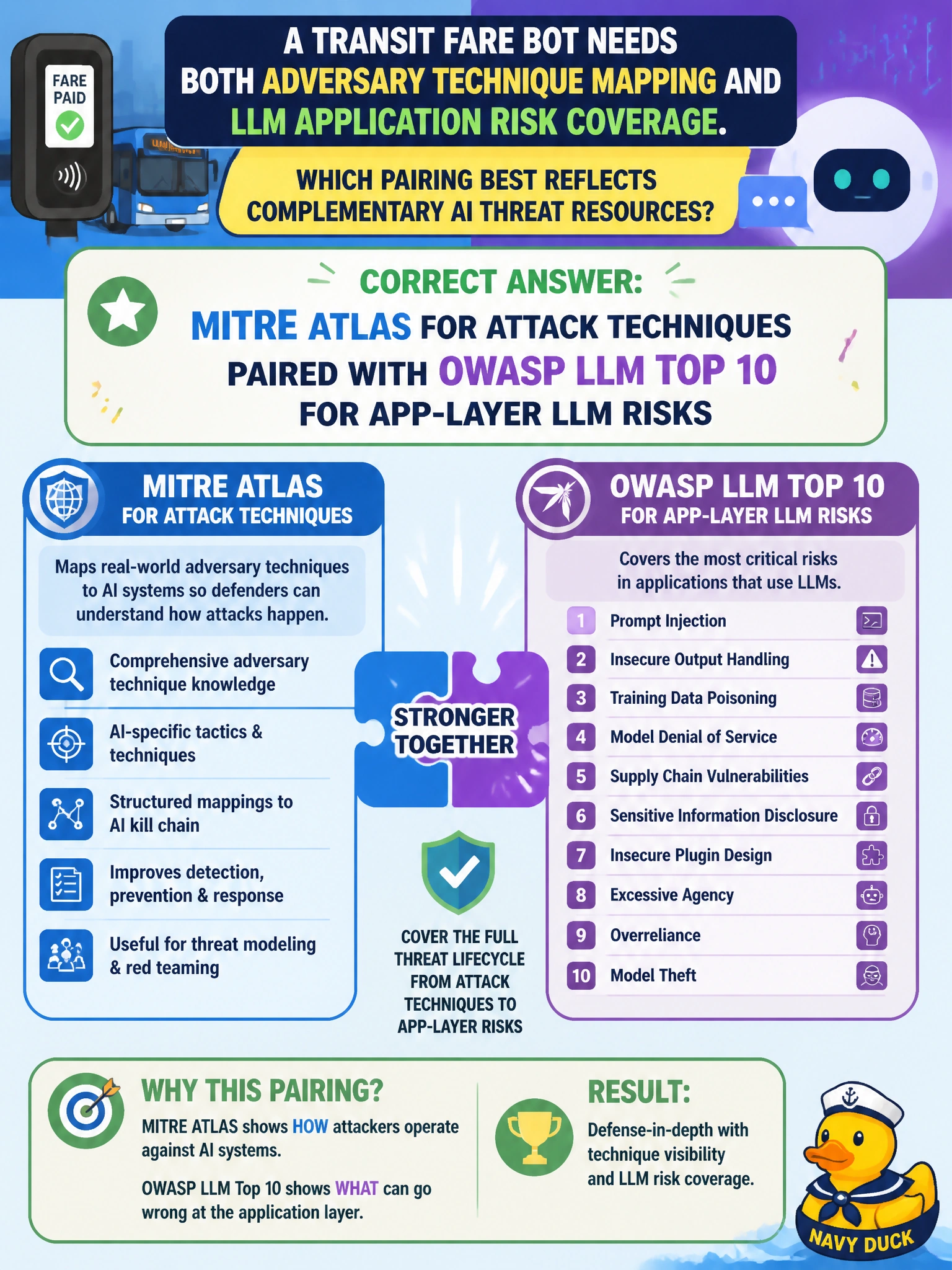
A transit fare bot needs both adversary technique mapping and LLM application risk coverage. Which pairing best reflects complementary AI threat resources?
Select an answer to reveal the explanation.
Short Explanation
One toolkit rarely covers the whole battlefield. Pair ATLAS for adversarial techniques with OWASP LLM Top 10 for chatbot app risks and the fare bot gets fuller coverage. ATT&CK Enterprise with OWASP LLM Top 10 gets you the right app list, but you'll still miss the AI-specific techniques that ATLAS maps, so it won't give you the full coverage you need.
Full Explanation
Complementary AI threat resources cover different layers of the problem space for municipal assistants. For a transit fare bot that needs both adversary technique mapping and LLM application risk coverage, pairing MITRE ATLAS with the OWASP LLM Top 10 is the strongest combination. ATLAS provides shared IDs for how adversaries steal models, poison data, probe APIs, or evade detectors; OWASP LLM Top 10 frames prompt injection, insecure output handling, sensitive disclosure, excessive agency, and related chatbot weaknesses in the fare-bot design. Using both lets transit security connect red-team scenarios to concrete application controls rather than relying on a single incomplete list.
NIST AI Risk Management Framework paired with ISO/IEC 42001 for attack techniques and LLM risk management misstates both sources, since the Framework provides governance functions to manage AI risk and ISO/IEC 42001 provides an AI management system, neither offering adversary technique mapping nor an LLM application risk catalog for this fare bot. MITRE ATT&CK Enterprise paired with OWASP LLM Top 10 gets the application side right but falls short on technique mapping, since ATT&CK Enterprise covers general enterprise tactics rather than AI-specific techniques like model theft, data poisoning, or LLM evasion that ATLAS maps for this fare bot. MITRE ATLAS paired with NIST SP 800-53 for app-layer LLM risks gets the technique side right but mischaracterizes the second source, since SP 800-53 provides general security control baselines, not the LLM application risk catalog for prompt injection, insecure output handling, and chatbot weaknesses that the fare bot needs.
Exam caveat: expect pairings of technique frameworks (ATLAS) with LLM application catalogs (OWASP LLM Top 10) when questions ask for complementary AI threat coverage. Operational check: maintain a fare-bot threat matrix with ATLAS techniques in one column and OWASP LLM items in another, map controls to both layers, and review the matrix before major fare-bot releases.
Prefer to study offline? Printable PDF study book + test engine ($7.50, unofficial). These questions stay free here.