
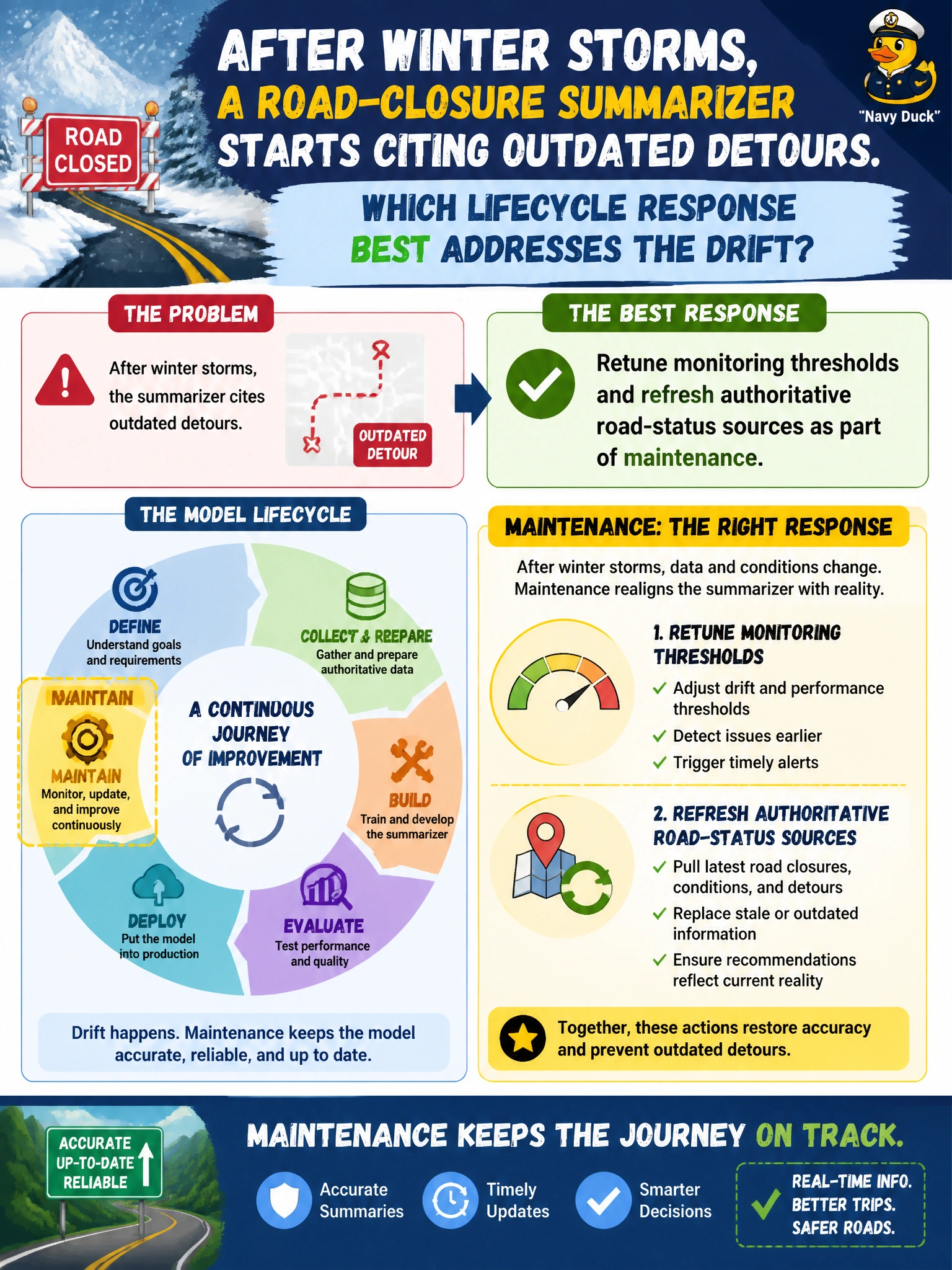
After winter storms, a road-closure summarizer starts citing outdated detours. Which lifecycle response best addresses the drift?
Select an answer to reveal the explanation.
Short Explanation
Storm season moves the goalposts — rebuilding your eval set with current-season closures as part of maintenance won't fix stale detours; your summarizer needs fresh road-status maps. Retuning monitors and refreshing road-status sources is how ops keep the assistant honest. Ignoring drift is how drivers get pointed into flooded lanes.
Full Explanation
Post-deployment monitoring and maintenance are continuous lifecycle controls because civic conditions and authoritative corpora change. When a road-closure summarizer begins citing outdated detours after winter storms, the correct response is to retune monitoring thresholds for freshness and accuracy alerts and to refresh authoritative road-status sources as part of maintenance. That combination restores grounding to current agency feeds and recalibrates detectors so operators notice drift early in the next storm cycle rather than after motorists follow stale advice. Retraining the summarizer on recent detailed regional closure summaries as part of maintenance might sharpen closure language, but it does not refresh live authoritative road-status feeds or retune freshness monitors, so outdated detours keep getting cited. Rebuilding the evaluation dataset with current-season traffic closures as part of maintenance may improve drift detection, but measurement alone does not update authoritative road-status sources or retune production monitors, so it will not stop outdated detours from appearing in summaries. Adjusting the summarizer prompt templates with source-citation instructions as part of maintenance may make citations explicit, but without refreshed road-status sources and retuned freshness alerts, it will just cite outdated detours more neatly rather than stop the stale advice. Exam caveat: model accuracy at launch does not freeze; municipal AI requires ongoing source refresh and monitor retuning when the operating environment changes. Operational check: subscribe the summarizer to current road-status APIs or bulletins, set freshness SLOs, page on outdated-citation rates, and require a post-storm maintenance checklist before declaring the assistant healthy.
Prefer to study offline? Printable PDF study book + test engine ($7.50, unofficial). These questions stay free here.