
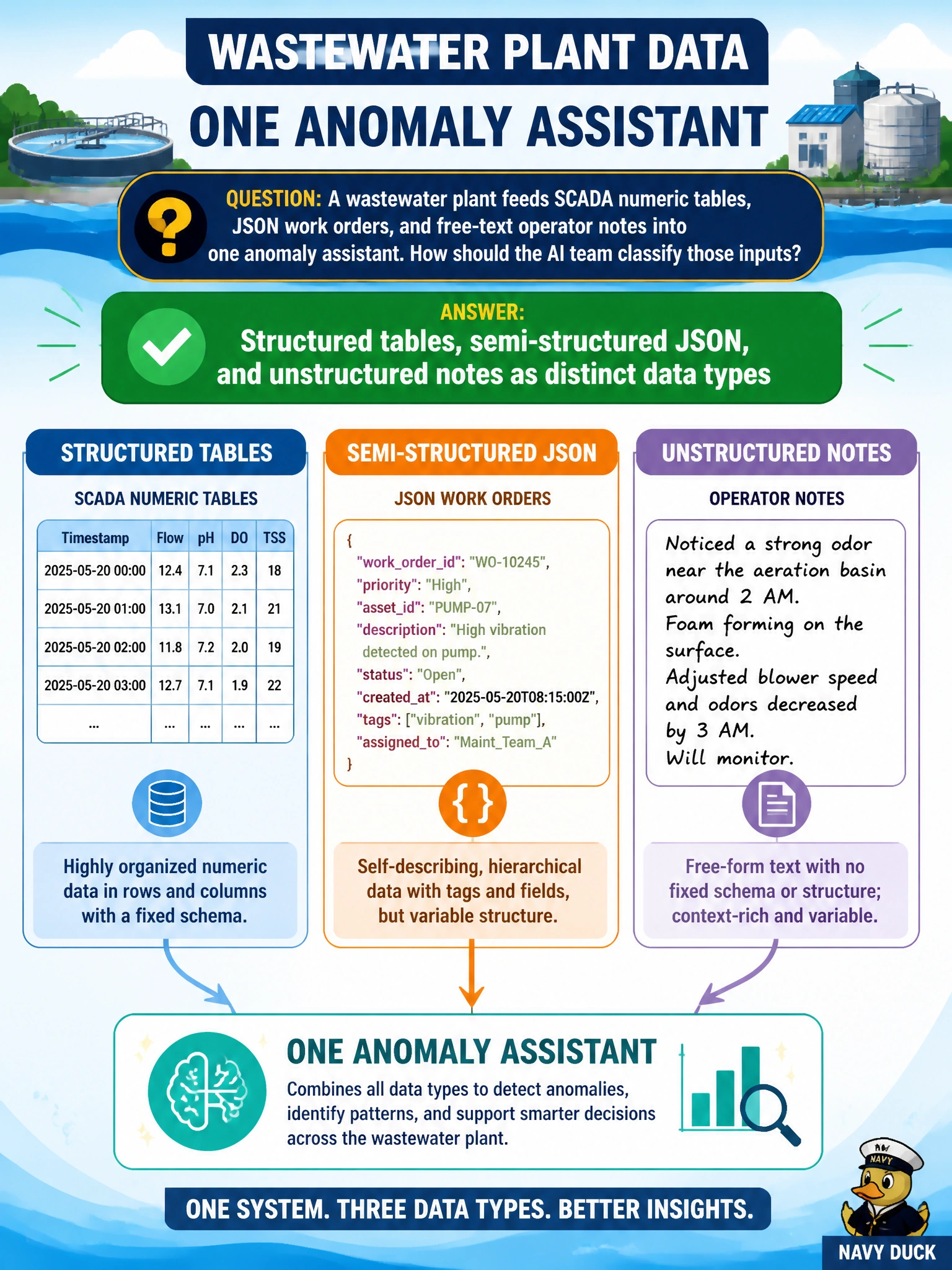
A wastewater plant feeds SCADA numeric tables, JSON work orders, and free-text operator notes into one anomaly assistant. How should the AI team classify those inputs?
Select an answer to reveal the explanation.
Short Explanation
SCADA tables are neat rows, JSON work orders are semi-structured, and operator notes are messy prose—three different data flavors in one plant pipeline. Call them what they are so you secure and process each type right.
Full Explanation
Feeding SCADA numeric tables, JSON work orders, and free-text operator notes into one anomaly assistant requires classifying inputs as structured tables, semi-structured JSON, and unstructured notes. Correct typing matters because schemas, validation, encryption, retention, and feature extraction differ by structure—relational keys versus nested JSON fields versus free prose. Classifying SCADA tables as structured, JSON work orders as unstructured, and operator notes as semi-structured fails because JSON is semi-structured by nature, free-text notes are unstructured, and swapping those labels misdirects validation and feature extraction. Labeling SCADA tables as semi-structured, JSON work orders as structured, and operator notes as unstructured fails because numeric SCADA tables have fixed schemas and relational keys, while JSON is inherently semi-structured rather than fully structured. Calling structured tables, semi-structured JSON, and semi-structured notes distinct data types fails because free-text operator notes are unstructured, not semi-structured, and treating them as semi-structured misdirects validation and feature extraction. Exam caveat: mixing modalities increases attack and privacy surface—operator notes may contain sensitive identifiers that structured SCADA points do not. Operational check: inventory each source’s data type, apply type-appropriate validation and DLP, document how each enters the anomaly feature store, and restrict free-text fields that are not needed for the detection task.
Prefer to study offline? Printable PDF study book + test engine ($7.50, unofficial). These questions stay free here.