
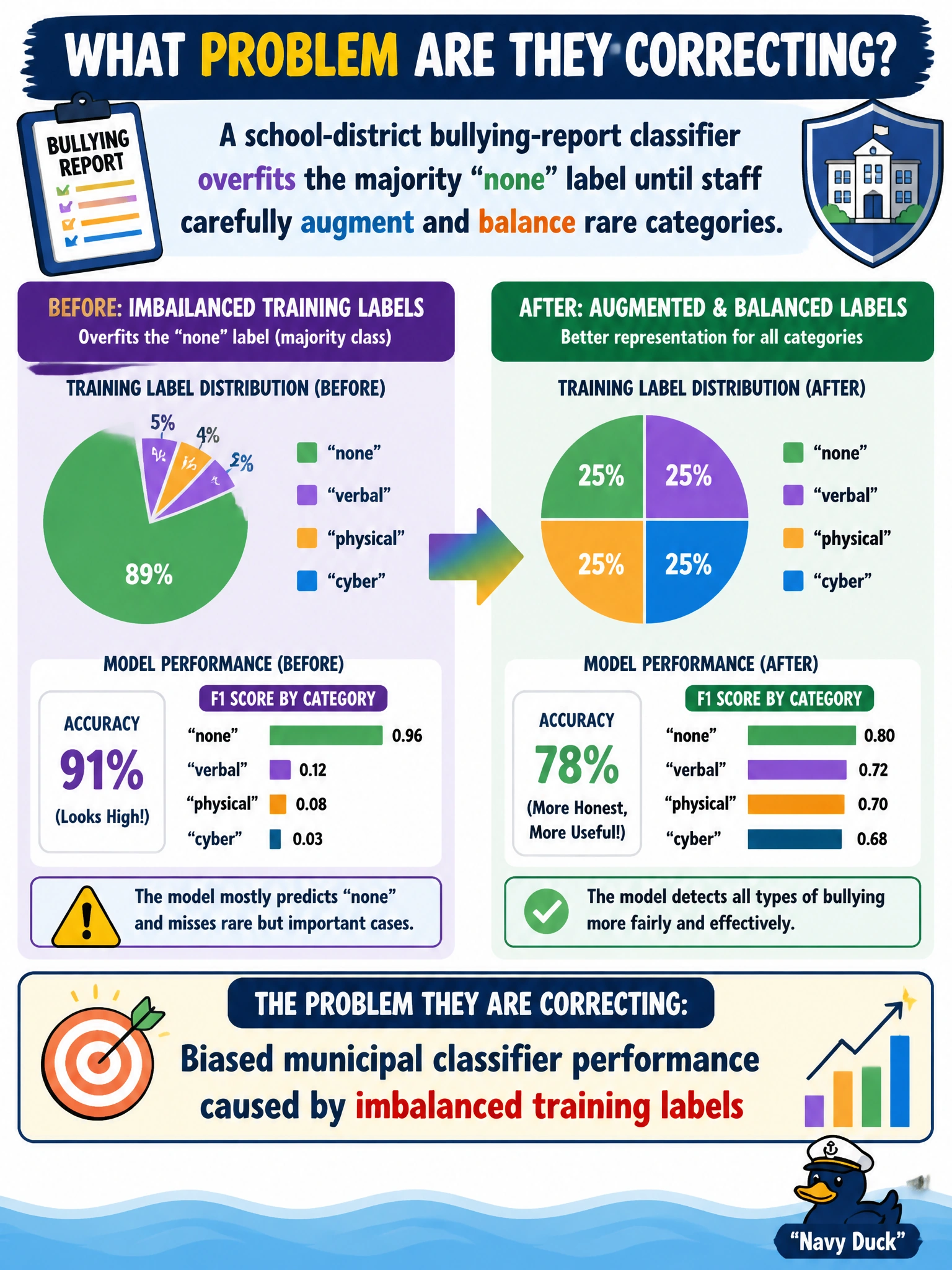
A school-district bullying-report classifier overfits the majority "none" label until staff carefully augment and balance rare categories. What problem are they correcting?
Select an answer to reveal the explanation.
Short Explanation
If almost every report is labeled "none," the model gets lazy and ignores rare bullying categories. Balancing and careful augmentation rebalance the deck so minority classes get a fair shot.
Full Explanation
When a bullying-report classifier overfits the majority "none" label until staff augment and balance rare categories, they are correcting biased municipal classifier performance caused by imbalanced training labels. Majority dominance drives high overall accuracy while missing scarce but high-harm bullying classes; careful augmentation and rebalancing restore learning signal for minority labels. Skewed validation accuracy caused by imbalanced leakage across splits fails by concept because imbalanced leakage distorts how validation accuracy is estimated across splits, whereas the issue described is majority-class overfitting driven by imbalanced training labels that augmentation and rebalancing directly address. Brittle bullying-report predictions caused by imbalanced drift over time fails because the scenario describes correcting a static skew in training class counts, not a model whose performance deteriorates as the real-world data distribution drifts over time. Diminished classifier robustness caused by limited augmentation tuning budgets fails because the root cause is the skewed distribution of training labels, not an inadequate tuning budget for augmentation. Exam caveat: naive oversampling can leak duplicates into validation or amplify labeling errors in rare classes; fairness across schools and demographics still needs separate evaluation. Operational check: report per-class precision/recall before and after rebalancing, keep a clean held-out set untouched by augmentation, involve counselors in rare-class labeling quality, and monitor live confusion matrices after deployment.
Prefer to study offline? Printable PDF study book + test engine ($7.50, unofficial). These questions stay free here.