
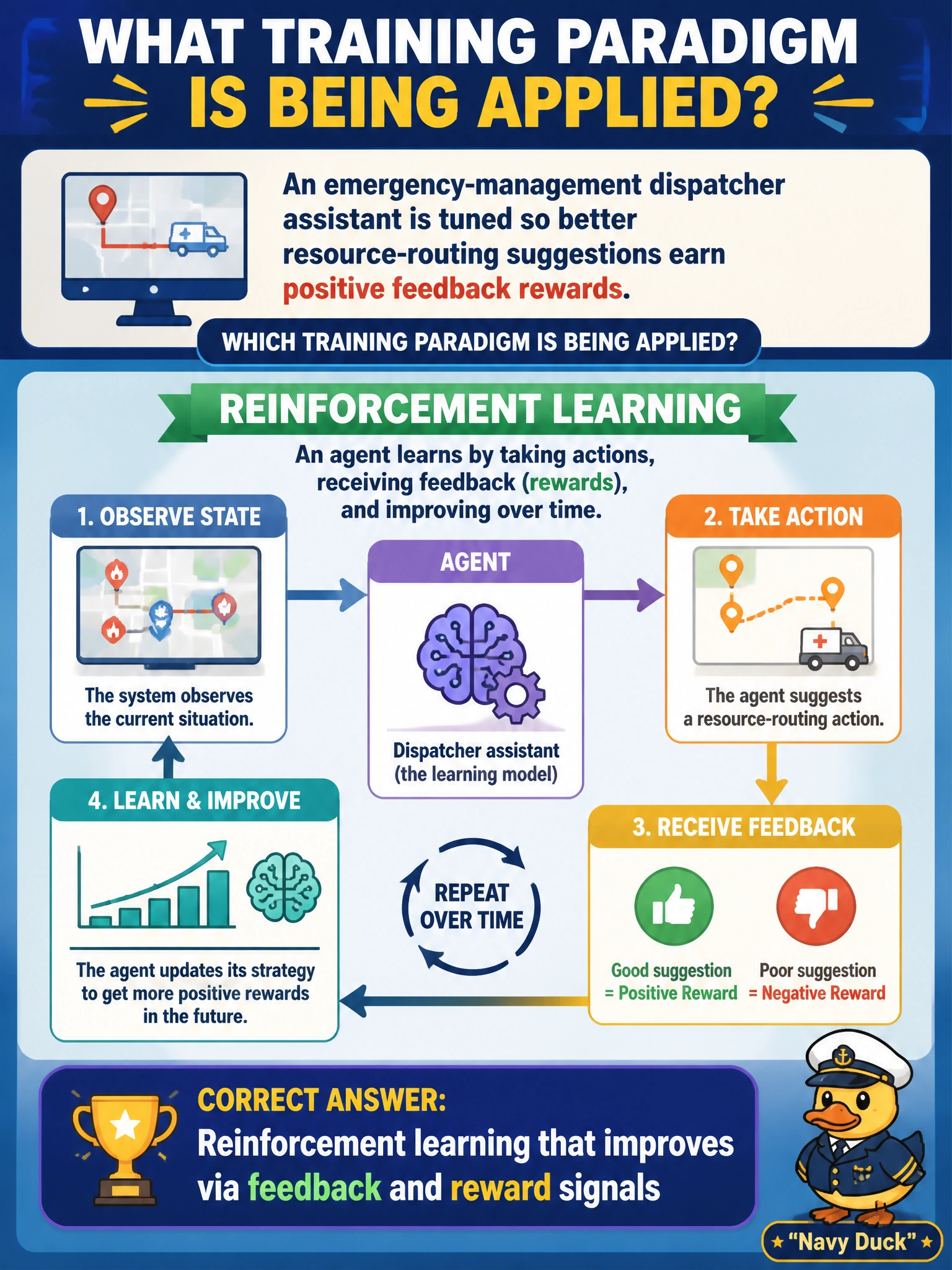
An emergency-management dispatcher assistant is tuned so better resource-routing suggestions earn positive feedback rewards. Which training paradigm is being applied?
Select an answer to reveal the explanation.
Short Explanation
Reinforcement learning is training with a scoreboard—good routing tips get a reward, weak ones don't. You'll see it get better as it chases those rewards, not as it just predicts old reward labels from past dispatches.
Full Explanation
Tuning a dispatcher assistant so better resource-routing suggestions earn positive feedback rewards applies reinforcement learning: the agent improves policy through reward signals tied to routing quality rather than only through static labeled examples or frozen rules. That paradigm fits emergency-management assistants that learn from operational feedback on suggestion usefulness. Unsupervised learning that clusters feedback logs by similarity patterns fails by concept because clustering discovers structure without any reward-driven policy improvement for routing quality. Supervised learning that predicts rewards from labeled past dispatches fails because predicting a reward label from static historical examples is not reward-driven policy improvement from routing outcomes—the model never adjusts its routing actions to maximize feedback about how well a suggestion performed. Imitation learning that mimics feedback rewards from expert dispatches fails because it copies expert behavior from demonstrations instead of improving from reward signals about routing outcomes. Exam caveat: poorly specified rewards can optimize the wrong objective (for example, speed over safety) and live RL in public-safety settings needs strong human oversight and simulation before production influence. Operational check: define reward metrics with emergency managers, train or evaluate offline against historical incidents first, log suggestion acceptance and outcomes, and keep a human dispatcher in the loop for consequential resource moves.
Prefer to study offline? Printable PDF study book + test engine ($7.50, unofficial). These questions stay free here.