
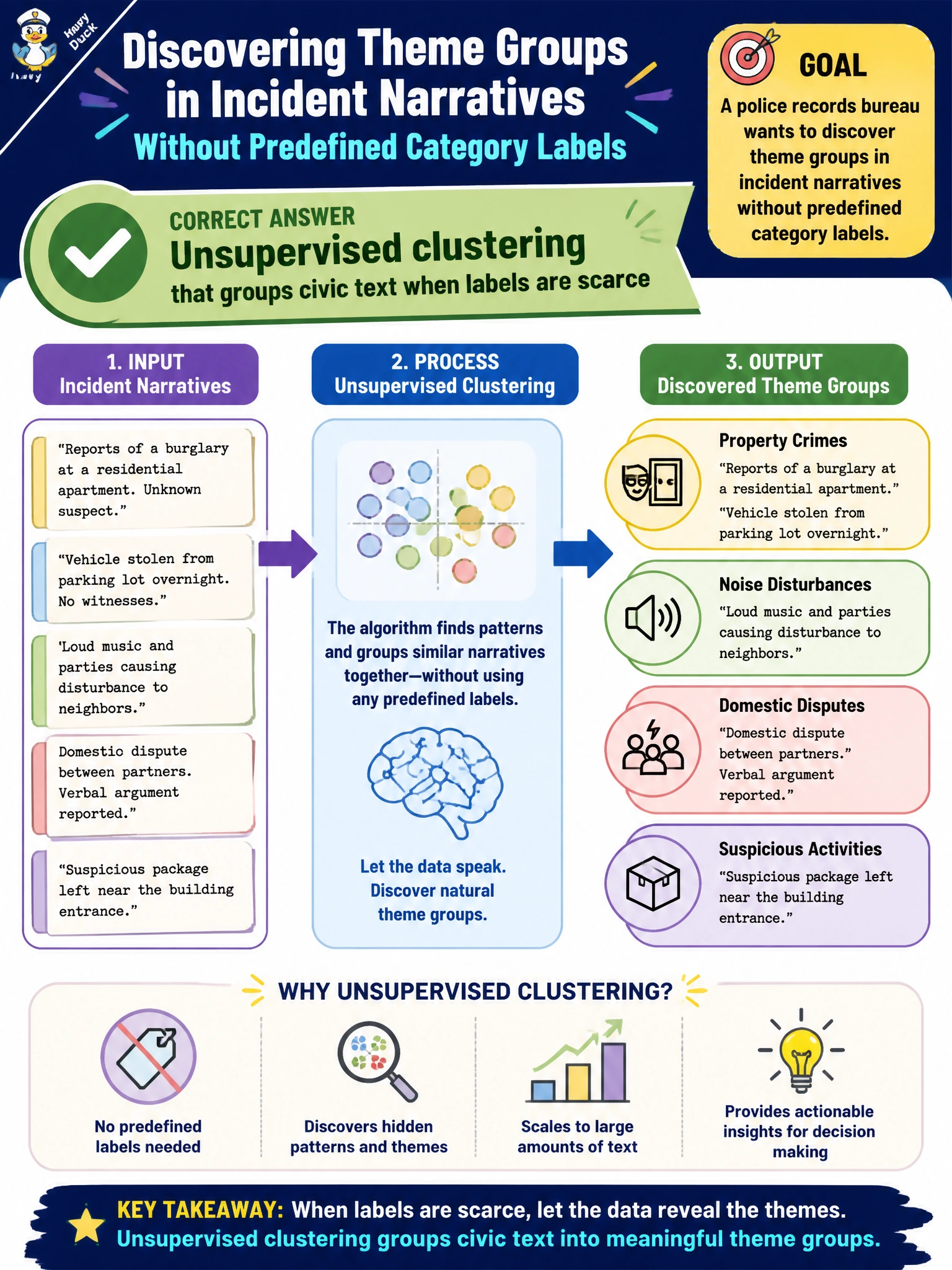
A police records bureau wants to discover theme groups in incident narratives without predefined category labels. Which learning approach fits that goal?
Select an answer to reveal the explanation.
Short Explanation
When nobody has pre-labeled the narratives, unsupervised clustering is how you let themes bubble up on their own. It's like sorting a messy evidence room by similarity when you don't have decision boundaries to file by yet.
Full Explanation
Discovering theme groups in police incident narratives without predefined category labels is an unsupervised clustering problem: algorithms group similar civic text so themes emerge when a finished taxonomy is unavailable. The approach fits because the bureau’s goal is exploratory structure discovery, not classification into a complete labeled code book. Supervised classification that groups civic text using decision boundaries fails by concept because it still requires predefined labeled examples to learn those decision boundaries, which the bureau does not yet have. Supervised regression that groups civic text via numeric trend estimation fails because it predicts a numeric output from labeled examples rather than discovering unlabeled theme groups in narrative text. Reinforcement learning that groups civic text through policy optimization fails because it optimizes behavior through reward signals rather than discovering theme structure in unlabeled incident narratives. Exam caveat: unsupervised clusters still need human interpretation; cluster labels can be misleading, and sensitive narratives demand access control, minimization, and audit even during exploratory analysis. Operational check: sample and name clusters with records analysts, measure stability across runs, restrict who can view raw narratives feeding the clusters, and only promote stable themes into any future supervised taxonomy.
Prefer to study offline? Printable PDF study book + test engine ($7.50, unofficial). These questions stay free here.