
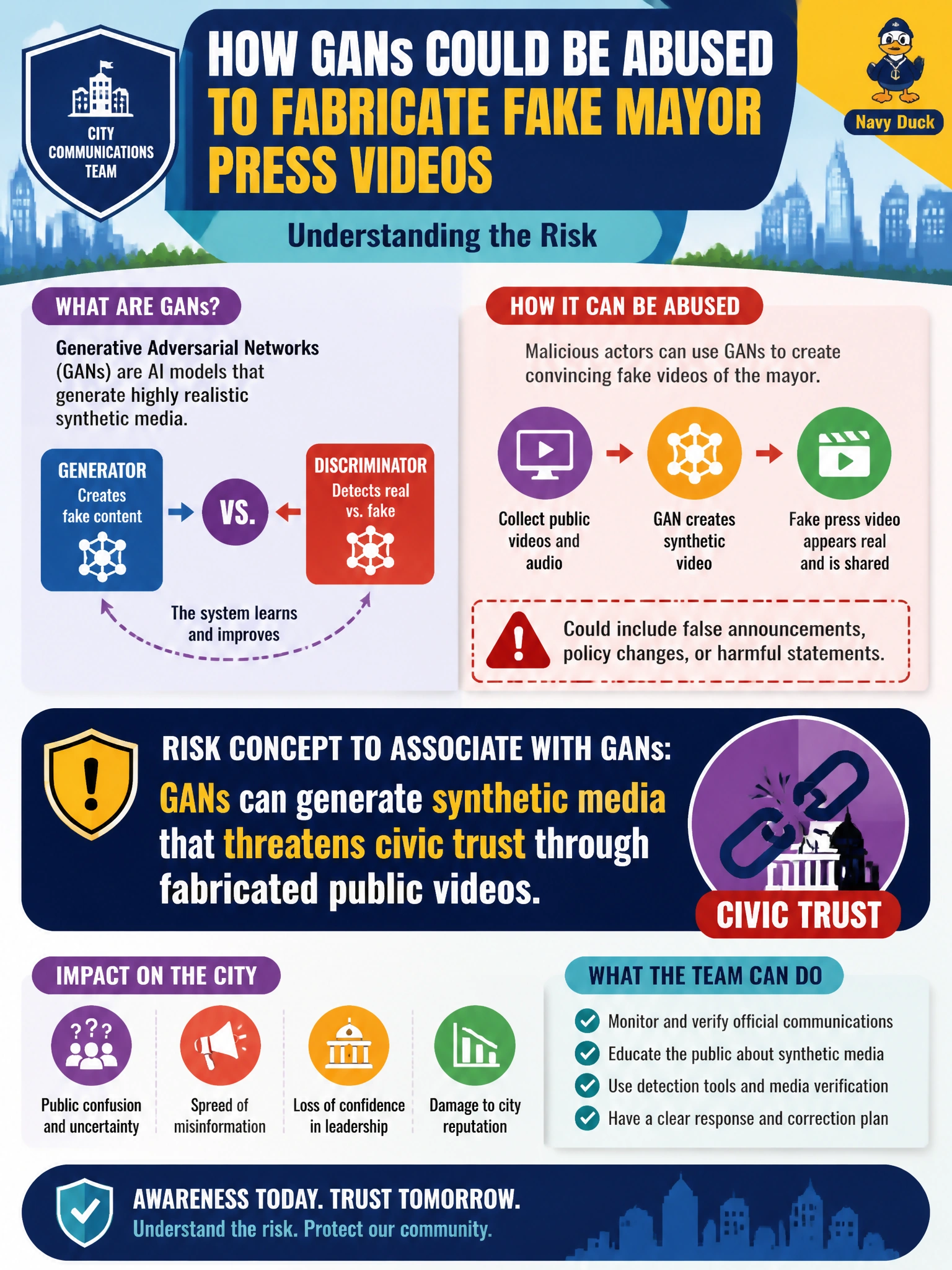
A city communications team reviews how generative adversarial networks could be abused to fabricate fake mayor press videos. What risk concept should the team associate with GANs in that scenario?
Select an answer to reveal the explanation.
Short Explanation
GANs are the tech behind those creepy fake videos that look almost real. For a mayor's press brief, that means synthetic media risk—someone could fabricate footage and shake public trust if the city isn't watching for it.
Full Explanation
Generative adversarial networks can synthesize realistic media, including fabricated video that resembles official mayor press appearances. The risk concept to associate is synthetic-media abuse that threatens civic trust: a convincing fake press video can mislead residents, disrupt emergency messaging, or damage institutional credibility. Claiming GANs only compress PDF ordinances and cannot synthesize video fails by concept because compression is not the defining GAN capability—adversarial generators are known for synthesizing images and video. Asserting GANs exclusively improve meter anomaly detection for utilities fails because anomaly detection is typically a different modeling family; GAN misuse for deepfakes is a communications integrity risk, not a SCADA analytics benefit. Limiting GANs to sorting 311 tickets into category codes fails because ticket classification is not media synthesis. Exam caveat: not every suspicious clip is GAN-made, and detection tools lag evolving generators; process controls (verified channels, cryptographic authenticity, rapid correction messaging) matter as much as technical detectors. Operational check: publish official video distribution channels, train communications staff on deepfake reporting, retain authentic masters with integrity marks, and establish a rapid public correction playbook when fabricated mayor media appears.
Prefer to study offline? Printable PDF study book + test engine ($7.50, unofficial). These questions stay free here.