
Your SOC receives hundreds of daily alerts from a web server rule that fires on legitimate admin uploads and backup jobs. You want to reduce noise without losing detection for malicious webshell uploads. What should you do first?
Select an answer to reveal the explanation.
Short Explanation
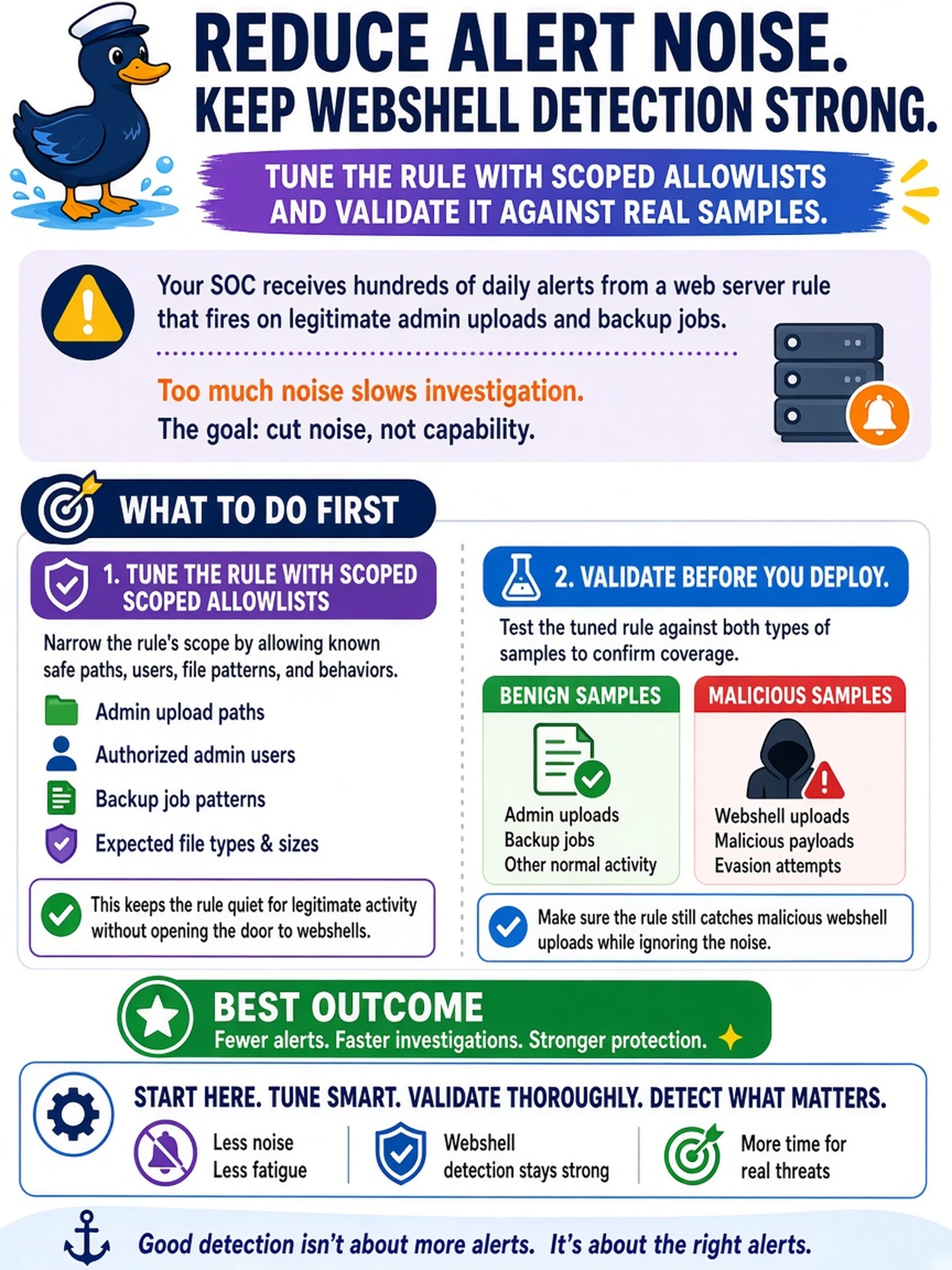
Think of a detection rule like a smoke detector: you don't want it screaming every time someone toasts bread, but you still need it to notice a real fire. You tune it by carving out known safe patterns and testing both good and bad samples so coverage stays intact. If you just turn the volume down, you may miss the fire.
Full Explanation
Detection rule tuning is a process-improvement activity that improves signal quality by narrowing a rule's logic to the malicious behavior it was intended to catch. In this case, the rule already detects webshell uploads, so the analyst should reduce false positives with scoped allowlists for known administrative and backup paths, then validate the revised rule against benign upload activity and known malicious samples. This preserves coverage because the rule continues to evaluate the same telemetry and only excludes conditions proven to be legitimate. Replacing the rule with a narrower directory-based rule can create blind spots because malicious uploads may occur in normal paths, and disabling the original rule removes existing detection coverage. Raising a volume threshold changes the rule from artifact-based detection to anomalous-rate detection, which can miss a single successful upload and is not a targeted fix for known benign noise. Suppressing service-account alerts delays visibility and can hide attacker abuse of legitimate accounts, which is worse than tuning the rule with evidence. Exam caveat: on CS0-004, choose the action that improves efficiency while maintaining detection coverage, not simply reducing alert count. Operational check: compare alert volumes and alert payloads before and after tuning to confirm false positives decrease and malicious test cases still trigger.