
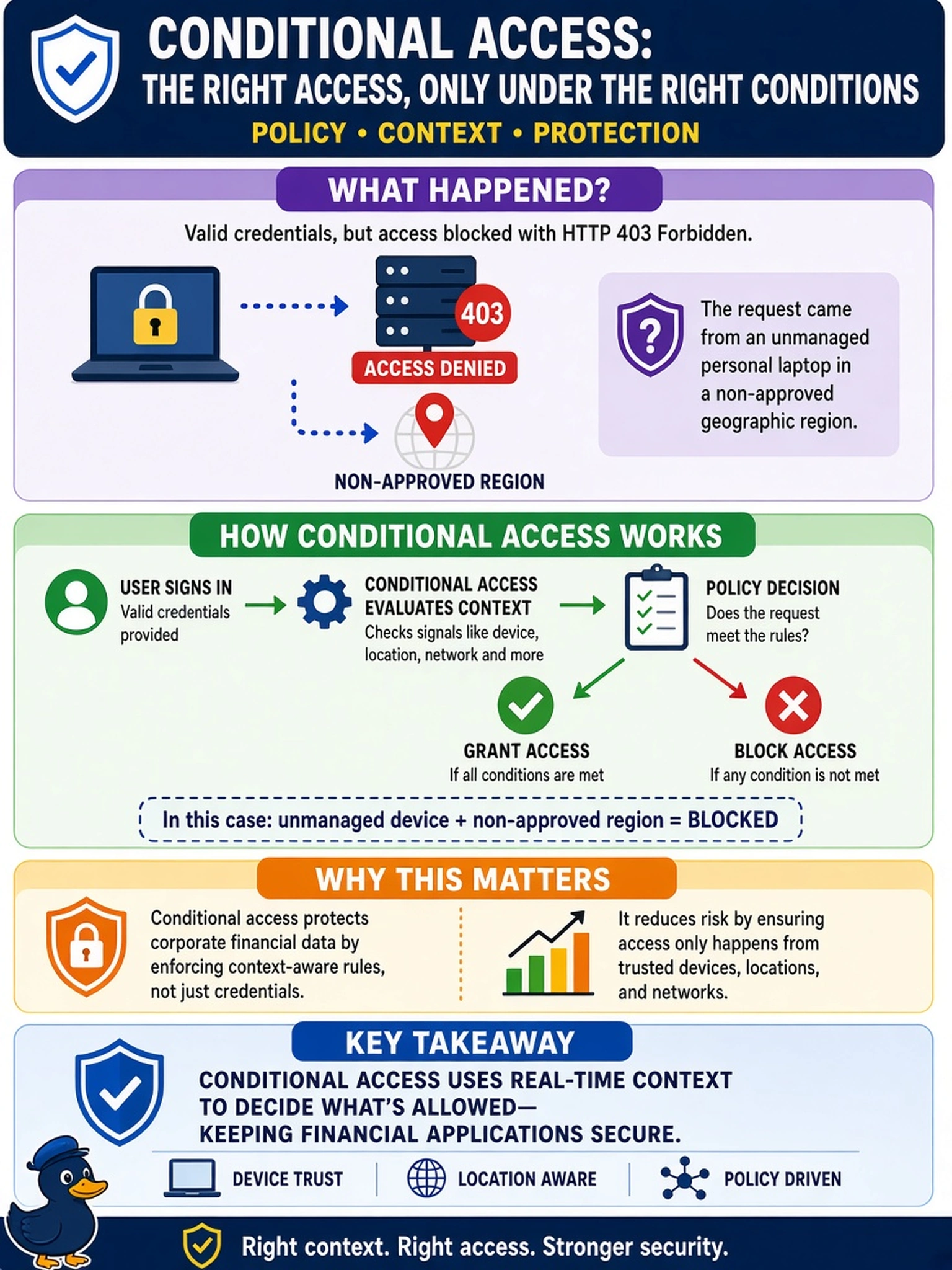
An analyst reviews logs for a user attempting to access a corporate financial application. The user's credentials are valid, but the application returns an HTTP 403 Forbidden status. The log shows the request originated from an unmanaged personal laptop in a non-approved geographic region. Which architectural control most likely triggered this block?
Select an answer to reveal the explanation.
Short Explanation
Think of it like this: valid credentials are only your ID, not a guaranteed entry pass. If the device posture or location violates policy, conditional access can block the session even after authentication. The trap is blaming a firewall or IPS for a context-aware identity decision.
Full Explanation
Conditional access is a security control that grants or denies access to resources based on real-time signals rather than static credentials alone. In this scenario, authentication succeeded because the credentials were valid, but authorization failed because the request violated policy conditions: the endpoint was unmanaged and the location was outside the approved geographic range. Conditional access evaluates identity, device posture, location, and risk to enforce least-privilege access dynamically. A network intrusion prevention system inspects traffic for known malicious patterns or anomalous behavior, but it does not normally decide access based on whether a user's laptop is corporate-managed. A static password complexity policy is enforced during password creation or change, not during an access attempt, and it ignores device and location context. A host-based firewall controls endpoint traffic by IP, port, and protocol, but it does not understand corporate device compliance or identity governance state. Exam caveat: Authentication proves who the user is, while conditional access decides whether that identity should be allowed in the current context. Operational check: Review identity provider sign-in logs for conditional access failure reasons such as device noncompliance, blocked location, or unsupported client application.