
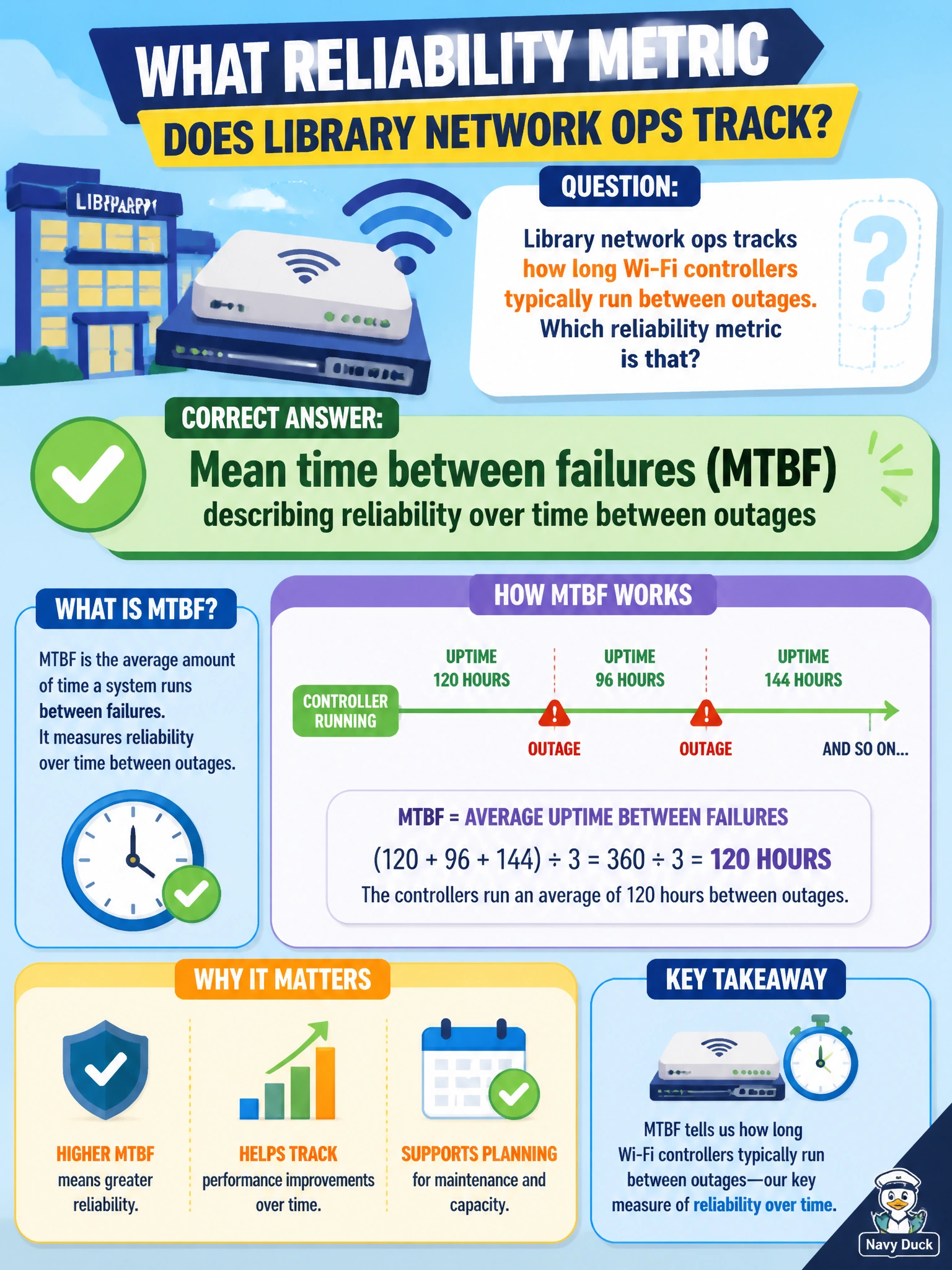
Library network ops tracks how long Wi-Fi controllers typically run between outages. Which reliability metric is that?
Select an answer to reveal the explanation.
Short Explanation
MTBF is the average calm stretch between Wi-Fi controller meltdowns. MTTR cares about fix speed; MTBF cares about how often the pain returns.
Full Explanation
Mean time between failures (MTBF) describes the average operating interval between failures—how long systems typically run before the next outage. Library network ops tracking how long Wi-Fi controllers typically run between outages is measuring MTBF: longer average intervals mean better reliability between breaks for patrons, students, and staff relying on library connectivity.
MTTR focused only on how fast staff acknowledge a ticket is about response or repair speed (and acknowledgment alone is not full restore), not the quiet interval between controller failures. An SLA credit schedule with the furniture vendor is a contractual commercial artifact unrelated to Wi-Fi controller reliability statistics on the network. Page-load time for the library events calendar alone is a performance latency indicator for a website, not controller failure spacing on the access gear.
Exam caveat: MTBF needs consistent failure definitions (hard down versus degraded radios) and sufficient sample size; a single outage does not make a meaningful mean for board reporting. Operational check: log Wi-Fi controller outage start times, compute intervals between consecutive failures, and review whether firmware or maintenance changes are lengthening MTBF.